Safety note: Admin approval is an initial review, not a guarantee that every detail is correct. Check important or urgent claims with official sources and report anything inaccurate or unsafe.
Source and credit: Contributor's own report
BHP Pay Dispute Continues as Port Hedland Union Talks Remain Unresolved - Port Hedland, WA
Smart summary
A proposed 17% pay rise and $25,000 transition payment have failed to settle tensions between BHP and Port Hedland port workers.
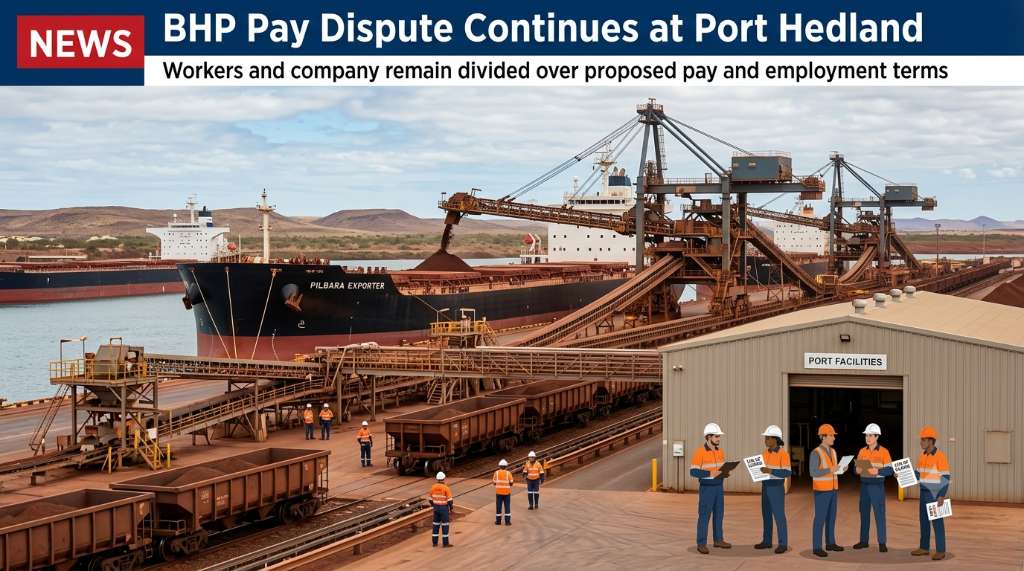
BHP’s ongoing employment dispute with workers at its Port Hedland iron ore operations remains unresolved, with unions continuing to challenge the company’s proposed new four-year agreement. The dispute involves workers represented by three unions, with negotiations continuing under the involvement of the Fair Work Commission.
BHP has proposed a 17% pay increase over four years, together with a $25,000 transition payment spread over two years and increased roster allowances. The company has described the offer as an effort to provide greater certainty and recognise the conditions and responsibilities associated with port work.
However, union representatives have argued that the proposal does not provide an equal outcome for all workers. They say around 40% of employees could be worse off relative to existing benefits, particularly because some current arrangements would be replaced by lower base rates and performance-related payments.
The dispute has already resulted in significant industrial action. Around 150 workers previously walked off the job, marking the first major industrial action involving the company’s Port Hedland operations in more than two decades. The negotiations are therefore being closely watched because of the importance of the port to Australia's iron ore export industry.
Port Hedland is home to one of the world's most important iron ore export facilities, and disruption to port operations could have wider consequences for Australia's mining industry and export supply chains. BHP ships a substantial volume of iron ore through the facility each day, making the outcome of the employment negotiations important beyond the local workforce.
The latest developments come as BHP faces broader scrutiny over its employment practices. On September 10, the Mining and Energy Union also announced its backing for a separate class action involving potentially thousands of workers over alleged unlawful public-holiday rostering at another BHP operation. That case is separate from the Port Hedland negotiations but adds to the wider labour pressure facing the mining company.
For Port Hedland workers, the central issue remains how wages, allowances and existing entitlements will be structured under a new agreement. Union representatives have argued that resolving differences between employee groups should not mean reducing the relative benefits of one group of workers.
Further negotiations are scheduled to continue, with the Fair Work Commission facilitating discussions. No final agreement has been reached at this stage, meaning uncertainty remains for employees and the company while both sides attempt to resolve the dispute.
PortWorkersHedlandCompanyDispute
BHP’s ongoing employment dispute with workers at its Port Hedland iron ore operations remains unresolved, with unions continuing to challenge the company’s proposed new four-year agreement. The dispute involves workers represented by three unions, with negotiations continuing under the involvement of the Fair Work Commission.
BHP has proposed a 17% pay increase over four years, together with a $25,000 transition payment spread over two years and increased roster allowances. The company has described the offer as an effort to provide greater certainty and recognise the conditions and responsibilities associated with port work.
However, union representatives have argued that the proposal does not provide an equal outcome for all workers. They say around 40% of employees could be worse off relative to existing benefits, particularly because some current arrangements would be replaced by lower base rates and performance-related payments.
The dispute has already resulted in significant industrial action. Around 150 workers previously walked off the job, marking the first major industrial action involving the company’s Port Hedland operations in more than two decades. The negotiations are therefore being closely watched because of the importance of the port to Australia's iron ore export industry.
Port Hedland is home to one of the world's most important iron ore export facilities, and disruption to port operations could have wider consequences for Australia's mining industry and export supply chains. BHP ships a substantial volume of iron ore through the facility each day, making the outcome of the employment negotiations important beyond the local workforce.
The latest developments come as BHP faces broader scrutiny over its employment practices. On September 10, the Mining and Energy Union also announced its backing for a separate class action involving potentially thousands of workers over alleged unlawful public-holiday rostering at another BHP operation. That case is separate from the Port Hedland negotiations but adds to the wider labour pressure facing the mining company.
For Port Hedland workers, the central issue remains how wages, allowances and existing entitlements will be structured under a new agreement. Union representatives have argued that resolving differences between employee groups should not mean reducing the relative benefits of one group of workers.
Further negotiations are scheduled to continue, with the Fair Work Commission facilitating discussions. No final agreement has been reached at this stage, meaning uncertainty remains for employees and the company while both sides attempt to resolve the dispute.
Cairns Regional Council has unanimously voted to seek $400,000 in Queensland Government funding for a program designed to connect local businesses with the region’s growing film...
Albury New South Wales · Business News · 17 Sep 2026
An Australian artificial intelligence company has purchased the former Visy paper mill site at Ettamogah, north of Albury, in a significant local business The company, Sharon AI...
A new multi-million-dollar poultry-processing facility has officially opened near Tamworth, bringing major investment and new employment opportunities t...
Two teenagers have appeared in a Perth court after allegedly breaking into a crocodile enclosure and attacking the 400-kilogram reptile with a metal pole.
Cairns Regional Council has unanimously voted to seek $400,000 in Queensland Government funding for a program designed to connect local businesses with the region’s growing film...
An automated external defibrillator and memorial plaque have been installed at Ellery Creek Big Hole following the death of disability advocate Ellen Fr...
Queensland firefighters spent several hours monitoring a significant grass fire at Mary Kinross Park in Bargara, near Bundaberg, after the blaze broke out on Wednesday evening....