Safety note: Admin approval is an initial review, not a guarantee that every detail is correct. Check important or urgent claims with official sources and report anything inaccurate or unsafe.
Source and credit: Contributor's own report
ATSB unable to determine why flight control was mis-set in fatal Shellharbour plane crash - Shellharbour, NSW
Smart summary
The Australian Transport Safety Bureau (ATSB) has concluded that a wrongly positioned horizontal stabilator caused the fatal Shellharbour Airport crash that killed three people in October 2025, but investigators say t...
The Australian Transport Safety Bureau (ATSB) has released its final report into the fatal light aircraft crash at Shellharbour Airport, concluding that the aircraft's pitch-control system was incorrectly positioned during take-off but acknowledging investigators could not determine what caused the error.
The crash occurred on 11 October 2025, when experienced pilot Andrew Connors, his wife Julianne Connors, and their friend Colin McLaughlin departed Shellharbour Airport on a private flight bound for Bathurst in regional New South Wales. Seconds after becoming airborne, the aircraft pitched sharply upwards, veered left, stalled and struck the runway before catching fire. All three occupants died at the scene.
Following a nearly year-long investigation involving examination of the burnt wreckage, CCTV footage, witness photographs, maintenance records and post-mortem evidence, the ATSB found the aircraft's horizontal stabilator—the movable tail surface that controls pitch—failed to move into the correct position after take-off. Instead, it remained in a fully flexed position that caused the aircraft's nose to rise excessively, leaving insufficient lift for continued flight.
ATSB Chief Commissioner Angus Mitchell said the aircraft became airborne after a ground roll of about 400 metres before pitching up abruptly, yawing left and entering an aerodynamic stall from which recovery was impossible due to the aircraft's very low altitude. Investigators said there was very little opportunity for the pilot to regain control before impact.
Despite identifying the immediate cause of the crash, investigators were unable to establish why the stabilator was incorrectly positioned. The ATSB examined several possible explanations, including wildlife strikes, environmental factors, unsecured items inside the cabin, pilot incapacitation and mechanical issues, but found no evidence supporting any of those scenarios. The agency described the outcome as frustrating because it could explain what happened, but not why it happened.
The investigation also confirmed there was no evidence of a medical episode affecting the pilot, and earlier findings had already established that Mr Connors was a highly experienced aviator with more than 1,000 flying hours, including about 27 hours in the accident aircraft. A preliminary report released in November 2025 similarly found no obvious mechanical faults before the aircraft departed.
Investigators acknowledged that pilots are generally not specifically trained to respond to an unexpected nose-up pitch caused by an incorrectly positioned stabilator immediately after take-off. While the ATSB has not issued a formal safety recommendation, Mr Mitchell suggested flight schools and pilots may wish to consider how they prepare for rare but potentially catastrophic control anomalies during the take-off phase.
The deaths of Andrew and Julianne Connors and Colin McLaughlin deeply affected the Illawarra community, with tributes left outside the airport following the accident. Although the ATSB's final report answers several technical questions about the crash, investigators acknowledge the precise reason the flight control was mis-set may never be known.
AircraftAtsbCrashFlightInvestigators
The Australian Transport Safety Bureau (ATSB) has released its final report into the fatal light aircraft crash at Shellharbour Airport, concluding that the aircraft's pitch-control system was incorrectly positioned during take-off but acknowledging investigators could not determine what caused the error.
The crash occurred on 11 October 2025, when experienced pilot Andrew Connors, his wife Julianne Connors, and their friend Colin McLaughlin departed Shellharbour Airport on a private flight bound for Bathurst in regional New South Wales. Seconds after becoming airborne, the aircraft pitched sharply upwards, veered left, stalled and struck the runway before catching fire. All three occupants died at the scene.
Following a nearly year-long investigation involving examination of the burnt wreckage, CCTV footage, witness photographs, maintenance records and post-mortem evidence, the ATSB found the aircraft's horizontal stabilator—the movable tail surface that controls pitch—failed to move into the correct position after take-off. Instead, it remained in a fully flexed position that caused the aircraft's nose to rise excessively, leaving insufficient lift for continued flight.
ATSB Chief Commissioner Angus Mitchell said the aircraft became airborne after a ground roll of about 400 metres before pitching up abruptly, yawing left and entering an aerodynamic stall from which recovery was impossible due to the aircraft's very low altitude. Investigators said there was very little opportunity for the pilot to regain control before impact.
Despite identifying the immediate cause of the crash, investigators were unable to establish why the stabilator was incorrectly positioned. The ATSB examined several possible explanations, including wildlife strikes, environmental factors, unsecured items inside the cabin, pilot incapacitation and mechanical issues, but found no evidence supporting any of those scenarios. The agency described the outcome as frustrating because it could explain what happened, but not why it happened.
The investigation also confirmed there was no evidence of a medical episode affecting the pilot, and earlier findings had already established that Mr Connors was a highly experienced aviator with more than 1,000 flying hours, including about 27 hours in the accident aircraft. A preliminary report released in November 2025 similarly found no obvious mechanical faults before the aircraft departed.
Investigators acknowledged that pilots are generally not specifically trained to respond to an unexpected nose-up pitch caused by an incorrectly positioned stabilator immediately after take-off. While the ATSB has not issued a formal safety recommendation, Mr Mitchell suggested flight schools and pilots may wish to consider how they prepare for rare but potentially catastrophic control anomalies during the take-off phase.
The deaths of Andrew and Julianne Connors and Colin McLaughlin deeply affected the Illawarra community, with tributes left outside the airport following the accident. Although the ATSB's final report answers several technical questions about the crash, investigators acknowledge the precise reason the flight control was mis-set may never be known.
Queensland Police have charged a 24-year-old Coomera man following an alleged stolen-truck incident and hit-and-run crash across the northern Gold Coast. Police say the investig...
A dramatic close call at Brisbane's Howard Smith Wharves has reignited discussions about pedestrian safety, rider responsibility and the use of shared p...
From European-style villages and tropical rainforests to turquoise beaches and dramatic desert landscapes, these Australian locations offer internationa...
The City of Moreton Bay will launch Australia's first next-generation AI traffic light pilot in Petrie, using intelligent sensors and artificial intelli...
Authorities have crushed 23 confiscated electric bikes in Blacktown under new laws targeting non-compliant e-bikes, following a joint enforcement operat...
A 15-year-old boy has been charged after police allege a woman was threatened during an early-morning home break-in before another woman was confronted...
NSW Police are seeking public assistance to locate a 14-year-old girl reported missing from the Central Coast, with officers and family holding serious...
Authorities have crushed 23 confiscated electric bikes in Blacktown under new laws targeting non-compliant e-bikes, following a joint enforcement operat...
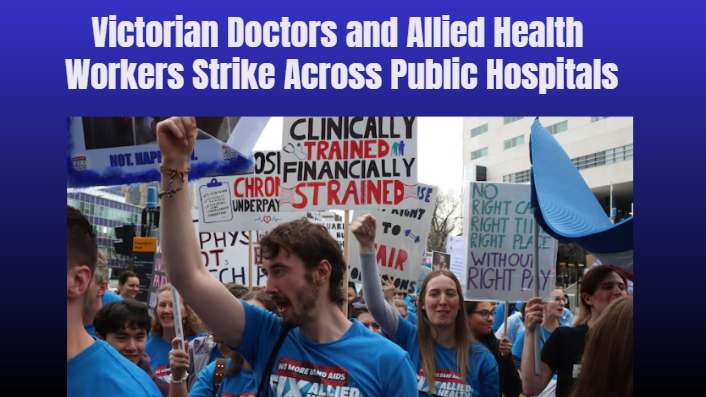
Thousands of Victorian doctors and allied health professionals have begun industrial action over stalled negotiations on pay and working conditions, wit...