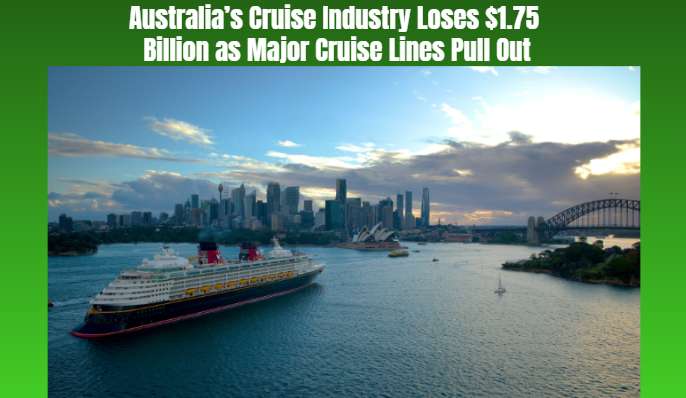
Australia’s Cruise Industry Loses $1.75 Billion as Major Cruise Lines Pull Out
By Chloe · Published 19 Nov 2026 · Updated 19 Nov 2026
National, ACT
Safety note: Admin approval is an initial review, not a guarantee that every detail is correct. Check important or urgent claims with official sources and report anything inaccurate or unsafe.
Source and credit: Contributor's own report
Australia’s Cruise Industry Loses $1.75 Billion as Major Cruise Lines Pull Out - National, ACT
Smart summary
Rising operating costs and uncertainty over regulations are putting pressure on Australia’s cruise tourism industry, with fewer ships visiting the country and local businesses facing a decline in tourism spending.
Australia’s cruise tourism industry is facing a significant downturn, with its contribution to the national economy falling by $1.75 billion over two years. A new industry report released on 19 November 2026 has highlighted the financial pressure on the sector as major international cruise companies reduce or end their Australian operations.
According to the report, the industry contributed approximately $6.68 billion to the Australian economy in 2025–26, compared with $8.43 billion in 2023–24. The latest figure represents a substantial decline for a sector that supports tourism businesses, port services, transport operators and thousands of workers.
The number of cruise ships stopping at Australian ports has also fallen. Ship visits declined by nearly 22 per cent, while passenger numbers dropped by 13.5 per cent. These reductions have affected businesses that depend on visitors arriving by sea, including hotels, restaurants, tour operators, shops and local attractions.
The decline is happening despite strong interest in cruise holidays among Australian travellers. The report recorded a record 1.45 million Australians taking an ocean cruise last year. However, many passengers are choosing to begin their holidays overseas, meaning some of the spending that could benefit Australian ports and tourism destinations is instead going to other countries.
Industry representatives have identified rising fuel prices, port charges and regulatory uncertainty as major challenges. Cruise companies plan their ship deployments years in advance, and uncertainty about future operating conditions can influence whether they choose Australia or another international destination.
Several well-known cruise brands have already reduced their Australian presence or ended local programs. Disney Cruise Line, Cunard and Virgin Voyages are among the companies mentioned in the report. Carnival has also announced plans to halve its Australian fleet from February 2028.
The financial impact differs across the country. Queensland's cruise tourism contribution fell by 9.4 per cent to $1.84 billion. Victoria and Western Australia recorded declines of more than 30 per cent, while South Australia's contribution dropped by 62.6 per cent.
The downturn affects more than the ports where ships arrive. Cruise operators purchase food, transport, fuel and other services from Australian suppliers. Farmers, food producers, maritime contractors and regional tourism businesses can all lose income when fewer ships visit.
The federal government has introduced changes intended to balance the industry's operating needs with protections for cruise ship workers. From January 2027, operators will face new requirements relating to collective bargaining and reporting crew complaints to Australia's maritime safety regulator.
The industry is calling for clearer rules and action to address operating costs before more cruise companies move their ships elsewhere. The latest figures raise concerns about Australia's ability to retain cruise operators and maintain the economic benefits that international visitors bring to coastal communities.
CruiseIndustryBillionCentOperators
Australia’s cruise tourism industry is facing a significant downturn, with its contribution to the national economy falling by $1.75 billion over two years. A new industry report released on 19 November 2026 has highlighted the financial pressure on the sector as major international cruise companies reduce or end their Australian operations.
According to the report, the industry contributed approximately $6.68 billion to the Australian economy in 2025–26, compared with $8.43 billion in 2023–24. The latest figure represents a substantial decline for a sector that supports tourism businesses, port services, transport operators and thousands of workers.
The number of cruise ships stopping at Australian ports has also fallen. Ship visits declined by nearly 22 per cent, while passenger numbers dropped by 13.5 per cent. These reductions have affected businesses that depend on visitors arriving by sea, including hotels, restaurants, tour operators, shops and local attractions.
The decline is happening despite strong interest in cruise holidays among Australian travellers. The report recorded a record 1.45 million Australians taking an ocean cruise last year. However, many passengers are choosing to begin their holidays overseas, meaning some of the spending that could benefit Australian ports and tourism destinations is instead going to other countries.
Industry representatives have identified rising fuel prices, port charges and regulatory uncertainty as major challenges. Cruise companies plan their ship deployments years in advance, and uncertainty about future operating conditions can influence whether they choose Australia or another international destination.
Several well-known cruise brands have already reduced their Australian presence or ended local programs. Disney Cruise Line, Cunard and Virgin Voyages are among the companies mentioned in the report. Carnival has also announced plans to halve its Australian fleet from February 2028.
The financial impact differs across the country. Queensland's cruise tourism contribution fell by 9.4 per cent to $1.84 billion. Victoria and Western Australia recorded declines of more than 30 per cent, while South Australia's contribution dropped by 62.6 per cent.
The downturn affects more than the ports where ships arrive. Cruise operators purchase food, transport, fuel and other services from Australian suppliers. Farmers, food producers, maritime contractors and regional tourism businesses can all lose income when fewer ships visit.
The federal government has introduced changes intended to balance the industry's operating needs with protections for cruise ship workers. From January 2027, operators will face new requirements relating to collective bargaining and reporting crew complaints to Australia's maritime safety regulator.
The industry is calling for clearer rules and action to address operating costs before more cruise companies move their ships elsewhere. The latest figures raise concerns about Australia's ability to retain cruise operators and maintain the economic benefits that international visitors bring to coastal communities.
Australia's unemployment rate unexpectedly increased to 4.9 per cent in October, with employment falling by 43,500 people, raising fresh concerns about...
Tasmania's well-known cheese and chocolate producer has entered voluntary administration, raising concerns about its future operations and the impact on...
Government support brings fresh hope to Mount Isa’s plan for a research facility aimed at attracting investment and creating new opportunities in Queens...
Komatsu Mining plans to shut its Moss Vale facility by 2030, with approximately 265 workers expected to be affected as operations gradually move to othe...
A 15-year-old boy has been left in critical condition after being shot with an arrow in Kempsey, while police investigate reports involving people alleg...
Two teenage boys have suffered stab wounds during a violent confrontation at Castle Towers Shopping Centre in Sydney's north-west, prompting an emergenc...
A South Australian farmer is facing an estimated $100,000 loss after a fire destroyed harvesting equipment near Sedan. Firefighters prevented the blaze...
Victorian sprinter Jake Ireland has officially been declared the winner of Australia's historic Stawell Gift after original champion Olufemi Komolafe wa...
Victorian detectives have arrested a teenager following an investigation into alleged organised crime attacks targeting bars, clubs and restaurants acro...
South Australian police have arrested a man and a woman after allegedly discovering 910 alkaloid poppy plants growing at a residential property in Brahm...
A 15-year-old boy has been left in critical condition after being shot with an arrow in Kempsey, while police investigate reports involving people alleg...
Two teenage boys have suffered stab wounds during a violent confrontation at Castle Towers Shopping Centre in Sydney's north-west, prompting an emergenc...