Safety note: Admin approval is an initial review, not a guarantee that every detail is correct. Check important or urgent claims with official sources and report anything inaccurate or unsafe.
Source and credit: Contributor's own report
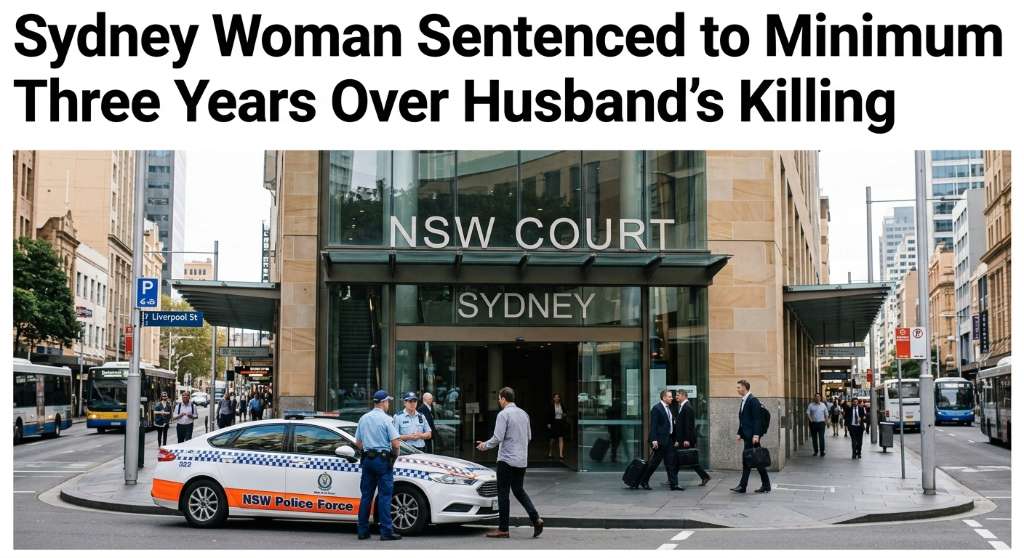
Sydney Woman Sentenced to Minimum Three Years Over Husband's Killing - Brisbane, QLD
Smart summary
A woman has been sentenced to a minimum three years in prison after killing her husband and disposing of his remains in bins across south-west Sydney.
A woman has been sentenced to a minimum three years in prison after being found responsible for the killing of her husband and the subsequent disposal of his remains across south-west Sydney.
The case was heard in the NSW court system, where details of the killing and the events that followed were considered during sentencing.
The woman was sentenced after the court examined the circumstances surrounding her husband's death and the steps taken to conceal and dispose of his remains. The remains were placed in bins at different locations in south-west Sydney, prompting an investigation after authorities became aware of the circumstances.
The court heard evidence about the relationship between the couple and the events leading up to the man's death. Investigators examined the circumstances inside the couple's home as well as locations where parts of the man's remains were later discovered.
The case involved extensive police inquiries across several Sydney suburbs. Detectives worked to establish what had happened to the victim and identify the locations connected with the disposal of his remains.
The sentencing decision means the woman will serve a minimum term of three years before becoming eligible for release, subject to the operation of NSW sentencing laws. The sentence reflects the court's assessment of the offence and the circumstances presented during the proceedings.
The case has also highlighted the investigative challenges involved when a person's remains are moved between multiple locations. Police had to examine different disposal sites and piece together evidence to establish the sequence of events.
The discovery of the remains led investigators to conduct further forensic and investigative work. Evidence gathered during the investigation was subsequently presented through the court process.
The woman's sentencing brings the current criminal proceedings against her to a significant stage, although the court's orders determine the minimum period of imprisonment rather than necessarily the total time she will spend in custody.
The case has attracted attention because of the circumstances surrounding the killing and the disposal of the man's remains across several locations in Sydney's south-west.
Authorities continue to treat cases involving suspected homicide and the concealment of remains as serious criminal investigations, with forensic evidence, witness information and other material used to establish what occurred.
RemainsCourtCircumstancesLocationsSydney
A woman has been sentenced to a minimum three years in prison after being found responsible for the killing of her husband and the subsequent disposal of his remains across south-west Sydney.
The case was heard in the NSW court system, where details of the killing and the events that followed were considered during sentencing.
The woman was sentenced after the court examined the circumstances surrounding her husband's death and the steps taken to conceal and dispose of his remains. The remains were placed in bins at different locations in south-west Sydney, prompting an investigation after authorities became aware of the circumstances.
The court heard evidence about the relationship between the couple and the events leading up to the man's death. Investigators examined the circumstances inside the couple's home as well as locations where parts of the man's remains were later discovered.
The case involved extensive police inquiries across several Sydney suburbs. Detectives worked to establish what had happened to the victim and identify the locations connected with the disposal of his remains.
The sentencing decision means the woman will serve a minimum term of three years before becoming eligible for release, subject to the operation of NSW sentencing laws. The sentence reflects the court's assessment of the offence and the circumstances presented during the proceedings.
The case has also highlighted the investigative challenges involved when a person's remains are moved between multiple locations. Police had to examine different disposal sites and piece together evidence to establish the sequence of events.
The discovery of the remains led investigators to conduct further forensic and investigative work. Evidence gathered during the investigation was subsequently presented through the court process.
The woman's sentencing brings the current criminal proceedings against her to a significant stage, although the court's orders determine the minimum period of imprisonment rather than necessarily the total time she will spend in custody.
The case has attracted attention because of the circumstances surrounding the killing and the disposal of the man's remains across several locations in Sydney's south-west.
Authorities continue to treat cases involving suspected homicide and the concealment of remains as serious criminal investigations, with forensic evidence, witness information and other material used to establish what occurred.
A 21-year-old man has been charged after investigators allege more than $2 million in suspected criminal proceeds moved through high-frequency, low-valu...
A 55-year-old man has been charged after police allegedly seized more than $900,000 worth of drugs, firearms and about $50,000 in cash from a South Bris...
A 21-year-old man has been charged after investigators allege more than $2 million in suspected criminal proceeds moved through high-frequency, low-valu...
An investigation has raised questions about what happened after NSW's building regulator disciplined a major developer and prepared a public statement a...