Safety note: Admin approval is an initial review, not a guarantee that every detail is correct. Check important or urgent claims with official sources and report anything inaccurate or unsafe.
Source and credit: Contributor's own report
Gold Coast Aquatic Centre Privatisation Vote Hangs in the Balance - Gold Coast, QLD
Smart summary
Councillors remain divided over a proposal to shift management of eight public aquatic centres to a private operator, with the final vote due on August 25.
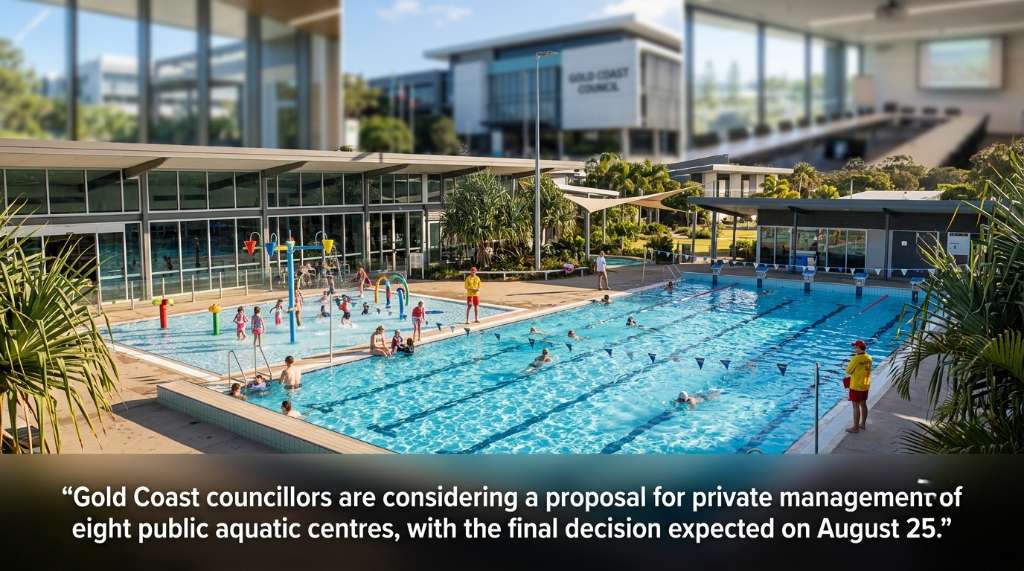
A major decision over the future management of Gold Coast City Council's aquatic centres is heading toward a closely contested council vote on 25 August 2026. The proposal would move management of council aquatic facilities toward a private operating model, but councillors remain divided over staffing, safety, fees and community access.
The proposal is being led by councillor Glenn Tozer, who argues that using a specialised private operator could provide a more efficient way to manage the city's aquatic-centre network while maintaining public oversight. A council report estimates the proposed model could deliver approximately $22 million in savings over 10 years.
However, the proposal has faced significant opposition. At a recent committee meeting, the recommendation was defeated 5–1, with opponents raising concerns about what private management could mean for employees, safety standards, fees and the long-term public interest. The final decision will now go to the full council.
One of the biggest issues is employment. Critics have warned that workers could eventually face different employment conditions if facilities move away from direct council management and toward private-sector arrangements. Supporters of the proposal say staff transitions would be managed under the existing Certified Agreement and that the change does not automatically mean existing employees will lose their jobs or conditions.
Another major concern is pool affordability. Aquatic centres are used by families, school groups, swimming clubs, fitness users and people learning to swim. Opponents fear that private operators could eventually seek higher fees to improve profitability. Supporters argue that the council would retain control over important service and pricing requirements, including annual fee reviews.
Community access is another central part of the debate. Facilities such as the Gold Coast Aquatic Centre in Southport provide swimming, diving, fitness and community programs, while also hosting local, national and international competitions.
The proposal has therefore attracted attention from community organisations that believe the aquatic centres should continue to be treated primarily as public assets rather than commercial operations. Some campaigners have called for greater transparency and more consultation before a final decision is made.
At the same time, supporters point to the financial pressure involved in operating a large network of public facilities. They argue that a specialised operator could potentially reduce operating costs, streamline management and increase participation while allowing the council to maintain strategic oversight.
The political situation remains particularly uncertain because the council appears to be closely divided. The latest reporting suggests an 8–7 outcome could be possible, meaning a single councillor's position could determine the result. Councillor Brooke Patterson has been identified as undecided, making her position potentially important to the final vote.
The issue is therefore not simply about who operates the pools. It is a wider debate about public ownership, employment conditions, financial efficiency, affordability and community services.
CouncilCouldAquaticCommunityManagement
A major decision over the future management of Gold Coast City Council's aquatic centres is heading toward a closely contested council vote on 25 August 2026. The proposal would move management of council aquatic facilities toward a private operating model, but councillors remain divided over staffing, safety, fees and community access.
The proposal is being led by councillor Glenn Tozer, who argues that using a specialised private operator could provide a more efficient way to manage the city's aquatic-centre network while maintaining public oversight. A council report estimates the proposed model could deliver approximately $22 million in savings over 10 years.
However, the proposal has faced significant opposition. At a recent committee meeting, the recommendation was defeated 5–1, with opponents raising concerns about what private management could mean for employees, safety standards, fees and the long-term public interest. The final decision will now go to the full council.
One of the biggest issues is employment. Critics have warned that workers could eventually face different employment conditions if facilities move away from direct council management and toward private-sector arrangements. Supporters of the proposal say staff transitions would be managed under the existing Certified Agreement and that the change does not automatically mean existing employees will lose their jobs or conditions.
Another major concern is pool affordability. Aquatic centres are used by families, school groups, swimming clubs, fitness users and people learning to swim. Opponents fear that private operators could eventually seek higher fees to improve profitability. Supporters argue that the council would retain control over important service and pricing requirements, including annual fee reviews.
Community access is another central part of the debate. Facilities such as the Gold Coast Aquatic Centre in Southport provide swimming, diving, fitness and community programs, while also hosting local, national and international competitions.
The proposal has therefore attracted attention from community organisations that believe the aquatic centres should continue to be treated primarily as public assets rather than commercial operations. Some campaigners have called for greater transparency and more consultation before a final decision is made.
At the same time, supporters point to the financial pressure involved in operating a large network of public facilities. They argue that a specialised operator could potentially reduce operating costs, streamline management and increase participation while allowing the council to maintain strategic oversight.
The political situation remains particularly uncertain because the council appears to be closely divided. The latest reporting suggests an 8–7 outcome could be possible, meaning a single councillor's position could determine the result. Councillor Brooke Patterson has been identified as undecided, making her position potentially important to the final vote.
The issue is therefore not simply about who operates the pools. It is a wider debate about public ownership, employment conditions, financial efficiency, affordability and community services.
Regional councils are calling on the Australian Government to establish a $200 million funding program to help maintain regional airports, after a surve...
A rural Western Australian shire has asked the federal government to recognise the challenges of operating childcare services in small communities, wher...
Armidale Regional Council will replace an ageing cast-iron water main in Ampol and Miller Streets with a modern system, with construction scheduled to b...
Fire crews and water-bombing helicopters are responding to a fast-moving bushfire near Oak Valley, north of Townsville, as residents in nearby areas are...
The Bureau of Meteorology is warning of possible thunderstorms across southern Queensland during the King’s Birthday long weekend, with unsettled weathe...
Changes to Australia’s working holiday visa program have raised concerns among tourism and hospitality businesses in Far North Queensland, where backpac...
Queensland Police established an emergency exclusion zone in Kallangur, north of Brisbane, after receiving reports of an armed person inside a residence...
A 36-year-old man extradited from Perth has received a suspended prison sentence after being convicted over a violent incident involving four people at...
Darwin's Frontier Bar and Grill manager Aston Bell has received two industry awards, recognising her leadership, customer service and contribution to th...
A teenager from Devonport has died and four other people were injured after a serious crash involving a ute on Mersey Main Road near Latrobe, Tasmania.