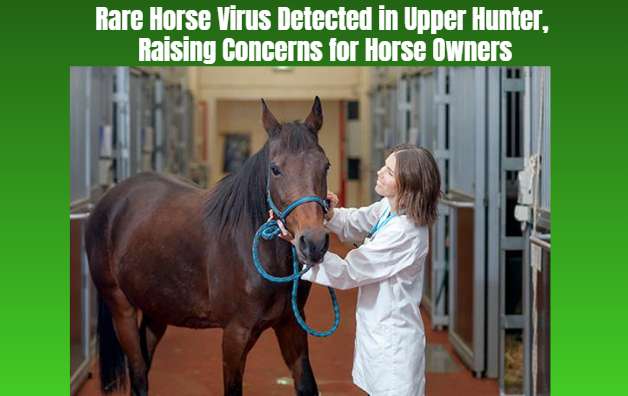
Rare Horse Virus Detected in Upper Hunter, Raising Concerns for Horse Owners
By Chloe · Published 19 Nov 2026 · Updated 19 Nov 2026
Upper Hunter, NSW
Safety note: Admin approval is an initial review, not a guarantee that every detail is correct. Check important or urgent claims with official sources and report anything inaccurate or unsafe.
Source and credit: Contributor's own report
Rare Horse Virus Detected in Upper Hunter, Raising Concerns for Horse Owners - Upper Hunter, NSW
Smart summary
Equine Herpesvirus-1 has been detected in four horses in the Upper Hunter region, prompting a biosecurity alert over the risk of neurological illness, pregnancy complications and deaths in newborn foals.
Horse owners across the Upper Hunter region of New South Wales have been alerted after a rare but highly contagious horse virus was detected in four horses. The discovery has raised concerns among the local equestrian and farming communities because the disease can cause serious health complications in affected animals.
The virus, known as Equine Herpesvirus-1 (EHV-1), has prompted the NSW Department of Primary Industries to issue a warning to horse owners. The alert highlights the importance of monitoring animal health and taking appropriate biosecurity precautions to reduce the possibility of further infections.
EHV-1 is a virus that commonly causes respiratory illness in horses. However, certain strains or forms of infection can lead to much more serious complications, including neurological problems, pregnancy loss and death in newborn foals.
One of the major concerns associated with the virus is its ability to remain dormant in an infected horse's body. Even after an animal recovers from its initial infection, the virus can remain present for life. It may become active again when the horse experiences stress or illness.
The neurological form of EHV-1 can affect the nervous system and cause symptoms such as weakness, difficulty walking, loss of coordination and, in severe cases, paralysis. These complications can create significant challenges for horse owners and veterinary professionals.
The detection of the virus in four horses has increased attention on disease monitoring throughout the Upper Hunter. Although the affected horses are not thoroughbreds, the discovery is relevant to the wider horse industry, including recreational riding, breeding and agricultural activities.
Horse owners are encouraged to monitor their animals carefully and seek veterinary advice if they notice unusual respiratory symptoms, fever, weakness or changes in movement and coordination.
Biosecurity precautions are particularly important when horses are transported between properties or come into contact with animals from other locations. Separating potentially infected animals and limiting unnecessary contact can help reduce transmission risks.
The virus can spread through direct contact between horses and through contaminated equipment or materials. This makes hygiene and careful management important measures for properties where multiple horses are kept.
The NSW Department of Primary Industries has issued its alert to make horse owners aware of the detection and potential consequences of the disease.
The latest discovery highlights the ongoing challenges associated with managing infectious animal diseases in regional Australia. Horse owners, breeders and veterinary professionals play an important role in identifying possible infections early and reducing the risk of wider transmission.
Authorities have not reported that the affected horses are thoroughbreds, and the incident should not be interpreted as evidence of an industry-wide outbreak.
The situation remains an important biosecurity concern for the Upper Hunter community as horse owners continue monitoring their animals and following veterinary guidance.
HorseHorsesOwnersVirusAnimals
Horse owners across the Upper Hunter region of New South Wales have been alerted after a rare but highly contagious horse virus was detected in four horses. The discovery has raised concerns among the local equestrian and farming communities because the disease can cause serious health complications in affected animals.
The virus, known as Equine Herpesvirus-1 (EHV-1), has prompted the NSW Department of Primary Industries to issue a warning to horse owners. The alert highlights the importance of monitoring animal health and taking appropriate biosecurity precautions to reduce the possibility of further infections.
EHV-1 is a virus that commonly causes respiratory illness in horses. However, certain strains or forms of infection can lead to much more serious complications, including neurological problems, pregnancy loss and death in newborn foals.
One of the major concerns associated with the virus is its ability to remain dormant in an infected horse's body. Even after an animal recovers from its initial infection, the virus can remain present for life. It may become active again when the horse experiences stress or illness.
The neurological form of EHV-1 can affect the nervous system and cause symptoms such as weakness, difficulty walking, loss of coordination and, in severe cases, paralysis. These complications can create significant challenges for horse owners and veterinary professionals.
The detection of the virus in four horses has increased attention on disease monitoring throughout the Upper Hunter. Although the affected horses are not thoroughbreds, the discovery is relevant to the wider horse industry, including recreational riding, breeding and agricultural activities.
Horse owners are encouraged to monitor their animals carefully and seek veterinary advice if they notice unusual respiratory symptoms, fever, weakness or changes in movement and coordination.
Biosecurity precautions are particularly important when horses are transported between properties or come into contact with animals from other locations. Separating potentially infected animals and limiting unnecessary contact can help reduce transmission risks.
The virus can spread through direct contact between horses and through contaminated equipment or materials. This makes hygiene and careful management important measures for properties where multiple horses are kept.
The NSW Department of Primary Industries has issued its alert to make horse owners aware of the detection and potential consequences of the disease.
The latest discovery highlights the ongoing challenges associated with managing infectious animal diseases in regional Australia. Horse owners, breeders and veterinary professionals play an important role in identifying possible infections early and reducing the risk of wider transmission.
Authorities have not reported that the affected horses are thoroughbreds, and the incident should not be interpreted as evidence of an industry-wide outbreak.
The situation remains an important biosecurity concern for the Upper Hunter community as horse owners continue monitoring their animals and following veterinary guidance.
The final section of Newcastle's $488 million Inner City Bypass has officially opened, giving motorists a new route around 11 traffic lights and improvi...
A proposed school sports field development at Canoe Point in Tannum Sands has been paused after environmental concerns were raised about clearing native...
Invasive snails have been discovered on two cargo vessels carrying imported goods at the Port of Newcastle, prompting quarantine and biosecurity treatme...
Federal funding will support planning for improvements to three important outback routes, including Flinders Ranges Way, Birdsville Track and Cordillo D...
A 15-year-old boy has been left in critical condition after being shot with an arrow in Kempsey, while police investigate reports involving people alleg...
Two teenage boys have suffered stab wounds during a violent confrontation at Castle Towers Shopping Centre in Sydney's north-west, prompting an emergenc...
Rising operating costs and uncertainty over regulations are putting pressure on Australia’s cruise tourism industry, with fewer ships visiting the count...
A South Australian farmer is facing an estimated $100,000 loss after a fire destroyed harvesting equipment near Sedan. Firefighters prevented the blaze...
Victorian detectives have arrested a teenager following an investigation into alleged organised crime attacks targeting bars, clubs and restaurants acro...
South Australian police have arrested a man and a woman after allegedly discovering 910 alkaloid poppy plants growing at a residential property in Brahm...
A 15-year-old boy has been left in critical condition after being shot with an arrow in Kempsey, while police investigate reports involving people alleg...
Two teenage boys have suffered stab wounds during a violent confrontation at Castle Towers Shopping Centre in Sydney's north-west, prompting an emergenc...