Safety note: Admin approval is an initial review, not a guarantee that every detail is correct. Check important or urgent claims with official sources and report anything inaccurate or unsafe.
Source and credit: Contributor's own report
New Wildlife Sanctuary Established on King Island - King Island, TAS
Smart summary
A 200-hectare property on King Island has been acquired to create a new wildlife sanctuary focused on protecting threatened native species and restoring habitat.
A major new conservation project has been announced on King Island in Tasmania, with the Australian Wildlife Conservancy acquiring a 200-hectare property to establish the Boulder Wildlife Sanctuary.
The acquisition marks the Australian Wildlife Conservancy's first move into Tasmania and is intended to provide additional protection for some of King Island's most threatened wildlife. The property is located on the island's north-east coast alongside the ecologically significant Lavinia State Reserve.
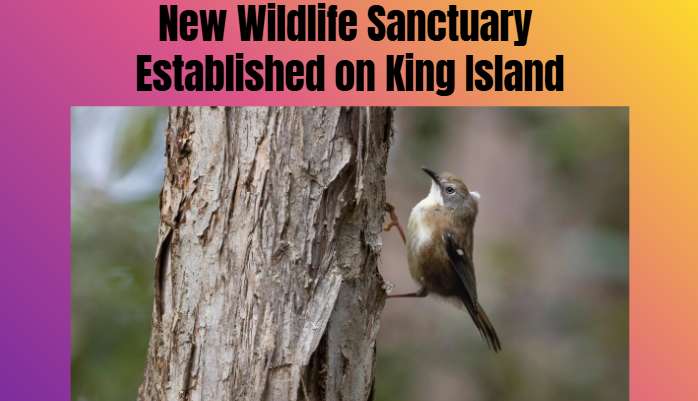
One of the key species targeted by the conservation project is the critically endangered King Island Scrubtit, a small bird found only on King Island and Tasmania. The species has suffered from extensive habitat loss, with about 70 per cent of King Island's native vegetation cleared since European settlement.
The new sanctuary will also provide habitat for other threatened species, including the King Island Brown Thornbill. The Australian Wildlife Conservancy says the property contains native vegetation with significant conservation value.
Initial work at Boulder Wildlife Sanctuary will focus on understanding the condition of the property and its wildlife. A comprehensive ecological survey is planned to establish a scientific baseline before larger-scale conservation management begins.
The organisation has also identified several immediate priorities, including controlling feral animals and invasive weeds, developing fire-management plans and improving connections between remaining areas of native habitat.
Feral cats are expected to be one of the major management challenges. Conservation organisations on King Island have previously highlighted introduced predators and habitat fragmentation as threats to native wildlife.
The sanctuary is also expected to build on conservation work already being undertaken by local residents and community organisations. The Australian Wildlife Conservancy says it will work with the local community while developing a broader King Island Conservation Program.
King Island is recognised as a significant biodiversity area and supports hundreds of native plant species and more than 160 bird species. Several of these species are threatened or found only on the island.
The project represents a long-term conservation effort rather than an immediate change for visitors or residents. Further ecological surveys and planning will take place over the coming months before active management is expanded.
For the King Island Scrubtit, the project is particularly significant because the bird has a very restricted range and depends on suitable native habitat. Conservation groups have been working for years to protect the remaining habitat and prevent further decline.
The Australian Wildlife Conservancy says the new sanctuary will form part of its wider strategy to protect threatened Australian wildlife and restore important ecosystems.
IslandWildlifeKingConservationHabitat
A major new conservation project has been announced on King Island in Tasmania, with the Australian Wildlife Conservancy acquiring a 200-hectare property to establish the Boulder Wildlife Sanctuary.
The acquisition marks the Australian Wildlife Conservancy's first move into Tasmania and is intended to provide additional protection for some of King Island's most threatened wildlife. The property is located on the island's north-east coast alongside the ecologically significant Lavinia State Reserve.
One of the key species targeted by the conservation project is the critically endangered King Island Scrubtit, a small bird found only on King Island and Tasmania. The species has suffered from extensive habitat loss, with about 70 per cent of King Island's native vegetation cleared since European settlement.
The new sanctuary will also provide habitat for other threatened species, including the King Island Brown Thornbill. The Australian Wildlife Conservancy says the property contains native vegetation with significant conservation value.
Initial work at Boulder Wildlife Sanctuary will focus on understanding the condition of the property and its wildlife. A comprehensive ecological survey is planned to establish a scientific baseline before larger-scale conservation management begins.
The organisation has also identified several immediate priorities, including controlling feral animals and invasive weeds, developing fire-management plans and improving connections between remaining areas of native habitat.
Feral cats are expected to be one of the major management challenges. Conservation organisations on King Island have previously highlighted introduced predators and habitat fragmentation as threats to native wildlife.
The sanctuary is also expected to build on conservation work already being undertaken by local residents and community organisations. The Australian Wildlife Conservancy says it will work with the local community while developing a broader King Island Conservation Program.
King Island is recognised as a significant biodiversity area and supports hundreds of native plant species and more than 160 bird species. Several of these species are threatened or found only on the island.
The project represents a long-term conservation effort rather than an immediate change for visitors or residents. Further ecological surveys and planning will take place over the coming months before active management is expanded.
For the King Island Scrubtit, the project is particularly significant because the bird has a very restricted range and depends on suitable native habitat. Conservation groups have been working for years to protect the remaining habitat and prevent further decline.
The Australian Wildlife Conservancy says the new sanctuary will form part of its wider strategy to protect threatened Australian wildlife and restore important ecosystems.
Police allege four people have been charged after an investigation into drug supply across the NSW–Queensland border led to the seizure of illicit drugs...
Two 16-year-old boys and an 18-year-old man have been charged after police investigated a series of alleged robberies, car thefts and home invasions acr...
George Town, Tasmania · Breaking News · 01 Oct 2026
Federal and Tasmanian governments have announced a $200 million support package and a five-year electricity agreement for the northern Tasmanian alumini...
Police allege four people have been charged after an investigation into drug supply across the NSW–Queensland border led to the seizure of illicit drugs...
George Town, Tasmania · Breaking News · 01 Oct 2026
Federal and Tasmanian governments have announced a $200 million support package and a five-year electricity agreement for the northern Tasmanian alumini...
Dozens of jobs could be affected at the Millicent paper mill as its new owner proposes changes aimed at keeping the 66-year-old South Australian operati...
Police allege four people have been charged after an investigation into drug supply across the NSW–Queensland border led to the seizure of illicit drugs...
Two 16-year-old boys and an 18-year-old man have been charged after police investigated a series of alleged robberies, car thefts and home invasions acr...
George Town, Tasmania · Breaking News · 01 Oct 2026
Federal and Tasmanian governments have announced a $200 million support package and a five-year electricity agreement for the northern Tasmanian alumini...