Safety note: Admin approval is an initial review, not a guarantee that every detail is correct. Check important or urgent claims with official sources and report anything inaccurate or unsafe.
Source and credit: Contributor's own report
NSW Government Considers Appeal After Controversial Court Ruling on Antisemitism - Sydney, NSW
Smart summary
Attorney-General seeks urgent legal advice after Supreme Court ruling involving anti-Israel vandalism and a rejected terrorism-order request.
The New South Wales Government is considering whether to appeal a controversial Supreme Court decision concerning antisemitism, anti-Israel vandalism and the legal threshold for taking action against alleged extremist conduct. The matter has attracted significant attention in Sydney and across NSW because of its implications for how authorities distinguish between political protest, offensive conduct and antisemitic behaviour.
The case concerns a ruling by NSW Supreme Court Justice Desmond Fagan involving an application for a terrorism-related order against Mohommed Farhat. The application followed allegations involving anti-Israel vandalism. Justice Fagan rejected the request, with the court finding that the conduct in question did not meet the relevant legal threshold for the order. The ruling has subsequently prompted discussion about how Australian law deals with politically motivated vandalism and conduct that may be perceived as antisemitic.
The NSW Attorney-General is now seeking urgent legal advice on the decision and is considering whether the government should appeal. An appeal would potentially allow a higher court to examine the legal reasoning behind the judgment and clarify how existing legislation should be applied in similar circumstances.
The issue is particularly sensitive in Sydney, where debates over Israel, Palestine, antisemitism and political demonstrations have become increasingly prominent. Community groups and political leaders have continued to debate how governments can protect freedom of political expression while responding firmly to conduct that crosses legal or community standards.
The controversy also highlights a broader legal question: whether conduct directed at Israel or Israeli interests should be treated as political expression, antisemitic behaviour, or potentially something more serious depending on the circumstances. The court's interpretation of the evidence and applicable legislation could therefore have consequences beyond this individual case.
For the NSW Government, the immediate priority is obtaining legal advice before deciding whether to challenge the ruling. If an appeal proceeds, the case could receive further judicial scrutiny and potentially establish clearer guidance for future cases involving alleged antisemitic conduct, political vandalism and terrorism-related legal powers.
LegalConductCourtPoliticalAppeal
The New South Wales Government is considering whether to appeal a controversial Supreme Court decision concerning antisemitism, anti-Israel vandalism and the legal threshold for taking action against alleged extremist conduct. The matter has attracted significant attention in Sydney and across NSW because of its implications for how authorities distinguish between political protest, offensive conduct and antisemitic behaviour.
The case concerns a ruling by NSW Supreme Court Justice Desmond Fagan involving an application for a terrorism-related order against Mohommed Farhat. The application followed allegations involving anti-Israel vandalism. Justice Fagan rejected the request, with the court finding that the conduct in question did not meet the relevant legal threshold for the order. The ruling has subsequently prompted discussion about how Australian law deals with politically motivated vandalism and conduct that may be perceived as antisemitic.
The NSW Attorney-General is now seeking urgent legal advice on the decision and is considering whether the government should appeal. An appeal would potentially allow a higher court to examine the legal reasoning behind the judgment and clarify how existing legislation should be applied in similar circumstances.
The issue is particularly sensitive in Sydney, where debates over Israel, Palestine, antisemitism and political demonstrations have become increasingly prominent. Community groups and political leaders have continued to debate how governments can protect freedom of political expression while responding firmly to conduct that crosses legal or community standards.
The controversy also highlights a broader legal question: whether conduct directed at Israel or Israeli interests should be treated as political expression, antisemitic behaviour, or potentially something more serious depending on the circumstances. The court's interpretation of the evidence and applicable legislation could therefore have consequences beyond this individual case.
For the NSW Government, the immediate priority is obtaining legal advice before deciding whether to challenge the ruling. If an appeal proceeds, the case could receive further judicial scrutiny and potentially establish clearer guidance for future cases involving alleged antisemitic conduct, political vandalism and terrorism-related legal powers.
The Federal Government is preparing new measures targeting temporary visas, visa overstayers, international students and visa-hopping, while maintaining...
One Nation’s proposed major reduction in migration has triggered warnings that a sharp cut to population growth could weaken Australia’s economy and cre...
A 36-year-old man has been charged after investigators allegedly found fraudulent identification documents, cloned number plates, cash and drug-manufact...
A Sydney court has heard that a man sent 249 messages to a former partner within 24 hours, with the messages treated as a single alleged breach of an ap...
A high-profile athlete has returned to court and told the hearing that an alleged unwanted kiss by former broadcaster Alan Jones remained difficult to f...
Work on the $150 million Sydney Town Hall Square project has been paused after the NSW Planning Minister referred the development for review by the Inde...
Cairns Regional Council has unanimously voted to seek $400,000 in Queensland Government funding for a program designed to connect local businesses with the region’s growing film...
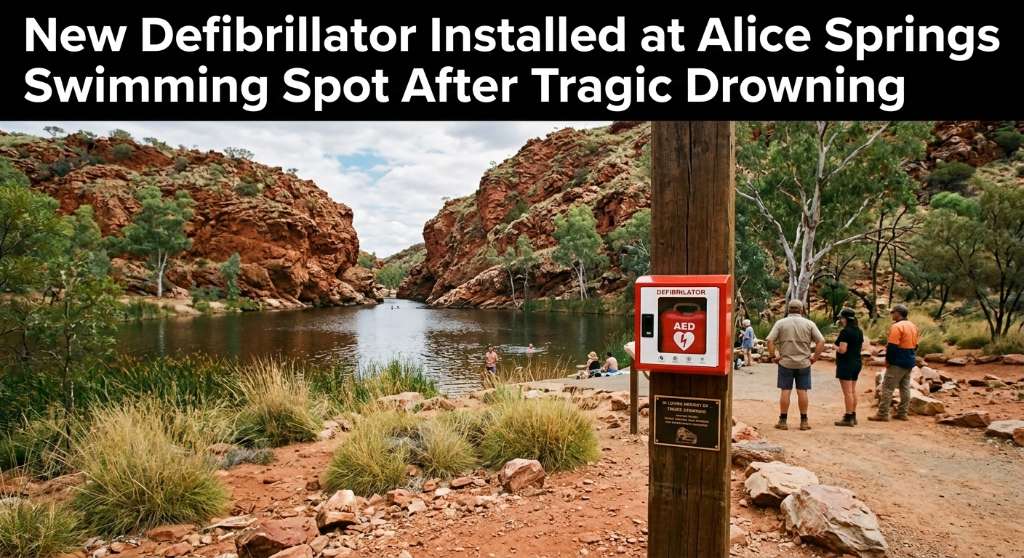
An automated external defibrillator and memorial plaque have been installed at Ellery Creek Big Hole following the death of disability advocate Ellen Fr...
Queensland firefighters spent several hours monitoring a significant grass fire at Mary Kinross Park in Bargara, near Bundaberg, after the blaze broke out on Wednesday evening....