Private Schools Dominate South Australia's AFL Draft Pathway
By Chloe · Published 17 Nov 2026 · Updated 17 Nov 2026
Adelaide, SA · South Australia News
Safety note: Admin approval is an initial review, not a guarantee that every detail is correct. Check important or urgent claims with official sources and report anything inaccurate or unsafe.
Source and credit: Contributor's own report
Private Schools Dominate South Australia's AFL Draft Pathway - Adelaide, SA
Smart summary
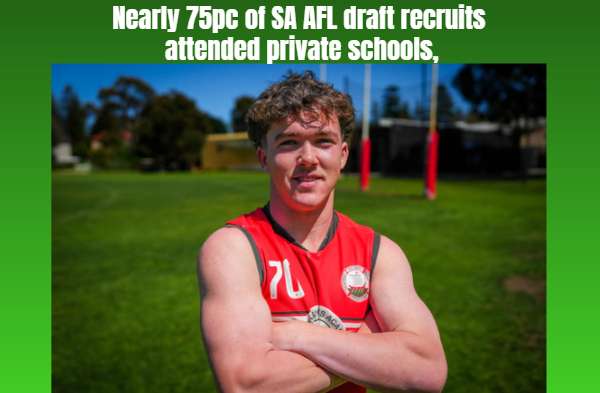
New analysis of the past 10 AFL national drafts finds nearly three-quarters of South Australian recruits attended private schools, while one public school has emerged as an exception.
A new analysis of South Australia's Australian Football League (AFL) recruitment pathways has revealed a significant difference between private and public school representation among young footballers selected in the national draft.
The investigation, published by ABC News on November 17, examined more than 100 South Australian players selected in the AFL national draft over the past decade. The analysis found that nearly three-quarters of the state's drafted players attended private schools, highlighting the influence of school-based sporting opportunities on the development of elite football talent.
However, one public school in Adelaide's western suburbs has emerged as an important exception. Henley High School has produced more AFL draftees than any other school in South Australia over the past ten years.
The school's success is closely connected to its specialist Sports Academy, which provides students with structured opportunities to develop their Australian Rules football skills while continuing their education.
The academy allows selected students to study Australian Rules football as part of their school curriculum. Its program includes football training, nutrition, game education and sports psychology. These subjects help young athletes understand the physical, technical and mental requirements of professional sport.
The ABC analysis found that almost half of South Australia's public school AFL draftees came from Henley High School. This makes the institution an important example of how public education can contribute to the development of professional sporting talent.
Among the academy's notable former students are Adelaide Crows player Izak Rankine and Port Adelaide player Jase Burgoyne. Dougie Cochrane, who has been discussed as a potential number one selection in the upcoming draft, is also associated with the school's football pathway.
Former Hawthorn player Ben Kane, who now leads Henley Sports Academy's football coaching program, explained that the academy focuses on developing individual students according to their needs. The objective is not only to improve football performance but also to help young people grow as individuals.
Sports sociologist Professor Brent McDonald from Victoria University said Henley's approach reflected some of the sporting advantages traditionally associated with private schools. He explained that creating a strong sporting culture within a school can help students access development opportunities that might otherwise be difficult to obtain.
School-based academies can also reduce practical barriers to participation. Students can complete training and sporting education during school hours instead of relying entirely on additional transport and family arrangements to reach separate training facilities.
Sean Toohey, head of talent at the South Australian National Football League (SANFL), said Henley's development model had been welcomed within professional football pathways. Students can complete development activities during the week and continue playing for their SANFL clubs on weekends.
The analysis also highlighted the challenges faced by regional footballers. Seventeen-year-old Brayden Whimpress, a student at Kapunda High School, said regional players could face additional difficulties when trying to reach professional football.
Despite those challenges, regional development programs continue to provide opportunities for talented young players.
The findings arrive ahead of the AFL national draft scheduled for November 19, 2026. The analysis has renewed discussion about equal sporting opportunities, school resources and the importance of accessible football development programs across South Australia.
SchoolFootballDevelopmentSouthStudents
A new analysis of South Australia's Australian Football League (AFL) recruitment pathways has revealed a significant difference between private and public school representation among young footballers selected in the national draft.
The investigation, published by ABC News on November 17, examined more than 100 South Australian players selected in the AFL national draft over the past decade. The analysis found that nearly three-quarters of the state's drafted players attended private schools, highlighting the influence of school-based sporting opportunities on the development of elite football talent.
However, one public school in Adelaide's western suburbs has emerged as an important exception. Henley High School has produced more AFL draftees than any other school in South Australia over the past ten years.
The school's success is closely connected to its specialist Sports Academy, which provides students with structured opportunities to develop their Australian Rules football skills while continuing their education.
The academy allows selected students to study Australian Rules football as part of their school curriculum. Its program includes football training, nutrition, game education and sports psychology. These subjects help young athletes understand the physical, technical and mental requirements of professional sport.
The ABC analysis found that almost half of South Australia's public school AFL draftees came from Henley High School. This makes the institution an important example of how public education can contribute to the development of professional sporting talent.
Among the academy's notable former students are Adelaide Crows player Izak Rankine and Port Adelaide player Jase Burgoyne. Dougie Cochrane, who has been discussed as a potential number one selection in the upcoming draft, is also associated with the school's football pathway.
Former Hawthorn player Ben Kane, who now leads Henley Sports Academy's football coaching program, explained that the academy focuses on developing individual students according to their needs. The objective is not only to improve football performance but also to help young people grow as individuals.
Sports sociologist Professor Brent McDonald from Victoria University said Henley's approach reflected some of the sporting advantages traditionally associated with private schools. He explained that creating a strong sporting culture within a school can help students access development opportunities that might otherwise be difficult to obtain.
School-based academies can also reduce practical barriers to participation. Students can complete training and sporting education during school hours instead of relying entirely on additional transport and family arrangements to reach separate training facilities.
Sean Toohey, head of talent at the South Australian National Football League (SANFL), said Henley's development model had been welcomed within professional football pathways. Students can complete development activities during the week and continue playing for their SANFL clubs on weekends.
The analysis also highlighted the challenges faced by regional footballers. Seventeen-year-old Brayden Whimpress, a student at Kapunda High School, said regional players could face additional difficulties when trying to reach professional football.
Despite those challenges, regional development programs continue to provide opportunities for talented young players.
The findings arrive ahead of the AFL national draft scheduled for November 19, 2026. The analysis has renewed discussion about equal sporting opportunities, school resources and the importance of accessible football development programs across South Australia.
Australia fell three points short at Murrayfield after a late comeback attempt, with Scotland holding on to secure an important home victory in the inte...
Australia delivers a dominant performance against Asian Cup champions Qatar in Doha, with Riley McGree, Tete Yengi and Nestory Irankunda scoring three f...
England's Kipp Popert and South Korea's Jeongwon Han secure impressive victories at Australia's major disability golf championship in Victoria, highligh...
Gold Coast Suns player Georgia Clayden has not been offered a contract for the 2027 season, just weeks before giving birth. The decision has renewed cal...
South Australia Police arrest five teenagers following investigations into multiple alleged robberies and attempted vehicle robberies in Adelaide's cent...
Three men from South Australia have been charged following a five-month investigation into alleged ATM thefts, vehicle stealing, property damage, break-...
South Australian Police are investigating a suspected deliberately lit fire at a business on Grand Junction Road in Rosewater after emergency crews resp...
A psychiatric report presented to South Australia's Supreme Court has raised questions about Tamika Chesser's mental competence in the case involving th...
Hundreds of Australians report feeling earthquake tremors across Darwin, Katherine and remote Northern Territory communities after a powerful earthquake...
The Tasmanian Government has begun approaching potential financial partners as concerns grow over the rising cost of the proposed Macquarie Point stadiu...
Large quantities of rubbish and potentially toxic building materials are being illegally dumped across Western Australia, raising concerns about environ...
Queensland Police establish an exclusion zone in the Western Downs town after a gas leak is reported, urging nearby residents to keep doors and windows...