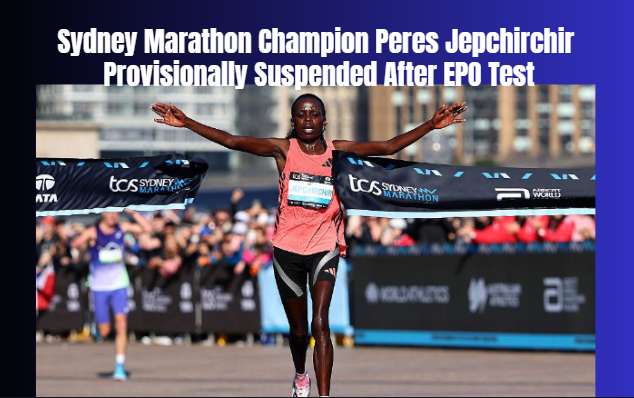
Sydney Marathon Champion Peres Jepchirchir Provisionally Suspended After EPO Test
By Chloe · Published 24 Oct 2026 · Updated 24 Oct 2026
Sydney, NSW · New South Wales News
Safety note: Admin approval is an initial review, not a guarantee that every detail is correct. Check important or urgent claims with official sources and report anything inaccurate or unsafe.
Source and credit: Contributor's own report
Sydney Marathon Champion Peres Jepchirchir Provisionally Suspended After EPO Test - Sydney, NSW
Smart summary
Kenyan marathon star Peres Jepchirchir has received a provisional suspension after an out-of-competition sample tested positive for the banned substance EPO. The finding has raised questions about her August victory a...
Kenyan distance runner Peres Jepchirchir has been provisionally suspended by the Athletics Integrity Unit (AIU) after a sample collected before her victory at the 2026 Sydney Marathon returned an adverse analytical finding for erythropoietin, commonly known as EPO. The development has placed renewed attention on anti-doping procedures in international athletics.
The AIU said the out-of-competition sample was collected in Kenya before Jepchirchir competed in Sydney. EPO is a prohibited substance that stimulates the production of red blood cells, helping the body transport oxygen more efficiently. Because endurance running places significant demands on the cardiovascular system, the substance is banned in competitive sport.
The provisional suspension means Jepchirchir cannot compete while the anti-doping case proceeds. It is not, however, a final determination that she committed an anti-doping violation. The disciplinary process must establish the outcome before a final sanction or other decision can be confirmed.
Jepchirchir, 33, has built an impressive international career. She won the women's marathon gold medal at the Tokyo Olympic Games in 2021 and later became world marathon champion in 2025. Her major marathon victories have included New York in 2021, Boston in 2022, London in 2024 and Sydney in 2026. She has also held the women's half-marathon world record.
At the Sydney Marathon on August 30, Jepchirchir finished in 2 hours, 18 minutes and 31 seconds. She crossed the finish line more than three minutes ahead of fellow Kenyan runner Irine Cheptai, making the result a significant achievement in her career. The positive test finding has now raised questions about the result, although any changes would depend on the applicable rules and the conclusion of the case.
Jepchirchir's agent, Gianni Demadonna, said in a statement that he felt terrible about the situation and that athletes who use performance-enhancing drugs should be disqualified. Sydney Marathon organisers also expressed disappointment, while stressing their commitment to fair competition and the principle that the case must go through due process.
The issue has broader implications for athletics. The AIU has sanctioned more than 140 Kenyan athletes since its establishment in 2017, according to reporting by the ABC. Anti-doping authorities have continued to emphasise testing and enforcement to protect competitors who follow the rules.
For now, Jepchirchir's case remains unresolved. The provisional suspension is an interim measure, and the final outcome will depend on the formal anti-doping process. The situation has drawn attention to the importance of independent testing, transparent investigations and fair treatment for all athletes while allegations are assessed.
JepchirchirMarathonSydneyAnti-DopingCase
Kenyan distance runner Peres Jepchirchir has been provisionally suspended by the Athletics Integrity Unit (AIU) after a sample collected before her victory at the 2026 Sydney Marathon returned an adverse analytical finding for erythropoietin, commonly known as EPO. The development has placed renewed attention on anti-doping procedures in international athletics.
The AIU said the out-of-competition sample was collected in Kenya before Jepchirchir competed in Sydney. EPO is a prohibited substance that stimulates the production of red blood cells, helping the body transport oxygen more efficiently. Because endurance running places significant demands on the cardiovascular system, the substance is banned in competitive sport.
The provisional suspension means Jepchirchir cannot compete while the anti-doping case proceeds. It is not, however, a final determination that she committed an anti-doping violation. The disciplinary process must establish the outcome before a final sanction or other decision can be confirmed.
Jepchirchir, 33, has built an impressive international career. She won the women's marathon gold medal at the Tokyo Olympic Games in 2021 and later became world marathon champion in 2025. Her major marathon victories have included New York in 2021, Boston in 2022, London in 2024 and Sydney in 2026. She has also held the women's half-marathon world record.
At the Sydney Marathon on August 30, Jepchirchir finished in 2 hours, 18 minutes and 31 seconds. She crossed the finish line more than three minutes ahead of fellow Kenyan runner Irine Cheptai, making the result a significant achievement in her career. The positive test finding has now raised questions about the result, although any changes would depend on the applicable rules and the conclusion of the case.
Jepchirchir's agent, Gianni Demadonna, said in a statement that he felt terrible about the situation and that athletes who use performance-enhancing drugs should be disqualified. Sydney Marathon organisers also expressed disappointment, while stressing their commitment to fair competition and the principle that the case must go through due process.
The issue has broader implications for athletics. The AIU has sanctioned more than 140 Kenyan athletes since its establishment in 2017, according to reporting by the ABC. Anti-doping authorities have continued to emphasise testing and enforcement to protect competitors who follow the rules.
For now, Jepchirchir's case remains unresolved. The provisional suspension is an interim measure, and the final outcome will depend on the formal anti-doping process. The situation has drawn attention to the importance of independent testing, transparent investigations and fair treatment for all athletes while allegations are assessed.
Former Port Adelaide forward Daniel Stewart has died aged 37. The AFL club has announced plans to pay tribute to the former player at its first home gam...
Wet weather is expected to add uncertainty to the Supercars championship street race, with leading drivers preparing for difficult track conditions on Q...
The veteran fullback has been recalled to captain Australia in his first Kangaroos Test since 2023, while four teammates are set to make their tournamen...
Six football clubs in Whyalla, South Australia, are facing an uncertain future as expected steelworks job losses threaten player numbers, club finances...
A new flight from Sydney to the Gold Coast is drawing attention to a journey that began eight decades ago, connecting Australia’s aviation history with...
Australian homicide detectives brought a 26-year-old man back from Poland to face a murder charge over the death of a 22-year-old man whose body was dis...
Planned train timetable changes affecting Sydney and the Illawarra have been abandoned following strong opposition from commuters, less than a month bef...
The ABC has begun wiping a small number of staff devices after researchers identified malicious online advertisements linked to a spyware campaign targe...
A new flight from Sydney to the Gold Coast is drawing attention to a journey that began eight decades ago, connecting Australia’s aviation history with...
Shipra Saini, an Indian citizen living in Ballarat, Victoria, says she must return to India before the end of October despite still needing to settle he...
A large sperm whale carcass has been buried near Turners Beach after the animal stranded on Tasmania’s north-west coast, raising concerns about environm...
A 75-year-old Perth woman has achieved a remarkable fitness milestone by becoming the oldest person to perform a handstand, demonstrating that strength...