NSW Rail Timetable Changes Scrapped After Commuter Backlash
By Chloe · Published 24 Oct 2026 · Updated 24 Oct 2026
Sydney, NSW · New South Wales News
Safety note: Admin approval is an initial review, not a guarantee that every detail is correct. Check important or urgent claims with official sources and report anything inaccurate or unsafe.
Planned train timetable changes affecting Sydney and the Illawarra have been abandoned following strong opposition from commuters, less than a month before their scheduled introduction.
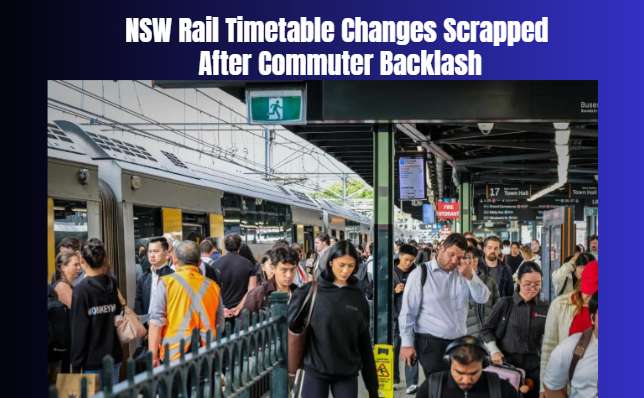
Plans to introduce major railway timetable changes across Sydney and the Illawarra region have been scrapped following a backlash from commuters, according to a report published on 24 October 2026. The decision comes less than a month before the changes were due to take effect, giving transport authorities and passengers renewed uncertainty about the future timetable arrangements.
The proposed changes had attracted opposition from commuters concerned about how adjustments to train services could affect their daily journeys. For people who depend on public transport to travel to work, attend education, reach medical appointments or connect with other services, timetable changes can have a significant impact on everyday routines.
Sydney's railway network is an essential part of the city's transport system. Thousands of passengers rely on trains to move between residential suburbs, employment centres and major transport interchanges. In the Illawarra region, rail services also provide an important connection for residents travelling between communities and Sydney. Changes to departure times, service frequency or connections can therefore affect not only individual passengers but also wider commuting patterns.
The decision to abandon the planned timetable changes highlights the importance of considering passenger feedback before introducing major public transport adjustments. Commuters often organise their working hours, childcare arrangements and onward transport around established train schedules. Even relatively small changes can create difficulties when passengers have limited alternatives or need to make connecting journeys.
The late reversal also raises practical questions about transport planning. Timetable development involves coordinating train movements, staffing, passenger demand and connections across different parts of the network. When a proposed schedule is withdrawn close to its intended introduction date, transport authorities must communicate clearly about what will happen next and ensure that passengers have accurate information.
For commuters, the immediate priority is to understand which timetable will apply to their usual services. Passengers should consult official NSW transport announcements and journey-planning services before travelling, particularly if they had already adjusted their routines in anticipation of the proposed changes.
The decision may also prompt renewed discussion about how transport authorities consult with passengers before making network-wide changes. Clear communication, advance notice and meaningful opportunities for public feedback can help identify problems before a new schedule is finalised.
Public transport services must balance operational requirements with the needs of the communities they serve. The cancellation of the proposed changes demonstrates that passenger concerns can become a significant factor in decisions affecting the railway network.
Further official information will be needed to establish whether a revised timetable will be proposed and whether any future changes will affect services across Sydney and the Illawarra. Until such details are confirmed, passengers should rely on published transport information rather than assume that a replacement schedule is already planned.
ChangesTransportPassengersTimetableServices
Plans to introduce major railway timetable changes across Sydney and the Illawarra region have been scrapped following a backlash from commuters, according to a report published on 24 October 2026. The decision comes less than a month before the changes were due to take effect, giving transport authorities and passengers renewed uncertainty about the future timetable arrangements.
The proposed changes had attracted opposition from commuters concerned about how adjustments to train services could affect their daily journeys. For people who depend on public transport to travel to work, attend education, reach medical appointments or connect with other services, timetable changes can have a significant impact on everyday routines.
Sydney's railway network is an essential part of the city's transport system. Thousands of passengers rely on trains to move between residential suburbs, employment centres and major transport interchanges. In the Illawarra region, rail services also provide an important connection for residents travelling between communities and Sydney. Changes to departure times, service frequency or connections can therefore affect not only individual passengers but also wider commuting patterns.
The decision to abandon the planned timetable changes highlights the importance of considering passenger feedback before introducing major public transport adjustments. Commuters often organise their working hours, childcare arrangements and onward transport around established train schedules. Even relatively small changes can create difficulties when passengers have limited alternatives or need to make connecting journeys.
The late reversal also raises practical questions about transport planning. Timetable development involves coordinating train movements, staffing, passenger demand and connections across different parts of the network. When a proposed schedule is withdrawn close to its intended introduction date, transport authorities must communicate clearly about what will happen next and ensure that passengers have accurate information.
For commuters, the immediate priority is to understand which timetable will apply to their usual services. Passengers should consult official NSW transport announcements and journey-planning services before travelling, particularly if they had already adjusted their routines in anticipation of the proposed changes.
The decision may also prompt renewed discussion about how transport authorities consult with passengers before making network-wide changes. Clear communication, advance notice and meaningful opportunities for public feedback can help identify problems before a new schedule is finalised.
Public transport services must balance operational requirements with the needs of the communities they serve. The cancellation of the proposed changes demonstrates that passenger concerns can become a significant factor in decisions affecting the railway network.
Further official information will be needed to establish whether a revised timetable will be proposed and whether any future changes will affect services across Sydney and the Illawarra. Until such details are confirmed, passengers should rely on published transport information rather than assume that a replacement schedule is already planned.
The new driverless metro service will connect Bankstown and Sydney’s south-western suburbs directly with the CBD and the north-west, ending more than tw...
A 79-year-old woman from Busselton is recovering in a Bali hospital after falling down a restaurant stairwell, with her family facing substantial medica...
A 19-year-old man from the Bendigo area died after the car he was driving struck a tree on Inglewood–Powlett Road near Fiery Flat. Police are investigat...
A passenger aircraft passed just above a van near the runway during its approach to Townsville Airport. Investigators are examining how the vehicle ente...
The ABC has begun wiping a small number of staff devices after researchers identified malicious online advertisements linked to a spyware campaign targe...
Several New South Wales MPs say a parliamentary security briefing left them anxious about how quickly security staff could respond to an incident, promp...
The ASX is maintaining a lower dividend payout and increasing spending on technology as it works to strengthen the reliability of Australia's financial...
The new driverless metro service will connect Bankstown and Sydney’s south-western suburbs directly with the CBD and the north-west, ending more than tw...
Queensland authorities are pursuing tougher legal penalties against the owner of two dogs that seriously injured a man in Brisbane’s north, while the po...
An ABC reporter and a bystander rescued a driver trapped inside a vehicle that was rapidly sinking in floodwater, highlighting the dangers of driving th...