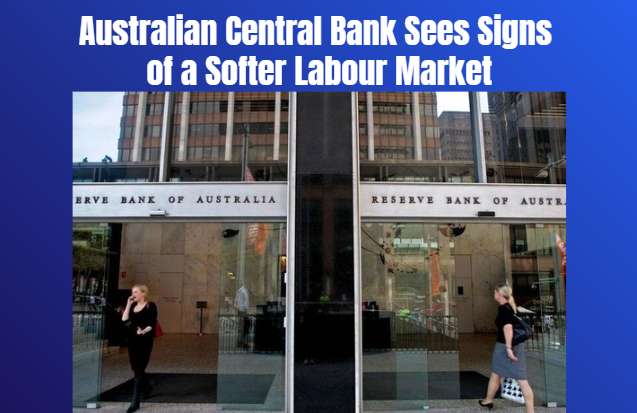
Australian Central Bank Sees Signs of a Softer Labour Market
By Chloe · Published 19 Oct 2026 · Updated 19 Oct 2026
Sydney, NSW · New South Wales News
Safety note: Admin approval is an initial review, not a guarantee that every detail is correct. Check important or urgent claims with official sources and report anything inaccurate or unsafe.
Source and credit: Contributor's own report
Australian Central Bank Sees Signs of a Softer Labour Market - Sydney, NSW
Smart summary
Reserve Bank official says employment conditions may be easing faster than expected.
Australia's labour market is attracting renewed attention after a senior Reserve Bank of Australia official indicated that employment conditions may be easing faster than previously expected. Christopher Kent, an assistant governor of the Reserve Bank of Australia (RBA), discussed the issue at a banking conference on Monday, 19 October.
The comments followed September employment figures showing that Australia's unemployment rate had risen to 4.7 per cent, its highest level in five years. The latest figures have prompted financial markets to reconsider the likelihood of further interest-rate increases.
Kent cautioned that monthly employment statistics should not be interpreted in isolation. However, he acknowledged that some indicators suggest the labour market has become less tight more quickly than policymakers had anticipated. Economists and investors are watching closely to determine whether this reflects weaker demand for workers or continued pressure from rising labour costs.
The RBA has increased interest rates four times during 2026, bringing the cash rate to 4.6 per cent, as it seeks to control inflation. Underlying inflation has remained at 3.6 per cent for three consecutive months, leaving policymakers with a difficult balance between controlling price increases and avoiding unnecessary pressure on households and businesses.
The next important indicator is quarterly inflation data expected the following week. Those figures could help the central bank assess whether inflationary pressures remain strong enough to justify another rate increase.
For Australian households, interest-rate decisions can affect mortgage repayments, consumer spending and borrowing costs. Businesses may also be affected through financing expenses and changes in customer demand. However, Kent's comments do not represent a confirmed decision to cut or increase rates at the next meeting.
Financial markets were assessing the possibility of another rate increase at the RBA's November meeting, with expectations changing following the latest employment data.
The situation remains uncertain. The central bank must determine whether weakening employment conditions are sufficient to ease inflationary pressure or whether prices remain too persistent to change its current approach. Upcoming economic data will therefore be important for investors, workers, borrowers and businesses across Australia.
BankEmploymentLabourRateWhether
Australia's labour market is attracting renewed attention after a senior Reserve Bank of Australia official indicated that employment conditions may be easing faster than previously expected. Christopher Kent, an assistant governor of the Reserve Bank of Australia (RBA), discussed the issue at a banking conference on Monday, 19 October.
The comments followed September employment figures showing that Australia's unemployment rate had risen to 4.7 per cent, its highest level in five years. The latest figures have prompted financial markets to reconsider the likelihood of further interest-rate increases.
Kent cautioned that monthly employment statistics should not be interpreted in isolation. However, he acknowledged that some indicators suggest the labour market has become less tight more quickly than policymakers had anticipated. Economists and investors are watching closely to determine whether this reflects weaker demand for workers or continued pressure from rising labour costs.
The RBA has increased interest rates four times during 2026, bringing the cash rate to 4.6 per cent, as it seeks to control inflation. Underlying inflation has remained at 3.6 per cent for three consecutive months, leaving policymakers with a difficult balance between controlling price increases and avoiding unnecessary pressure on households and businesses.
The next important indicator is quarterly inflation data expected the following week. Those figures could help the central bank assess whether inflationary pressures remain strong enough to justify another rate increase.
For Australian households, interest-rate decisions can affect mortgage repayments, consumer spending and borrowing costs. Businesses may also be affected through financing expenses and changes in customer demand. However, Kent's comments do not represent a confirmed decision to cut or increase rates at the next meeting.
Financial markets were assessing the possibility of another rate increase at the RBA's November meeting, with expectations changing following the latest employment data.
The situation remains uncertain. The central bank must determine whether weakening employment conditions are sufficient to ease inflationary pressure or whether prices remain too persistent to change its current approach. Upcoming economic data will therefore be important for investors, workers, borrowers and businesses across Australia.
Small-scale flower growers and local entrepreneurs in Western Australia's Kimberley region are stepping in to meet demand after the town's main florist...
Rising rents and living costs are pushing more people, including working families and older Australians, towards homelessness, according to Western Aust...
The planned opening of Broome’s multi-million-dollar Cable Beach foreshore redevelopment has been pushed back to 2027, leaving local residents and busin...
Land Forces 2026 opens in Perth for the first time, bringing international defence organisations, Australian industry and heightened security measures t...
Emergency services have located a body during a search in the Royal National Park near Engadine. Police believe it may be a 23-year-old man reported mis...
Rugby league player Seriah Palepale has received a community-based sentence after a high-speed police pursuit in south-west Sydney, following guilty ple...
A two-day police operation across the Central Coast, Newcastle and Hunter region resulted in 15 arrests, 23 charges and the seizure of two knives during...
Small-scale flower growers and local entrepreneurs in Western Australia's Kimberley region are stepping in to meet demand after the town's main florist...
South East Queensland faces a prolonged period of heavy rainfall, with Brisbane, the Gold Coast and the Sunshine Coast warned of potentially significant...
A 53-year-old man has been charged after an alleged domestic disturbance escalated into a fire and confrontation with police on the Gold Coast. Three of...
Two Greenpeace activists have been charged after allegedly climbing onto Woodside’s Scarborough offshore gas platform, around 200 kilometres off Western...