Safety note: Admin approval is an initial review, not a guarantee that every detail is correct. Check important or urgent claims with official sources and report anything inaccurate or unsafe.
Source and credit: Contributor's own report
Smart summary
Pauline Hanson’s One Nation has become the highest-polling federal party on primary support, intensifying pressure on both Labor and the Coalition and reshaping Australia’s political landscape.
A major new national opinion poll has revealed a significant shift in Australian federal politics, with Pauline Hanson’s One Nation recording 30% primary support and overtaking the governing Labor Party. The News24/You Gov Pulse poll was conducted between 1 and 8 September 2026, surveying 1,510 Australian voters. The results represent one of the strongest polling performances for One Nation in recent years and indicate that Australia’s traditional Labor–Coalition political contest is facing increasing competition from the right.
One Nation recorded 30%, an increase of four percentage points from the previous poll. Labor fell three points to 26%, while the Liberal–National Coalition declined to 18%. The Greens remained on 12%. This gives One Nation a four-point advantage over Labor and a substantial 12-point lead over the Coalition on primary support.
The result is particularly significant because One Nation is not currently the governing party and has historically been regarded as a minor or protest party. Its latest polling performance suggests that a growing number of voters may be willing to support it as a serious political alternative. Recent analysis also points to the 29 August Western Australian Secret Harbour by-election, where One Nation performed strongly, as an important event preceding the latest national polling movement.
Despite One Nation's primary-vote lead, the polling does not mean that Pauline Hanson would automatically become prime minister or that One Nation would win government at an election. Australia's preferential voting system means primary votes are redistributed through preferences. On the poll's two-party-preferred measures, Labor remains ahead of the Coalition 52–48 and leads One Nation 53–47. Therefore, Labor would still be in a stronger position under these measures if the polling were replicated at an election.
Leadership figures also show that Prime Minister Anthony Albanese retains an advantage. Albanese is preferred as prime minister by 43%, compared with 39% for Opposition Leader Angus Taylor, while 18% are undecided. Against Pauline Hanson, Albanese leads 51% to 40%.
The surge presents a particularly serious strategic problem for the Coalition. One Nation's growth could divide conservative and right-leaning voters, potentially reducing the Coalition's primary vote and making it harder for the Liberal–National parties to challenge Labor in marginal electorates.
For Labor, the development is also significant. One Nation's strongest themes—including immigration, cost of living, housing pressure, national identity and dissatisfaction with established political parties—could attract voters who previously supported Labor or the Coalition. The party is also promoting policies designed to appeal directly to households under financial pressure, including a controversial proposal allowing some workers to redirect part of their compulsory superannuation contributions into take-home pay.
The latest result should nevertheless be treated as a snapshot rather than an election prediction. Previous You Gov polling has produced substantially different results, demonstrating that voter support can move quickly. In July, for example, You Gov had Labor leading One Nation 56–44 on a two-party-preferred basis.
The central political story is therefore not simply that One Nation is leading a poll. It is that the party has reached a level of national support capable of disrupting the traditional two-party contest and forcing both Labor and the Coalition to reconsider their strategies ahead of the next federal election.
NationLaborCoalitionNationalParty
A major new national opinion poll has revealed a significant shift in Australian federal politics, with Pauline Hanson’s One Nation recording 30% primary support and overtaking the governing Labor Party. The News24/You Gov Pulse poll was conducted between 1 and 8 September 2026, surveying 1,510 Australian voters. The results represent one of the strongest polling performances for One Nation in recent years and indicate that Australia’s traditional Labor–Coalition political contest is facing increasing competition from the right.
One Nation recorded 30%, an increase of four percentage points from the previous poll. Labor fell three points to 26%, while the Liberal–National Coalition declined to 18%. The Greens remained on 12%. This gives One Nation a four-point advantage over Labor and a substantial 12-point lead over the Coalition on primary support.
The result is particularly significant because One Nation is not currently the governing party and has historically been regarded as a minor or protest party. Its latest polling performance suggests that a growing number of voters may be willing to support it as a serious political alternative. Recent analysis also points to the 29 August Western Australian Secret Harbour by-election, where One Nation performed strongly, as an important event preceding the latest national polling movement.
Despite One Nation's primary-vote lead, the polling does not mean that Pauline Hanson would automatically become prime minister or that One Nation would win government at an election. Australia's preferential voting system means primary votes are redistributed through preferences. On the poll's two-party-preferred measures, Labor remains ahead of the Coalition 52–48 and leads One Nation 53–47. Therefore, Labor would still be in a stronger position under these measures if the polling were replicated at an election.
Leadership figures also show that Prime Minister Anthony Albanese retains an advantage. Albanese is preferred as prime minister by 43%, compared with 39% for Opposition Leader Angus Taylor, while 18% are undecided. Against Pauline Hanson, Albanese leads 51% to 40%.
The surge presents a particularly serious strategic problem for the Coalition. One Nation's growth could divide conservative and right-leaning voters, potentially reducing the Coalition's primary vote and making it harder for the Liberal–National parties to challenge Labor in marginal electorates.
For Labor, the development is also significant. One Nation's strongest themes—including immigration, cost of living, housing pressure, national identity and dissatisfaction with established political parties—could attract voters who previously supported Labor or the Coalition. The party is also promoting policies designed to appeal directly to households under financial pressure, including a controversial proposal allowing some workers to redirect part of their compulsory superannuation contributions into take-home pay.
The latest result should nevertheless be treated as a snapshot rather than an election prediction. Previous You Gov polling has produced substantially different results, demonstrating that voter support can move quickly. In July, for example, You Gov had Labor leading One Nation 56–44 on a two-party-preferred basis.
The central political story is therefore not simply that One Nation is leading a poll. It is that the party has reached a level of national support capable of disrupting the traditional two-party contest and forcing both Labor and the Coalition to reconsider their strategies ahead of the next federal election.
The Federal Government is preparing new measures targeting temporary visas, visa overstayers, international students and visa-hopping, while maintaining...
One Nation’s proposed major reduction in migration has triggered warnings that a sharp cut to population growth could weaken Australia’s economy and cre...
The Federal Government is preparing new measures targeting temporary visas, visa overstayers, international students and visa-hopping, while maintaining...
One Nation’s proposed major reduction in migration has triggered warnings that a sharp cut to population growth could weaken Australia’s economy and cre...
A Canberra woman has become the first person in the ACT whose death has been linked to a highly potent synthetic opioid, prompting renewed concern about...
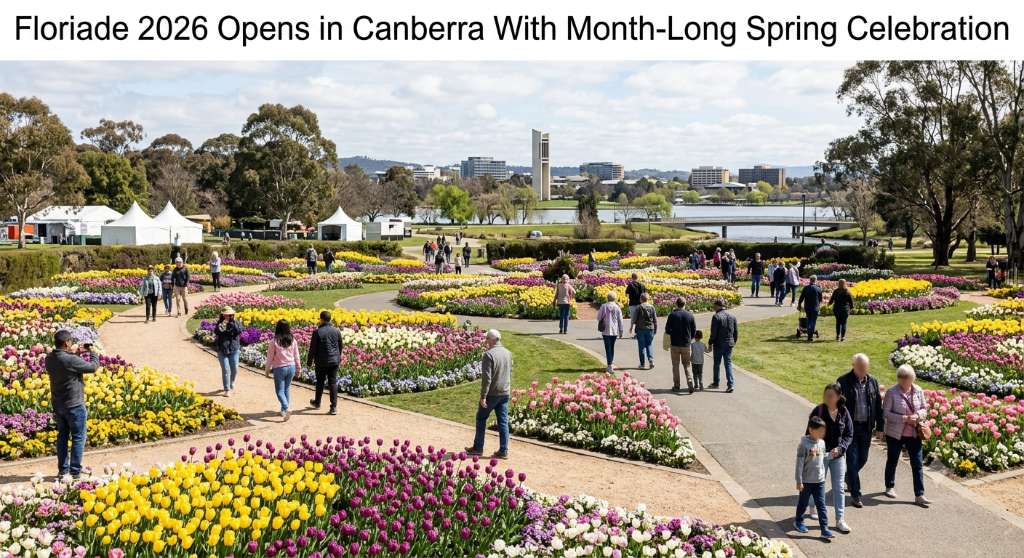
Canberra’s Commonwealth Park has welcomed visitors for the annual Floriade festival, bringing flowers, entertainment and spring activities to the city.
Cairns Regional Council has unanimously voted to seek $400,000 in Queensland Government funding for a program designed to connect local businesses with the region’s growing film...
An automated external defibrillator and memorial plaque have been installed at Ellery Creek Big Hole following the death of disability advocate Ellen Fr...
Queensland firefighters spent several hours monitoring a significant grass fire at Mary Kinross Park in Bargara, near Bundaberg, after the blaze broke out on Wednesday evening....