Safety note: Admin approval is an initial review, not a guarantee that every detail is correct. Check important or urgent claims with official sources and report anything inaccurate or unsafe.
Source and credit: Contributor's own report
Queensland Short-Stay Owner Ordered to Pay $3,500 After Guide Dog Refusal - Agnes Water, QLD
Smart summary
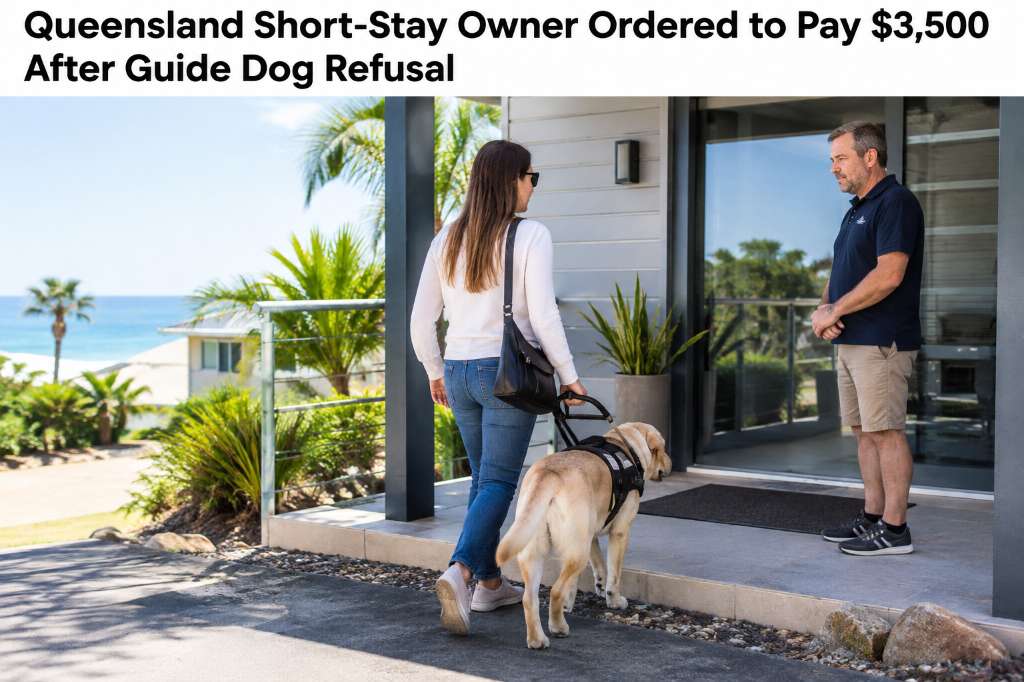
A Queensland short-stay accommodation owner has been ordered to pay $3,500 compensation after refusing accommodation to a legally blind woman because she was travelling with a guide dog.
A Queensland short-stay accommodation owner has been ordered to pay $3,500 in compensation after refusing service to a legally blind woman who was travelling with her guide dog.
The case involved a woman from Moreton Bay who had booked short-stay accommodation at Agnes Water. The accommodation owner refused to allow her to stay after discovering that she was accompanied by a guide dog.
The incident occurred in December 2024, when the woman arrived at the accommodation property. She had been wearing smart glasses that recorded the interaction, and the footage was later presented during proceedings.
During the confrontation, the accommodation owner referred to a no-pets policy and told the woman that she would need to pay an additional $100 cleaning fee if she wanted to stay. The dispute eventually became the subject of legal proceedings.
Under Queensland law, people who use legally recognised guide, hearing or assistance dogs have protections when accessing services and accommodation. Businesses cannot simply refuse service because a person is accompanied by a guide or assistance dog, and additional cleaning charges cannot be imposed solely because of the assistance dog.
The Queensland Civil and Administrative Tribunal ordered the accommodation owner to pay $3,500 to the woman after finding that the conduct breached anti-discrimination protections.
The accommodation owner acknowledged that he had made a mistake and said he would comply with the tribunal's order. He was given a deadline in late September to make the payment.
The case followed separate criminal proceedings relating to the same incident. A Magistrates Court had previously imposed a $2,800 fine for a breach of Queensland's Guide, Hearing and Assistance Dogs Act.
The woman said she had experienced difficulties accessing restaurants, hotels, airports and other venues while travelling with her guide dog. She explained that she had decided to document the interaction because she wanted greater awareness of the legal rights of people who rely on assistance animals.
The case has highlighted the difference between ordinary pets and legally recognised assistance animals. While businesses may have policies concerning pets, those policies do not automatically apply in the same way to guide and assistance dogs protected under Queensland law.
The decision also highlights the responsibilities of accommodation providers when accepting bookings from people who use assistance animals. Businesses need to understand their legal obligations before refusing accommodation or adding additional fees.
The compensation order is the latest development in a dispute that began in 2024, but the tribunal decision was reported on 21 September 2026.
The case has also drawn attention to the difficulties some people with disabilities can face when accessing everyday services. Legal protections are intended to ensure that people who rely on assistance animals can access accommodation and other services without being treated differently because of their disability or assistance animal.
AccommodationAssistanceGuideOwnerQueensland
A Queensland short-stay accommodation owner has been ordered to pay $3,500 in compensation after refusing service to a legally blind woman who was travelling with her guide dog.
The case involved a woman from Moreton Bay who had booked short-stay accommodation at Agnes Water. The accommodation owner refused to allow her to stay after discovering that she was accompanied by a guide dog.
The incident occurred in December 2024, when the woman arrived at the accommodation property. She had been wearing smart glasses that recorded the interaction, and the footage was later presented during proceedings.
During the confrontation, the accommodation owner referred to a no-pets policy and told the woman that she would need to pay an additional $100 cleaning fee if she wanted to stay. The dispute eventually became the subject of legal proceedings.
Under Queensland law, people who use legally recognised guide, hearing or assistance dogs have protections when accessing services and accommodation. Businesses cannot simply refuse service because a person is accompanied by a guide or assistance dog, and additional cleaning charges cannot be imposed solely because of the assistance dog.
The Queensland Civil and Administrative Tribunal ordered the accommodation owner to pay $3,500 to the woman after finding that the conduct breached anti-discrimination protections.
The accommodation owner acknowledged that he had made a mistake and said he would comply with the tribunal's order. He was given a deadline in late September to make the payment.
The case followed separate criminal proceedings relating to the same incident. A Magistrates Court had previously imposed a $2,800 fine for a breach of Queensland's Guide, Hearing and Assistance Dogs Act.
The woman said she had experienced difficulties accessing restaurants, hotels, airports and other venues while travelling with her guide dog. She explained that she had decided to document the interaction because she wanted greater awareness of the legal rights of people who rely on assistance animals.
The case has highlighted the difference between ordinary pets and legally recognised assistance animals. While businesses may have policies concerning pets, those policies do not automatically apply in the same way to guide and assistance dogs protected under Queensland law.
The decision also highlights the responsibilities of accommodation providers when accepting bookings from people who use assistance animals. Businesses need to understand their legal obligations before refusing accommodation or adding additional fees.
The compensation order is the latest development in a dispute that began in 2024, but the tribunal decision was reported on 21 September 2026.
The case has also drawn attention to the difficulties some people with disabilities can face when accessing everyday services. Legal protections are intended to ensure that people who rely on assistance animals can access accommodation and other services without being treated differently because of their disability or assistance animal.
Tasmania is facing pressure on mental health services in the state's north-west after a fire damaged the Spencer Clinic at North West Regional Hospital...
Two separate crashes occurred minutes apart on the Warrego Highway near Boonarga, close to Chinchilla, with emergency crews responding to multiple peopl...
A man has died and another man has been seriously injured after both were found on a Maffra street late Sunday night, with homicide detectives investiga...
A coronial inquest in Cairns has heard evidence from witnesses who questioned the theory that missing Mossman mother Joanne Butterfield took her own lif...
A Gippsland mother has been charged after allegedly placing a recording device in her non-verbal seven-year-old son's clothing following concerns about...
Bathurst New South Wales · Business News · 21 Sep 2026
Bathurst-based Bell Conveyancing has received three honours at the 2026 Carillon Business Awards, marking a significant recognition for the local business and its work in the re...
A 95-year-old man has died after a vehicle collided with his mobility scooter at an intersection in Bruce earlier this month, with investigators now exa...