Technology Failure Forces Hundreds of University of Melbourne Students to Abandon Final Exams
By Chloe · Published 16 Nov 2026 · Updated 16 Nov 2026
Melbourne, VIC · Victoria News
Safety note: Admin approval is an initial review, not a guarantee that every detail is correct. Check important or urgent claims with official sources and report anything inaccurate or unsafe.
Source and credit: Contributor's own report
Technology Failure Forces Hundreds of University of Melbourne Students to Abandon Final Exams - Melbourne, VIC
Smart summary
A digital examination platform failure disrupted final assessments in Melbourne, leaving hundreds of students unable to access their exams and forcing university staff to cancel several tests.
Hundreds of students at the University of Melbourne were forced to abandon their final examinations on Monday after a technical failure prevented many of them from accessing the university's digital examination platform.
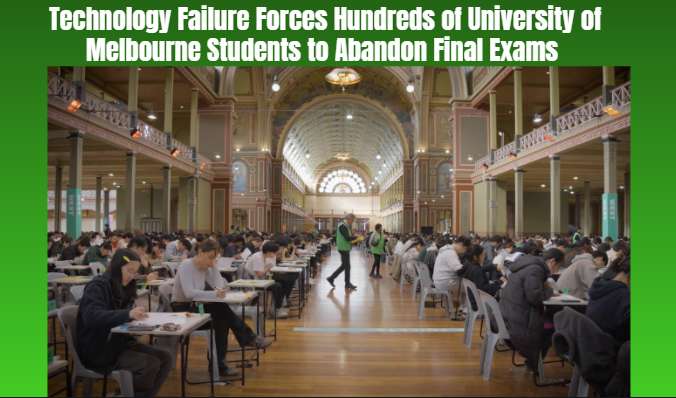
The disruption occurred during morning examinations at the Royal Exhibition Building in Carlton, where students had gathered to complete their scheduled assessments. Many students arrived expecting to sit their final examinations but instead encountered problems when attempting to log into the digital system.
The technical failure affected several examination sessions, leaving students uncertain about whether they would be able to complete their assessments.
According to students who attended the examinations, approximately half of those sitting one Australian politics examination were able to access the platform and begin writing. Others were left facing blank screens while waiting for the system to become available.
The examination was designed to require students to complete two essays of approximately 1,000 words each within a two-hour period. However, students who could not access the system were unable to begin their work.
After approximately 50 minutes of waiting, examination coordinators informed students that the technical problems could not be resolved and instructed them to leave the examination venue.
The incident caused frustration among students who had spent weeks preparing for their final assessments. Many had organised their study schedules, travel arrangements and personal commitments around the examination timetable.
A University of Melbourne spokesperson confirmed that technical problems had resulted in the cancellation of a small number of examinations on November 11 and November 16.
The university said early indications suggested that the issue was connected to third-party technical partners involved in delivering digital examinations.
University teams were working through established contingency procedures to investigate the problem and communicate alternative arrangements to affected students.
The institution also acknowledged that examination disruptions could create considerable stress, particularly during an already demanding assessment period. Support services were made available to students who needed assistance.
However, the announcement left some students uncertain about when replacement examinations would take place. With thousands of other students scheduled to complete their assessments during the same week, finding suitable alternative examination times presented an additional challenge.
Some students also raised concerns about travel arrangements during the upcoming holiday period. Delayed examinations could affect planned trips and create additional expenses for students who had already booked transportation.
The incident has highlighted the growing dependence of Australian universities on digital examination platforms. Online assessment systems offer convenience and can simplify marking and administration, but technical failures can disrupt large numbers of students when reliable backup arrangements are unavailable.
Universities increasingly use third-party technology providers to manage examinations, student accounts and assessment systems. These arrangements make technical reliability and effective contingency planning essential.
The University of Melbourne is now working to establish alternative arrangements for affected students while investigating the cause of the disruption.
Students are awaiting further communication about replacement examination dates and whether revised assessment arrangements will be necessary.
The incident has renewed discussion about the importance of reliable digital infrastructure in higher education and the need to ensure students are not disadvantaged by technology failures beyond their control.
A major Microsoft service disruption affected millions of users worldwide, interrupting email, workplace communication, healthcare administration and bu...
A new national online threat centre has opened to help identify dangerous extremist content, tackle online radicalisation and strengthen Australia's res...
New battery-powered trailer technology is attracting attention in Australia's transport industry, with the potential to reduce fuel consumption, operati...
Western Berry is investing in artificial intelligence, autonomous machinery and mechanical harvesting to reduce farming costs and address seasonal worke...
Police are investigating a daylight theft after three valuable trophies belonging to Australia's legendary racehorse were taken from an exhibition displ...
A front-seat passenger died at the scene after a vehicle left the road and struck a tree in western Victoria, while the driver suffered life-threatening...
Independent federal MP Helen Haines has begun rehabilitation after being discharged from a Melbourne hospital, weeks after a vehicle attack outside her...
Independent federal MP Helen Haines has begun rehabilitation after being discharged from a Melbourne hospital, weeks after a vehicle attack outside her...
NSW patient survey findings highlight safety concerns in several major hospitals, as the state government commits additional security staff to emergency...
Police are investigating a daylight theft after three valuable trophies belonging to Australia's legendary racehorse were taken from an exhibition displ...
Operation Amarok 15 resulted in 1,594 charges, hundreds of apprehended domestic violence order breaches identified and dozens of firearms seized across...