Western Australian Blueberry Farm Turns to AI and Driverless Tractors to Expand Production
By Chloe · Published 14 Nov 2026 · Updated 14 Nov 2026
Ginigin, WA
Safety note: Admin approval is an initial review, not a guarantee that every detail is correct. Check important or urgent claims with official sources and report anything inaccurate or unsafe.
Source and credit: Contributor's own report
Western Australian Blueberry Farm Turns to AI and Driverless Tractors to Expand Production - Ginigin, WA
Smart summary
Western Berry is investing in artificial intelligence, autonomous machinery and mechanical harvesting to reduce farming costs and address seasonal worker shortages while planning to triple blueberry production.
One of Western Australia's largest blueberry producers is embracing artificial intelligence and autonomous farming technology as it prepares for a major expansion in production. The family-owned business, Western Berry, is introducing advanced machinery and automated systems to improve productivity, reduce operating costs and address the increasing difficulty of finding seasonal agricultural workers.
The farm is located approximately 100 kilometres north of Perth and covers around 120 hectares. It currently produces just under 1,500 tonnes of blueberries annually, supplying supermarkets across Australia and international markets in Asia.
The Kwiecien-Fisher family, which operates the business, hopes to triple production over the coming years. However, increasing production also means managing higher harvesting requirements, labour expenses and transportation demands.
To address these challenges, the company is investing in driverless tractors, mechanical harvesting equipment and artificial intelligence systems.
Operations manager Marek Kwiecien-Fisher said the business was testing autonomous technology across different parts of its operations. Driverless tractors are already being used for spraying blueberry plants, controlling weeds and transporting harvested fruit from fields to the packing facility.
The machinery uses GPS mapping, cameras and sensors to navigate designated routes. Some equipment can also be monitored and operated remotely, reducing the amount of manual work required for routine agricultural tasks.
Technology is also being introduced into the packing process. Photographic systems examine blueberries multiple times before they are sorted, graded and placed into consumer packaging. Automated systems help improve consistency and support the handling of large quantities of fruit.
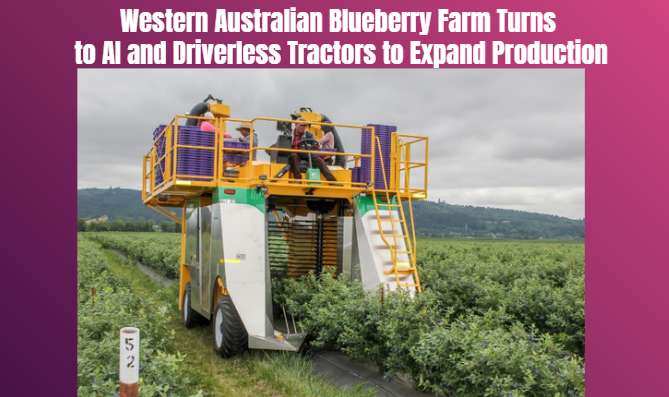
One of the farm's major investments is mechanical harvesting. The business currently operates two harvesting machines, including a newer battery-powered and solar-powered model that can collect fruit and stack trays with limited manual assistance.
According to the company, a harvesting machine can collect up to six tonnes of blueberries daily. The estimated harvesting cost is approximately 50 cents per kilogram, compared with around six dollars per kilogram for traditional hand picking.
The company is also exploring additional artificial intelligence applications. Future plans include AI-assisted pruning, automated mowing, flower counting and crop-health monitoring.
These technologies could help farmers identify irrigation problems, monitor plant development and estimate future harvest volumes. More accurate production forecasting could also improve supply planning and reduce unnecessary costs.
Despite the increasing use of machinery, Western Berry does not expect technology to eliminate the need for agricultural workers.
The business employs more than 200 people during harvesting operations, making it an important employer in the surrounding region. The family expects its workforce requirements to continue growing as production expands.
The development also highlights new employment opportunities in agricultural technology, including machinery operation, artificial intelligence, computer science and automated equipment maintenance.
Western Berry began as a family farming operation almost three decades ago. Derek Fisher and his wife Barbara initially established the property before their sons became involved in managing its operations, supply chain and expansion.
The company's latest investment demonstrates how traditional Australian agriculture is adapting to changing labour conditions and growing international demand.
The business now aims to combine experienced workers with advanced machinery to increase production while maintaining the quality of Australian blueberries.
HarvestingProductionAlsoBusinessMachinery
One of Western Australia's largest blueberry producers is embracing artificial intelligence and autonomous farming technology as it prepares for a major expansion in production. The family-owned business, Western Berry, is introducing advanced machinery and automated systems to improve productivity, reduce operating costs and address the increasing difficulty of finding seasonal agricultural workers.
The farm is located approximately 100 kilometres north of Perth and covers around 120 hectares. It currently produces just under 1,500 tonnes of blueberries annually, supplying supermarkets across Australia and international markets in Asia.
The Kwiecien-Fisher family, which operates the business, hopes to triple production over the coming years. However, increasing production also means managing higher harvesting requirements, labour expenses and transportation demands.
To address these challenges, the company is investing in driverless tractors, mechanical harvesting equipment and artificial intelligence systems.
Operations manager Marek Kwiecien-Fisher said the business was testing autonomous technology across different parts of its operations. Driverless tractors are already being used for spraying blueberry plants, controlling weeds and transporting harvested fruit from fields to the packing facility.
The machinery uses GPS mapping, cameras and sensors to navigate designated routes. Some equipment can also be monitored and operated remotely, reducing the amount of manual work required for routine agricultural tasks.
Technology is also being introduced into the packing process. Photographic systems examine blueberries multiple times before they are sorted, graded and placed into consumer packaging. Automated systems help improve consistency and support the handling of large quantities of fruit.
One of the farm's major investments is mechanical harvesting. The business currently operates two harvesting machines, including a newer battery-powered and solar-powered model that can collect fruit and stack trays with limited manual assistance.
According to the company, a harvesting machine can collect up to six tonnes of blueberries daily. The estimated harvesting cost is approximately 50 cents per kilogram, compared with around six dollars per kilogram for traditional hand picking.
The company is also exploring additional artificial intelligence applications. Future plans include AI-assisted pruning, automated mowing, flower counting and crop-health monitoring.
These technologies could help farmers identify irrigation problems, monitor plant development and estimate future harvest volumes. More accurate production forecasting could also improve supply planning and reduce unnecessary costs.
Despite the increasing use of machinery, Western Berry does not expect technology to eliminate the need for agricultural workers.
The business employs more than 200 people during harvesting operations, making it an important employer in the surrounding region. The family expects its workforce requirements to continue growing as production expands.
The development also highlights new employment opportunities in agricultural technology, including machinery operation, artificial intelligence, computer science and automated equipment maintenance.
Western Berry began as a family farming operation almost three decades ago. Derek Fisher and his wife Barbara initially established the property before their sons became involved in managing its operations, supply chain and expansion.
The company's latest investment demonstrates how traditional Australian agriculture is adapting to changing labour conditions and growing international demand.
The business now aims to combine experienced workers with advanced machinery to increase production while maintaining the quality of Australian blueberries.
A digital examination platform failure disrupted final assessments in Melbourne, leaving hundreds of students unable to access their exams and forcing u...
A major Microsoft service disruption affected millions of users worldwide, interrupting email, workplace communication, healthcare administration and bu...
A new national online threat centre has opened to help identify dangerous extremist content, tackle online radicalisation and strengthen Australia's res...
New battery-powered trailer technology is attracting attention in Australia's transport industry, with the potential to reduce fuel consumption, operati...
Operation Amarok 15 resulted in 1,594 charges, hundreds of apprehended domestic violence order breaches identified and dozens of firearms seized across...
Australia fell three points short at Murrayfield after a late comeback attempt, with Scotland holding on to secure an important home victory in the inte...
A private conversation between the two leaders was accidentally recorded during a break at the international climate summit in Türkiye, prompting widesp...
Australia delivers a dominant performance against Asian Cup champions Qatar in Doha, with Riley McGree, Tete Yengi and Nestory Irankunda scoring three f...
NSW patient survey findings highlight safety concerns in several major hospitals, as the state government commits additional security staff to emergency...
Police are investigating a daylight theft after three valuable trophies belonging to Australia's legendary racehorse were taken from an exhibition displ...
Operation Amarok 15 resulted in 1,594 charges, hundreds of apprehended domestic violence order breaches identified and dozens of firearms seized across...