Battery-Powered Trailers Could Cut Diesel Costs for Australian Truck Operators
By Chloe · Published 14 Nov 2026 · Updated 14 Nov 2026
Sydney, NSW · New South Wales News
Safety note: Admin approval is an initial review, not a guarantee that every detail is correct. Check important or urgent claims with official sources and report anything inaccurate or unsafe.
Source and credit: Contributor's own report
Battery-Powered Trailers Could Cut Diesel Costs for Australian Truck Operators - Sydney, NSW
Smart summary
New battery-powered trailer technology is attracting attention in Australia's transport industry, with the potential to reduce fuel consumption, operating expenses and emissions for heavy freight operators.
Australian transport operators are exploring new battery-powered trailer technology that could help reduce diesel consumption and operating costs across the country's heavy freight industry.
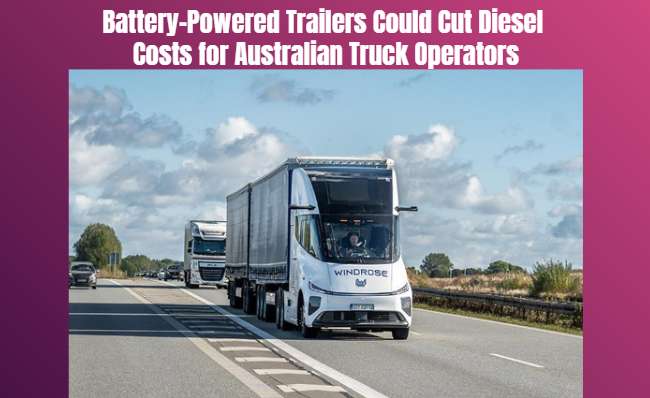
The technology uses an additional electric power system installed within a truck trailer. Instead of relying entirely on the diesel engine to move heavy loads, the battery-powered system can provide supplementary assistance during transportation.
The development is attracting interest because Australia's freight industry depends heavily on diesel-powered vehicles. Heavy trucks transport food, construction materials, agricultural products, manufactured goods and other essential supplies across long distances.
Fuel represents a major operating expense for transport businesses. Changes in diesel prices can affect delivery costs, business profitability and the prices paid by customers.
Battery-powered trailers offer another approach to improving fuel efficiency without requiring transport companies to immediately replace their entire fleet with electric trucks.
The technology is designed to provide additional power during driving, helping reduce the workload placed on the truck's diesel engine. Depending on the system and operating conditions, this could improve overall energy efficiency.
One potential advantage is that businesses may be able to adopt the technology using existing compatible trucks. This could make it easier for transport operators to explore lower-emission solutions without undertaking the substantial investment required to purchase entirely new heavy vehicles.
Battery systems could also help reduce emissions associated with conventional freight operations. However, the actual environmental benefits would depend on battery production, charging arrangements, vehicle weight and the electricity source used.
Australia presents a particularly interesting market for this technology because freight vehicles frequently travel long distances between cities, regional centres and industrial locations.
Long-distance transport operators need solutions that can operate reliably across different road conditions and changing weather conditions. Battery capacity, charging infrastructure and maintenance requirements will therefore be important factors when considering wider adoption.
The technology could also create opportunities for Australian companies involved in battery manufacturing, vehicle engineering and transport innovation.
Although battery-powered trailers are not a complete replacement for conventional diesel engines, they represent another possible step towards improving efficiency in the heavy transport sector.
Transport businesses will need to assess purchase costs, expected fuel savings, maintenance requirements and the availability of suitable charging infrastructure before introducing the technology across their fleets.
The development comes as Australian industries continue exploring ways to reduce operating expenses while responding to growing expectations around environmental sustainability.
If the technology proves commercially effective, it could provide freight operators with another option for reducing diesel consumption while continuing to use existing transport vehicles.
TransportTechnologyCouldDieselBattery-Powered
Australian transport operators are exploring new battery-powered trailer technology that could help reduce diesel consumption and operating costs across the country's heavy freight industry.
The technology uses an additional electric power system installed within a truck trailer. Instead of relying entirely on the diesel engine to move heavy loads, the battery-powered system can provide supplementary assistance during transportation.
The development is attracting interest because Australia's freight industry depends heavily on diesel-powered vehicles. Heavy trucks transport food, construction materials, agricultural products, manufactured goods and other essential supplies across long distances.
Fuel represents a major operating expense for transport businesses. Changes in diesel prices can affect delivery costs, business profitability and the prices paid by customers.
Battery-powered trailers offer another approach to improving fuel efficiency without requiring transport companies to immediately replace their entire fleet with electric trucks.
The technology is designed to provide additional power during driving, helping reduce the workload placed on the truck's diesel engine. Depending on the system and operating conditions, this could improve overall energy efficiency.
One potential advantage is that businesses may be able to adopt the technology using existing compatible trucks. This could make it easier for transport operators to explore lower-emission solutions without undertaking the substantial investment required to purchase entirely new heavy vehicles.
Battery systems could also help reduce emissions associated with conventional freight operations. However, the actual environmental benefits would depend on battery production, charging arrangements, vehicle weight and the electricity source used.
Australia presents a particularly interesting market for this technology because freight vehicles frequently travel long distances between cities, regional centres and industrial locations.
Long-distance transport operators need solutions that can operate reliably across different road conditions and changing weather conditions. Battery capacity, charging infrastructure and maintenance requirements will therefore be important factors when considering wider adoption.
The technology could also create opportunities for Australian companies involved in battery manufacturing, vehicle engineering and transport innovation.
Although battery-powered trailers are not a complete replacement for conventional diesel engines, they represent another possible step towards improving efficiency in the heavy transport sector.
Transport businesses will need to assess purchase costs, expected fuel savings, maintenance requirements and the availability of suitable charging infrastructure before introducing the technology across their fleets.
The development comes as Australian industries continue exploring ways to reduce operating expenses while responding to growing expectations around environmental sustainability.
If the technology proves commercially effective, it could provide freight operators with another option for reducing diesel consumption while continuing to use existing transport vehicles.
A digital examination platform failure disrupted final assessments in Melbourne, leaving hundreds of students unable to access their exams and forcing u...
A major Microsoft service disruption affected millions of users worldwide, interrupting email, workplace communication, healthcare administration and bu...
A new national online threat centre has opened to help identify dangerous extremist content, tackle online radicalisation and strengthen Australia's res...
Western Berry is investing in artificial intelligence, autonomous machinery and mechanical harvesting to reduce farming costs and address seasonal worke...
NSW patient survey findings highlight safety concerns in several major hospitals, as the state government commits additional security staff to emergency...
New government figures show a decline in the country's illicit tobacco market following record seizures and increased enforcement by Australian Border F...
A major Microsoft service disruption affected millions of users worldwide, interrupting email, workplace communication, healthcare administration and bu...
NSW patient survey findings highlight safety concerns in several major hospitals, as the state government commits additional security staff to emergency...
Police are investigating a daylight theft after three valuable trophies belonging to Australia's legendary racehorse were taken from an exhibition displ...
Operation Amarok 15 resulted in 1,594 charges, hundreds of apprehended domestic violence order breaches identified and dozens of firearms seized across...