Safety note: Admin approval is an initial review, not a guarantee that every detail is correct. Check important or urgent claims with official sources and report anything inaccurate or unsafe.
Source and credit: Contributor's own report
WA Launches New Plan to Eliminate Rheumatic Heart Disease by 2036 - Perth, WA
Smart summary
Western Australia has released a 10-year strategic framework aimed at eliminating new cases of rheumatic heart disease across the state by 2036.
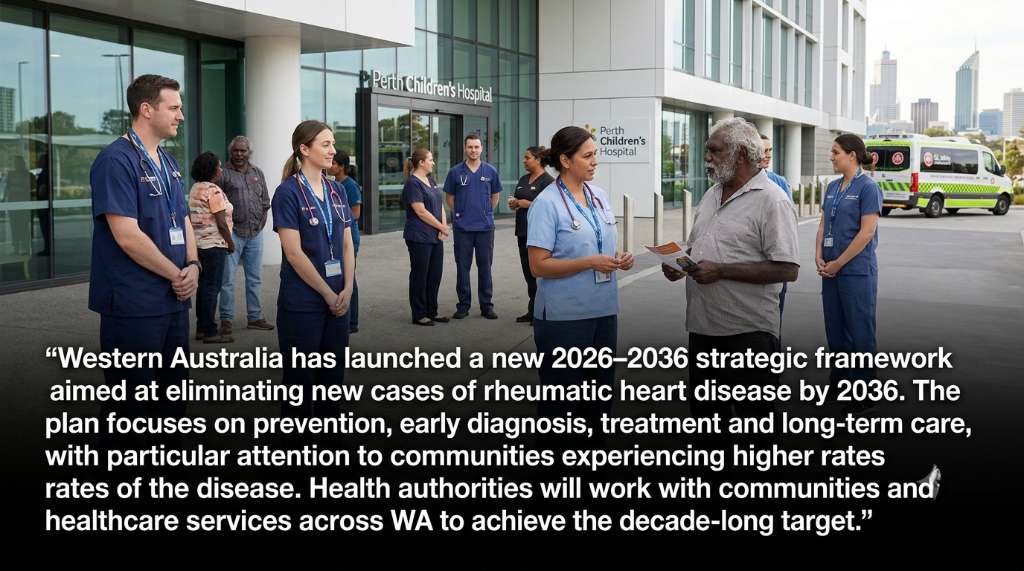
The Western Australian Government has launched a new Rheumatic Heart Disease Strategic Framework 2026–2036, outlining a long-term plan to eliminate new cases of rheumatic heart disease in the state by 2036.
The framework brings together health services, prevention programs, community organisations and government agencies in an effort to address one of Australia's preventable chronic health conditions. Rheumatic heart disease can develop following repeated episodes of acute rheumatic fever, which itself can occur after certain bacterial infections.
The new strategy is intended to strengthen prevention, early diagnosis, treatment and ongoing care across Western Australia. A major focus is reducing the factors that contribute to rheumatic fever and ensuring people who develop the condition receive appropriate medical support.
The announcement is particularly significant for Western Australia because rheumatic heart disease disproportionately affects some Aboriginal and Torres Strait Islander communities. Improving prevention and access to healthcare is therefore an important part of the state's broader health strategy.
The framework covers the period from 2026 to 2036, giving authorities a decade-long timeframe to work toward the elimination target. Rather than relying on one intervention, the strategy takes a coordinated approach involving prevention, clinical care, monitoring and community engagement.
Early identification can be important because repeated episodes of acute rheumatic fever can cause permanent damage to heart valves. Providing appropriate treatment and follow-up can help reduce the risk of serious complications.
The new framework also recognises that health outcomes can be influenced by factors outside hospitals and clinics. Access to healthcare, housing conditions, education, transport and other social factors can all affect a person's ability to receive timely treatment and maintain long-term health.
For Perth and the wider Western Australian community, the strategy represents a significant statewide public-health initiative. Perth is home to major hospitals and specialist medical services that support patients from metropolitan and regional areas.
However, achieving the 2036 target will require work well beyond Perth. Regional and remote communities will also need access to appropriate diagnosis, treatment and prevention programs.
The framework provides a long-term direction for health authorities and community organisations, with the ultimate goal of preventing new cases rather than simply treating complications after they develop.
The government says the strategy will support a coordinated approach across Western Australia and build on existing programs addressing rheumatic fever and rheumatic heart disease.
For the Perth community, the announcement highlights a broader effort to improve prevention and reduce the long-term impact of a condition that can cause serious heart damage.
The next decade will be important for measuring progress against the state's 2036 target. Success will depend on effective prevention, early treatment, consistent follow-up and continued collaboration between health professionals, communities and government agencies.
RheumaticHeartHealthPreventionDisease
The Western Australian Government has launched a new Rheumatic Heart Disease Strategic Framework 2026–2036, outlining a long-term plan to eliminate new cases of rheumatic heart disease in the state by 2036.
The framework brings together health services, prevention programs, community organisations and government agencies in an effort to address one of Australia's preventable chronic health conditions. Rheumatic heart disease can develop following repeated episodes of acute rheumatic fever, which itself can occur after certain bacterial infections.
The new strategy is intended to strengthen prevention, early diagnosis, treatment and ongoing care across Western Australia. A major focus is reducing the factors that contribute to rheumatic fever and ensuring people who develop the condition receive appropriate medical support.
The announcement is particularly significant for Western Australia because rheumatic heart disease disproportionately affects some Aboriginal and Torres Strait Islander communities. Improving prevention and access to healthcare is therefore an important part of the state's broader health strategy.
The framework covers the period from 2026 to 2036, giving authorities a decade-long timeframe to work toward the elimination target. Rather than relying on one intervention, the strategy takes a coordinated approach involving prevention, clinical care, monitoring and community engagement.
Early identification can be important because repeated episodes of acute rheumatic fever can cause permanent damage to heart valves. Providing appropriate treatment and follow-up can help reduce the risk of serious complications.
The new framework also recognises that health outcomes can be influenced by factors outside hospitals and clinics. Access to healthcare, housing conditions, education, transport and other social factors can all affect a person's ability to receive timely treatment and maintain long-term health.
For Perth and the wider Western Australian community, the strategy represents a significant statewide public-health initiative. Perth is home to major hospitals and specialist medical services that support patients from metropolitan and regional areas.
However, achieving the 2036 target will require work well beyond Perth. Regional and remote communities will also need access to appropriate diagnosis, treatment and prevention programs.
The framework provides a long-term direction for health authorities and community organisations, with the ultimate goal of preventing new cases rather than simply treating complications after they develop.
The government says the strategy will support a coordinated approach across Western Australia and build on existing programs addressing rheumatic fever and rheumatic heart disease.
For the Perth community, the announcement highlights a broader effort to improve prevention and reduce the long-term impact of a condition that can cause serious heart damage.
The next decade will be important for measuring progress against the state's 2036 target. Success will depend on effective prevention, early treatment, consistent follow-up and continued collaboration between health professionals, communities and government agencies.
Ambulance crews in Bairnsdale have reportedly spent several hours waiting to transfer patients into hospital care, prompting concerns from the Victorian...
Central Coast New South Wales · Health News · 30 Sep 2026
Central Coast communities are set to receive more than $1.8 million in funding for health facility upgrades, with the money allocated to the Central Coast Local Health District...
A South Australian soccer player with two broken bones in his lower leg travelled about 70 kilometres by private car after waiting at a regional hospita...
A 59-year-old rubbish-truck driver has been charged with dangerous driving causing death after a 70-year-old man was fatally struck in Queens Park earli...
Police have arrested five people after a man was taken to hospital with a gunshot wound following a serious incident at Moonyoonooka, east of Geraldton,...
A 36-year-old man extradited from Perth has received a suspended prison sentence after being convicted over a violent incident involving four people at...
Darwin's Frontier Bar and Grill manager Aston Bell has received two industry awards, recognising her leadership, customer service and contribution to th...
A teenager from Devonport has died and four other people were injured after a serious crash involving a ute on Mersey Main Road near Latrobe, Tasmania.