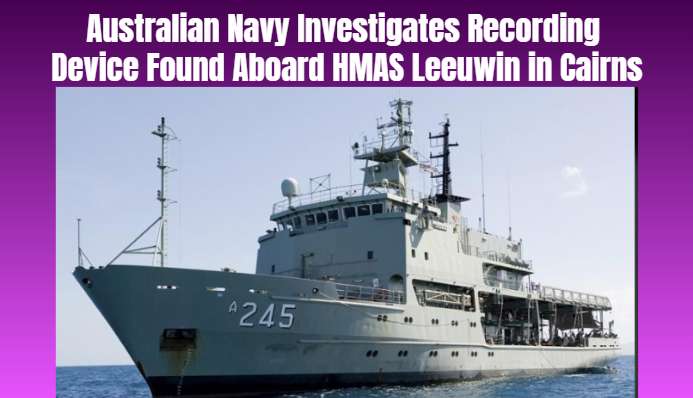
Australian Navy Investigates Recording Device Found Aboard HMAS Leeuwin in Cairns
By Chloe · Published 19 Oct 2026 · Updated 19 Oct 2026
Cairns, QLD · Queensland News
Safety note: Admin approval is an initial review, not a guarantee that every detail is correct. Check important or urgent claims with official sources and report anything inaccurate or unsafe.
Source and credit: Contributor's own report
Australian Navy Investigates Recording Device Found Aboard HMAS Leeuwin in Cairns - Cairns, QLD
Smart summary
An Australian Defence Force member has been identified as a person of interest after a recording device was discovered aboard a Navy vessel docked in Cairns. The investigation is continuing.
The Australian Defence Force is investigating the discovery of a recording device aboard the Royal Australian Navy vessel HMAS Leeuwin while the ship was docked in Cairns, Queensland. The discovery has prompted an internal investigation into the circumstances surrounding the device and whether any unauthorised recording or disclosure of information occurred.
According to ABC News reporting published on 19 October 2026, the device was discovered on 11 October while HMAS Leeuwin was docked in Cairns. An Australian Defence Force member has been identified as a person of interest in the investigation and has been stood down without pay, according to the report.
The Navy has not publicly disclosed all the details surrounding the discovery. Investigators are examining the circumstances in which the recording device was found, its intended purpose and whether any rules or security requirements may have been breached.
Chief of Navy Vice Admiral Matthew Buckley addressed the incident during a media briefing. He said there was no evidence at that stage that any recorded material had been shared online. He also stressed the importance of allowing the investigation to proceed without compromising the process or any potential findings.
The distinction between discovering a recording device and establishing that information was improperly recorded or distributed is important. At this stage, the publicly reported information does not establish that sensitive material was captured, accessed by unauthorised people or published online.
HMAS Leeuwin is associated with the Royal Australian Navy's hydrographic survey capability. Naval vessels operate under security procedures designed to protect personnel, equipment, operational information and sensitive activities. Any suspected breach involving recording equipment can therefore require careful examination to determine whether it poses a security concern.
Investigators may need to establish how the device came to be aboard the vessel, whether it was authorised, and whether its use was consistent with relevant Navy rules. The outcome will depend on the evidence gathered and any subsequent disciplinary or legal processes.
The incident also highlights the broader security responsibilities associated with military workplaces. Personnel must follow procedures governing electronic equipment, photography, recording and the handling of information that may relate to defence operations. Such requirements help protect both individual privacy and operational security.
Cairns is an important location for maritime activity in northern Australia, with commercial shipping, naval operations and other vessels using its port facilities. The discovery aboard HMAS Leeuwin has brought attention to the procedures used to maintain security when Navy vessels are docked and personnel are working aboard them.
The Australian Defence Force has not, in the reported update, announced a final finding or confirmed that criminal conduct occurred. The member identified as a person of interest should not be regarded as guilty of wrongdoing on the basis of the investigation alone.
Further information may become available as investigators establish the facts and determine whether any formal action is warranted. Until then, the Navy's stated position remains that the investigation is ongoing and that there is no evidence reported so far of material being shared online.
The case underlines the importance of protecting security-sensitive environments while ensuring that allegations are examined fairly and supported by evidence.
NavyDeviceRecordingInformationSecurity
The Australian Defence Force is investigating the discovery of a recording device aboard the Royal Australian Navy vessel HMAS Leeuwin while the ship was docked in Cairns, Queensland. The discovery has prompted an internal investigation into the circumstances surrounding the device and whether any unauthorised recording or disclosure of information occurred.
According to ABC News reporting published on 19 October 2026, the device was discovered on 11 October while HMAS Leeuwin was docked in Cairns. An Australian Defence Force member has been identified as a person of interest in the investigation and has been stood down without pay, according to the report.
The Navy has not publicly disclosed all the details surrounding the discovery. Investigators are examining the circumstances in which the recording device was found, its intended purpose and whether any rules or security requirements may have been breached.
Chief of Navy Vice Admiral Matthew Buckley addressed the incident during a media briefing. He said there was no evidence at that stage that any recorded material had been shared online. He also stressed the importance of allowing the investigation to proceed without compromising the process or any potential findings.
The distinction between discovering a recording device and establishing that information was improperly recorded or distributed is important. At this stage, the publicly reported information does not establish that sensitive material was captured, accessed by unauthorised people or published online.
HMAS Leeuwin is associated with the Royal Australian Navy's hydrographic survey capability. Naval vessels operate under security procedures designed to protect personnel, equipment, operational information and sensitive activities. Any suspected breach involving recording equipment can therefore require careful examination to determine whether it poses a security concern.
Investigators may need to establish how the device came to be aboard the vessel, whether it was authorised, and whether its use was consistent with relevant Navy rules. The outcome will depend on the evidence gathered and any subsequent disciplinary or legal processes.
The incident also highlights the broader security responsibilities associated with military workplaces. Personnel must follow procedures governing electronic equipment, photography, recording and the handling of information that may relate to defence operations. Such requirements help protect both individual privacy and operational security.
Cairns is an important location for maritime activity in northern Australia, with commercial shipping, naval operations and other vessels using its port facilities. The discovery aboard HMAS Leeuwin has brought attention to the procedures used to maintain security when Navy vessels are docked and personnel are working aboard them.
The Australian Defence Force has not, in the reported update, announced a final finding or confirmed that criminal conduct occurred. The member identified as a person of interest should not be regarded as guilty of wrongdoing on the basis of the investigation alone.
Further information may become available as investigators establish the facts and determine whether any formal action is warranted. Until then, the Navy's stated position remains that the investigation is ongoing and that there is no evidence reported so far of material being shared online.
The case underlines the importance of protecting security-sensitive environments while ensuring that allegations are examined fairly and supported by evidence.
A 32-year-old man has been charged with seven offences following an investigation into reports of an armed man in a stolen vehicle that was allegedly se...
Australian Federal Police allege a 32-year-old Bentleigh East man imported 71 conducted energy devices and 30 canisters of pepper spray. Investigators s...
A 57-year-old former digital forensic officer has been charged with multiple offences, including alleged possession of child abuse material, following a...
South Australia Police have released CCTV footage in an effort to identify a man suspected of stealing a gold bracelet from a jewellery store in Salisbu...
South East Queensland faces a prolonged period of heavy rainfall, with Brisbane, the Gold Coast and the Sunshine Coast warned of potentially significant...
A 53-year-old man has been charged after an alleged domestic disturbance escalated into a fire and confrontation with police on the Gold Coast. Three of...
Both dogs involved in an attack on a man in Brisbane’s northern suburbs have been captured and placed in council custody while authorities consider thei...
The celebrated novel tops ABC Radio National’s Top 100 Australian Books poll after more than 280,000 votes, reaffirming its place in the country’s liter...
Four Melbourne councils and Melbourne Water have joined forces to improve the Yarra River's water quality, with a long-term goal of making parts of the...
Small-scale flower growers and local entrepreneurs in Western Australia's Kimberley region are stepping in to meet demand after the town's main florist...
South East Queensland faces a prolonged period of heavy rainfall, with Brisbane, the Gold Coast and the Sunshine Coast warned of potentially significant...