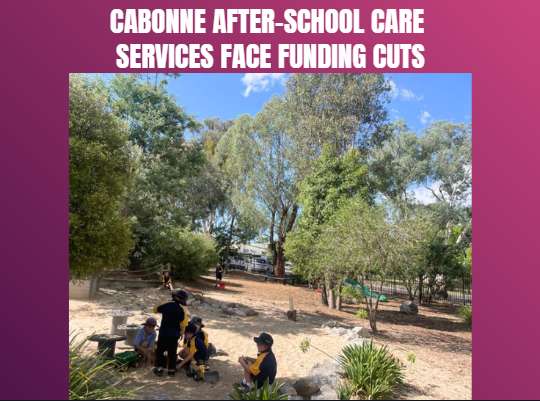
Cabonne Council-run after-school care services face funding cuts
By Chloe · Published 04 Nov 2026 · Updated 04 Nov 2026
Molong, NSW
Safety note: Admin approval is an initial review, not a guarantee that every detail is correct. Check important or urgent claims with official sources and report anything inaccurate or unsafe.
Source and credit: Contributor's own report
Cabonne Council-run after-school care services face funding cuts - Molong, NSW
Smart summary
Federal funding cuts affecting out-of-school-hours care services have prompted Cabonne councillors to call for a review, raising concerns about childcare access for regional families.
Families in the Cabonne region of New South Wales are facing uncertainty after the Federal Government's decision to cut funding for out-of-school-hours (OOSH) care services operated by Cabonne Council. The development was reported on 4 November 2026 and has prompted local councillors to call for a review of the funding decision.
Out-of-school-hours care provides supervision and activities for school-aged children before and after regular school hours. These services are particularly important for working parents, carers and families who need reliable childcare arrangements while managing their employment and other responsibilities.
Cabonne Council operates several community services across its regional area. The funding reduction has raised concerns about the future affordability and availability of after-school care for families who depend on council-operated programmes.
For parents working full-time, access to after-school care can be essential. Without suitable arrangements, some families may have difficulty balancing work commitments with school collection times. The situation could also create additional pressure for households that have limited access to alternative childcare providers.
Regional communities often face different childcare challenges from larger metropolitan areas. Families may have fewer providers to choose from, and travelling to another town for childcare can create additional costs and inconvenience.
Councillors have responded by calling for a review of the decision and examining what the funding changes could mean for local services. Maintaining access to affordable childcare is an important issue for communities that rely on local government to provide essential family support.
The funding issue also highlights the broader challenges faced by regional councils when delivering community services. Councils must manage operating expenses, staffing requirements and service demand while working within available government funding arrangements.
For Cabonne Shire, the future of after-school care will be important not only for parents but also for children who benefit from structured activities and supervised environments outside normal classroom hours.
School-age care programmes can provide opportunities for children to participate in recreational activities, interact with other students and receive support in a safe setting. They also help working families maintain stable daily routines.
The council's call for a review reflects concerns that changes to funding arrangements could place additional financial pressure on families or make it more difficult to maintain existing services.
Further discussions between the council and relevant government authorities will be important in determining whether alternative funding arrangements or other support measures can be considered.
The issue remains significant for regional families as they seek clarity about the future availability of childcare services.
FundingFamiliesServicesCareChildcare
Families in the Cabonne region of New South Wales are facing uncertainty after the Federal Government's decision to cut funding for out-of-school-hours (OOSH) care services operated by Cabonne Council. The development was reported on 4 November 2026 and has prompted local councillors to call for a review of the funding decision.
Out-of-school-hours care provides supervision and activities for school-aged children before and after regular school hours. These services are particularly important for working parents, carers and families who need reliable childcare arrangements while managing their employment and other responsibilities.
Cabonne Council operates several community services across its regional area. The funding reduction has raised concerns about the future affordability and availability of after-school care for families who depend on council-operated programmes.
For parents working full-time, access to after-school care can be essential. Without suitable arrangements, some families may have difficulty balancing work commitments with school collection times. The situation could also create additional pressure for households that have limited access to alternative childcare providers.
Regional communities often face different childcare challenges from larger metropolitan areas. Families may have fewer providers to choose from, and travelling to another town for childcare can create additional costs and inconvenience.
Councillors have responded by calling for a review of the decision and examining what the funding changes could mean for local services. Maintaining access to affordable childcare is an important issue for communities that rely on local government to provide essential family support.
The funding issue also highlights the broader challenges faced by regional councils when delivering community services. Councils must manage operating expenses, staffing requirements and service demand while working within available government funding arrangements.
For Cabonne Shire, the future of after-school care will be important not only for parents but also for children who benefit from structured activities and supervised environments outside normal classroom hours.
School-age care programmes can provide opportunities for children to participate in recreational activities, interact with other students and receive support in a safe setting. They also help working families maintain stable daily routines.
The council's call for a review reflects concerns that changes to funding arrangements could place additional financial pressure on families or make it more difficult to maintain existing services.
Further discussions between the council and relevant government authorities will be important in determining whether alternative funding arrangements or other support measures can be considered.
The issue remains significant for regional families as they seek clarity about the future availability of childcare services.
A kindness campaign founder, a long-serving community volunteer, a young hip-hop artist and a wildlife conservationist have been recognised for their co...
Australians across the country pause for a minute of silence to remember military personnel who lost their lives in wars and conflicts, as newly identif...
Residents of Hermannsburg in the Northern Territory can once again access free-to-air television, restoring an important source of news, entertainment a...
Australia fell three points short at Murrayfield after a late comeback attempt, with Scotland holding on to secure an important home victory in the inte...
A private conversation between the two leaders was accidentally recorded during a break at the international climate summit in Türkiye, prompting widesp...
Australia delivers a dominant performance against Asian Cup champions Qatar in Doha, with Riley McGree, Tete Yengi and Nestory Irankunda scoring three f...
Far North Queensland continues to experience extreme temperatures, with Weipa recording its hottest November day and communities facing water shortages...
A digital examination platform failure disrupted final assessments in Melbourne, leaving hundreds of students unable to access their exams and forcing u...
Australia fell three points short at Murrayfield after a late comeback attempt, with Scotland holding on to secure an important home victory in the inte...
Prime Minister Anthony Albanese is meeting Philippine President Ferdinand Marcos Jr in Manila following a new defence cooperation agreement focused on m...
New government figures show a decline in the country's illicit tobacco market following record seizures and increased enforcement by Australian Border F...