Safety note: Admin approval is an initial review, not a guarantee that every detail is correct. Check important or urgent claims with official sources and report anything inaccurate or unsafe.
Source and credit: Contributor's own report
Food Delivery Workers Gain New Minimum Standards - Brisbane, QLD
Smart summary
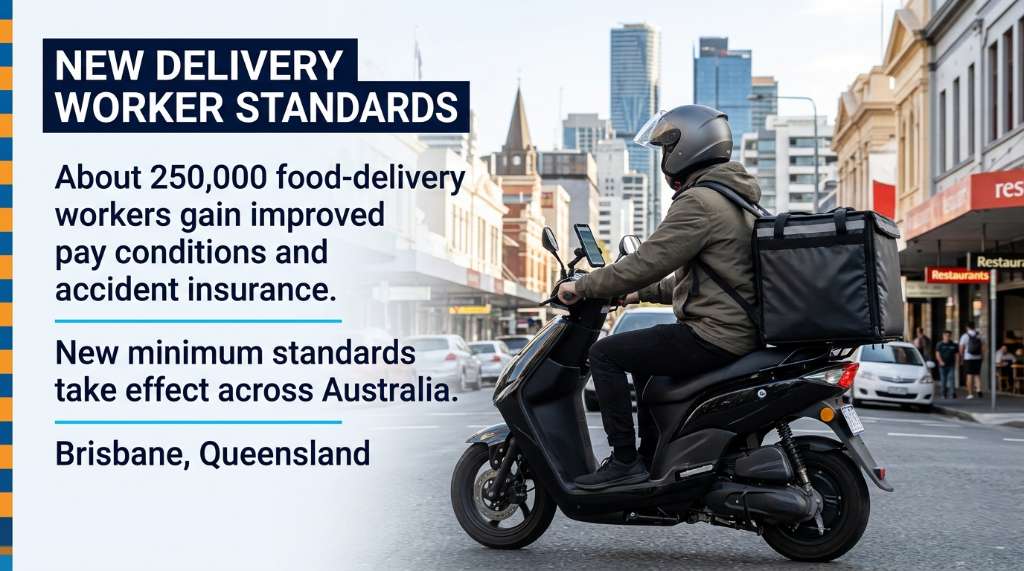
New minimum standards for food-delivery workers come into effect across Australia, providing about 250,000 workers with improved pay conditions and personal accident insurance.
New minimum standards for food-delivery workers have come into effect across Australia, introducing stronger protections for people working through app-based delivery platforms. The changes are particularly relevant to Brisbane, where thousands of people participate in the growing gig-economy workforce and where food-delivery services have become an important part of the city's hospitality and transport network.
The new standards are designed to provide delivery workers with improved employment conditions and greater protection while they are working. According to the report, about 250,000 food-delivery workers are expected to benefit from the changes, which include improved pay conditions and personal accident insurance.
Food-delivery work has become increasingly common in Australian cities. Workers use digital platforms to receive orders from restaurants and deliver meals to customers using cars, motorcycles, scooters and bicycles. While the system provides flexibility, workers have historically faced concerns about income security, workplace safety and access to protections that are available in more traditional forms of employment.
The introduction of minimum standards represents an effort to address some of these concerns. By establishing clearer requirements for pay and insurance, the changes are intended to provide workers with greater certainty when they undertake delivery work.
For Brisbane's food-delivery workforce, the changes could have a significant practical impact. Brisbane has a large hospitality sector, with restaurants, cafes and takeaway businesses relying heavily on delivery platforms to reach customers. Delivery workers provide the connection between these businesses and households across the metropolitan area.
The new standards are also relevant to workers who rely on delivery work as a primary source of income as well as those who use it as a flexible way to earn additional money. The flexibility of app-based work has made food delivery attractive to many people, but concerns about financial security and workplace risks have remained an important part of the wider discussion surrounding the gig economy.
One of the key changes is the introduction of improved minimum pay conditions. For delivery workers, earnings can vary depending on the number of orders available, distances travelled and demand at different times of the day. Minimum standards are intended to provide a stronger baseline for workers and reduce uncertainty around the amount they can earn.
Another important element is personal accident insurance. Delivery workers spend significant amounts of time travelling on public roads, meaning they can face risks from traffic, weather and accidents. Having access to accident protection can provide additional financial security when workers suffer an injury while performing their jobs.
The changes also highlight the changing nature of employment in Australia. Traditional employment arrangements are increasingly being supplemented by digital platforms that connect workers directly with customers. Governments and regulators have been examining how workplace protections should apply to these new forms of work.
For consumers, the changes may eventually influence the cost or structure of food-delivery services. Delivery platforms and restaurants may need to adjust their operations to accommodate the new standards, although the immediate effects will vary between businesses and platforms.
For restaurants, delivery services remain an important way to reach customers beyond their physical locations. Reliable delivery workers can help businesses maintain customer service during busy periods and expand their trading reach.
For workers, however, the focus remains on ensuring that flexibility does not come at the expense of basic workplace protections. Minimum standards can provide a clearer framework while still allowing people to participate in platform-based work.
The introduction of these protections represents an important development for Australia's gig economy. It acknowledges that digital delivery workers play a significant role in the modern hospitality and retail system while also recognising the need for appropriate workplace safeguards.
In Brisbane, where food delivery is widely used by residents, businesses and visitors, the changes could influence how the industry operates in the future. Workers may have greater confidence that their pay and safety are covered by established standards, while platforms will need to ensure they meet their responsibilities.
The reforms also provide an opportunity to consider how employment protections should evolve as technology changes the way people work. App-based employment has developed rapidly, and policymakers are increasingly being asked to ensure that new forms of work provide appropriate protections.
Ultimately, the new minimum standards are intended to create a fairer and safer environment for food-delivery workers while maintaining the flexibility that has made platform work popular.
The changes represent a significant step for Australia's delivery workforce and could become an important model for how other forms of gig work are regulated in the future.
WorkersDeliveryChangesStandardsWork
New minimum standards for food-delivery workers have come into effect across Australia, introducing stronger protections for people working through app-based delivery platforms. The changes are particularly relevant to Brisbane, where thousands of people participate in the growing gig-economy workforce and where food-delivery services have become an important part of the city's hospitality and transport network.
The new standards are designed to provide delivery workers with improved employment conditions and greater protection while they are working. According to the report, about 250,000 food-delivery workers are expected to benefit from the changes, which include improved pay conditions and personal accident insurance.
Food-delivery work has become increasingly common in Australian cities. Workers use digital platforms to receive orders from restaurants and deliver meals to customers using cars, motorcycles, scooters and bicycles. While the system provides flexibility, workers have historically faced concerns about income security, workplace safety and access to protections that are available in more traditional forms of employment.
The introduction of minimum standards represents an effort to address some of these concerns. By establishing clearer requirements for pay and insurance, the changes are intended to provide workers with greater certainty when they undertake delivery work.
For Brisbane's food-delivery workforce, the changes could have a significant practical impact. Brisbane has a large hospitality sector, with restaurants, cafes and takeaway businesses relying heavily on delivery platforms to reach customers. Delivery workers provide the connection between these businesses and households across the metropolitan area.
The new standards are also relevant to workers who rely on delivery work as a primary source of income as well as those who use it as a flexible way to earn additional money. The flexibility of app-based work has made food delivery attractive to many people, but concerns about financial security and workplace risks have remained an important part of the wider discussion surrounding the gig economy.
One of the key changes is the introduction of improved minimum pay conditions. For delivery workers, earnings can vary depending on the number of orders available, distances travelled and demand at different times of the day. Minimum standards are intended to provide a stronger baseline for workers and reduce uncertainty around the amount they can earn.
Another important element is personal accident insurance. Delivery workers spend significant amounts of time travelling on public roads, meaning they can face risks from traffic, weather and accidents. Having access to accident protection can provide additional financial security when workers suffer an injury while performing their jobs.
The changes also highlight the changing nature of employment in Australia. Traditional employment arrangements are increasingly being supplemented by digital platforms that connect workers directly with customers. Governments and regulators have been examining how workplace protections should apply to these new forms of work.
For consumers, the changes may eventually influence the cost or structure of food-delivery services. Delivery platforms and restaurants may need to adjust their operations to accommodate the new standards, although the immediate effects will vary between businesses and platforms.
For restaurants, delivery services remain an important way to reach customers beyond their physical locations. Reliable delivery workers can help businesses maintain customer service during busy periods and expand their trading reach.
For workers, however, the focus remains on ensuring that flexibility does not come at the expense of basic workplace protections. Minimum standards can provide a clearer framework while still allowing people to participate in platform-based work.
The introduction of these protections represents an important development for Australia's gig economy. It acknowledges that digital delivery workers play a significant role in the modern hospitality and retail system while also recognising the need for appropriate workplace safeguards.
In Brisbane, where food delivery is widely used by residents, businesses and visitors, the changes could influence how the industry operates in the future. Workers may have greater confidence that their pay and safety are covered by established standards, while platforms will need to ensure they meet their responsibilities.
The reforms also provide an opportunity to consider how employment protections should evolve as technology changes the way people work. App-based employment has developed rapidly, and policymakers are increasingly being asked to ensure that new forms of work provide appropriate protections.
Ultimately, the new minimum standards are intended to create a fairer and safer environment for food-delivery workers while maintaining the flexibility that has made platform work popular.
The changes represent a significant step for Australia's delivery workforce and could become an important model for how other forms of gig work are regulated in the future.
Tasmanian homeowners and businesses are facing higher borrowing costs after the Reserve Bank lifted the cash rate to 4.6 per cent, with lower average wa...
The ACT will begin the first phase of the Thriving Kids program on October 1, providing developmental support pathways for children while concerns remai...
Geelong's historic Botanic Gardens are preparing for their 175th anniversary, with volunteers and horticultural staff working to preserve a living colle...
Three high-school students have joined the Carnarvon Volunteer Fire and Rescue Service as the regional organisation works to strengthen its volunteer nu...
A Queensland government audit has identified gaps in record-keeping around social housing applications cancelled because applicants could not be contact...
BESIX Watpac and John Holland have been selected as the sole finalist to progress contract negotiations for Brisbane’s planned 63,000-seat Victoria Park...
Gold Coast Mayor Tom Tate has renewed his proposal for a separate daylight-saving arrangement in southeast Queensland as daylight saving begins in sever...
Authorities have crushed 23 confiscated electric bikes in Blacktown under new laws targeting non-compliant e-bikes, following a joint enforcement operat...
Thousands of Victorian doctors and allied health professionals have begun industrial action over stalled negotiations on pay and working conditions, wit...