Free Noodle Bar in Fremantle Promotes a Switch from Gas to Electric Cooking
By Chloe · Published 24 Oct 2026 · Updated 24 Oct 2026
Fremantle, WA · Western Australia News
Safety note: Admin approval is an initial review, not a guarantee that every detail is correct. Check important or urgent claims with official sources and report anything inaccurate or unsafe.
Source and credit: Contributor's own report
Free Noodle Bar in Fremantle Promotes a Switch from Gas to Electric Cooking - Fremantle, WA
Smart summary
A community group is offering free vegetarian noodles cooked on induction equipment to demonstrate that households can move away from gas cooking without losing the high heat needed for stir-frying.
A community initiative in Fremantle is using free freshly cooked noodles to encourage residents to consider replacing gas appliances with electric alternatives. The Electric Noodle Bar was organised by Electrify Fremantle as part of Fremantle Design Week, with the aim of demonstrating how induction cooking works in practice.
The event was designed to address a common concern among households considering the transition away from gas: whether electric appliances can deliver the intense heat required for traditional wok cooking. Rather than relying solely on written information or online campaigns, organisers invited people to see, smell and taste food prepared using induction equipment.
Electrify Fremantle is a volunteer group that supports households interested in converting their appliances to electricity, allowing them to make greater use of renewable energy. Organiser Wilf Johnston said cooking often becomes a major consideration for people weighing up whether to disconnect their homes from the gas network.
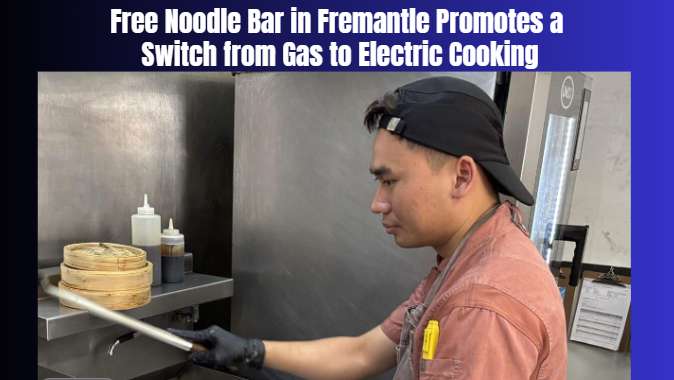
At the noodle bar, chef Amanda Auwdina prepared vegetarian noodles using different types of induction equipment. One setup used a flat-bottomed wok on a conventional induction hotplate, while another featured a specially designed curved induction burner that accommodates a round wok.
The organisers said the demonstration showed that modern induction appliances can provide sufficient heat for stir-frying while offering practical options for everyday cooking. Visitors were able to observe the cooking process and discuss the advantages and limitations of switching to electric appliances.
Induction cooktops heat compatible cookware through electromagnetic energy rather than burning gas. This method can transfer energy efficiently into a pan, allowing the cooking surface to respond quickly to temperature adjustments. Consumer research by Choice, cited in the report, found induction cooktops transfer approximately 85 per cent of their energy into cookware, compared with about 32 per cent for gas cooking elements.
Running costs were another topic discussed at the event. Organisers argued that households can save money by eliminating gas supply charges and using efficient electric appliances. However, the financial outcome for an individual household depends on electricity tariffs, appliance choices, installation costs and how much energy the household uses.
The group also wanted to reach residents who had not previously considered home electrification. By setting up the noodle bar in a public shopping area, organisers could speak with passers-by who might otherwise not engage with renewable energy campaigns.
The wider transition away from gas is already being discussed in Western Australia. The report noted that Albany is expected to undergo a transition involving the end of its reticulated gas supply over the coming years. Organisers believe the long-term viability of gas networks will remain an important issue as more homes adopt electric appliances.
Nevertheless, switching a household entirely to electricity can require substantial upfront investment. Depending on the property, residents may need to purchase new cooktops, replace other gas appliances or upgrade electrical infrastructure. These costs can be a barrier even when electric appliances offer potential savings over time.
The Fremantle initiative highlights how community demonstrations can help residents evaluate unfamiliar technology before making household decisions. By combining food, practical demonstrations and conversations, the organisers hope to make the transition to electric cooking more accessible.
The event also reflects a broader discussion about reducing household emissions, improving energy efficiency and making better use of renewable electricity. For residents considering a change, comparing installation costs, running expenses and cooking requirements remains important before deciding which appliances best suit their homes.
AppliancesCookingElectricInductionEnergy
A community initiative in Fremantle is using free freshly cooked noodles to encourage residents to consider replacing gas appliances with electric alternatives. The Electric Noodle Bar was organised by Electrify Fremantle as part of Fremantle Design Week, with the aim of demonstrating how induction cooking works in practice.
The event was designed to address a common concern among households considering the transition away from gas: whether electric appliances can deliver the intense heat required for traditional wok cooking. Rather than relying solely on written information or online campaigns, organisers invited people to see, smell and taste food prepared using induction equipment.
Electrify Fremantle is a volunteer group that supports households interested in converting their appliances to electricity, allowing them to make greater use of renewable energy. Organiser Wilf Johnston said cooking often becomes a major consideration for people weighing up whether to disconnect their homes from the gas network.
At the noodle bar, chef Amanda Auwdina prepared vegetarian noodles using different types of induction equipment. One setup used a flat-bottomed wok on a conventional induction hotplate, while another featured a specially designed curved induction burner that accommodates a round wok.
The organisers said the demonstration showed that modern induction appliances can provide sufficient heat for stir-frying while offering practical options for everyday cooking. Visitors were able to observe the cooking process and discuss the advantages and limitations of switching to electric appliances.
Induction cooktops heat compatible cookware through electromagnetic energy rather than burning gas. This method can transfer energy efficiently into a pan, allowing the cooking surface to respond quickly to temperature adjustments. Consumer research by Choice, cited in the report, found induction cooktops transfer approximately 85 per cent of their energy into cookware, compared with about 32 per cent for gas cooking elements.
Running costs were another topic discussed at the event. Organisers argued that households can save money by eliminating gas supply charges and using efficient electric appliances. However, the financial outcome for an individual household depends on electricity tariffs, appliance choices, installation costs and how much energy the household uses.
The group also wanted to reach residents who had not previously considered home electrification. By setting up the noodle bar in a public shopping area, organisers could speak with passers-by who might otherwise not engage with renewable energy campaigns.
The wider transition away from gas is already being discussed in Western Australia. The report noted that Albany is expected to undergo a transition involving the end of its reticulated gas supply over the coming years. Organisers believe the long-term viability of gas networks will remain an important issue as more homes adopt electric appliances.
Nevertheless, switching a household entirely to electricity can require substantial upfront investment. Depending on the property, residents may need to purchase new cooktops, replace other gas appliances or upgrade electrical infrastructure. These costs can be a barrier even when electric appliances offer potential savings over time.
The Fremantle initiative highlights how community demonstrations can help residents evaluate unfamiliar technology before making household decisions. By combining food, practical demonstrations and conversations, the organisers hope to make the transition to electric cooking more accessible.
The event also reflects a broader discussion about reducing household emissions, improving energy efficiency and making better use of renewable electricity. For residents considering a change, comparing installation costs, running expenses and cooking requirements remains important before deciding which appliances best suit their homes.
An unconventional mosaic featuring sequins, high heels and discarded beauty items is bringing a celebrated Australian drag performer’s image into the wo...
The Australian government has targeted two North Korean companies and two individuals accused of helping generate revenue for Pyongyang through fraudule...
Australia's expanding battery storage capacity is reshaping the electricity market, storing renewable energy during the day and supplying power during p...
A new agreement between the Victorian and federal governments sets a pathway towards fully funding public schools by 2034, with education leaders cautio...
A 56-year-old man has been refused bail after allegedly threatening staff at Western Australian MP Hannah Beazley’s electorate office while carrying a w...
Children learning through Western Australia’s School of the Air have collaborated with country musician Josh Arnold to create a music video celebrating...
Western Australian detectives are investigating whether an organised crime group recruited a 13-year-old Victorian boy who allegedly used a self-loading...
A woman in her 50s died in hospital after experiencing a medical emergency shortly after a roadside breath test in Mount Tarcoola. Western Australia Pol...
Families are raising concerns about limits on education support for students with type 1 diabetes, saying children may need more assistance at school to...
Australian comedian and actor Magda Szubanski has spoken about the isolation she experienced while growing up and how finding a supportive community hel...
Former Port Adelaide forward Daniel Stewart has died aged 37. The AFL club has announced plans to pay tribute to the former player at its first home gam...
Australian homicide detectives brought a 26-year-old man back from Poland to face a murder charge over the death of a 22-year-old man whose body was dis...