Remote Pilbara Students Record Country Song With Award-Winning Musician
By Chloe · Published 22 Oct 2026 · Updated 22 Oct 2026
Port Hedland, WA · Western Australia News
Safety note: Admin approval is an initial review, not a guarantee that every detail is correct. Check important or urgent claims with official sources and report anything inaccurate or unsafe.
Source and credit: Contributor's own report
Remote Pilbara Students Record Country Song With Award-Winning Musician - Port Hedland, WA
Smart summary
Children learning through Western Australia’s School of the Air have collaborated with country musician Josh Arnold to create a music video celebrating rural education and life on remote cattle stations.
Children living on remote cattle stations in Western Australia's Pilbara region have joined an award-winning country musician to record a song showcasing their education, friendships and everyday lives in the Australian outback.
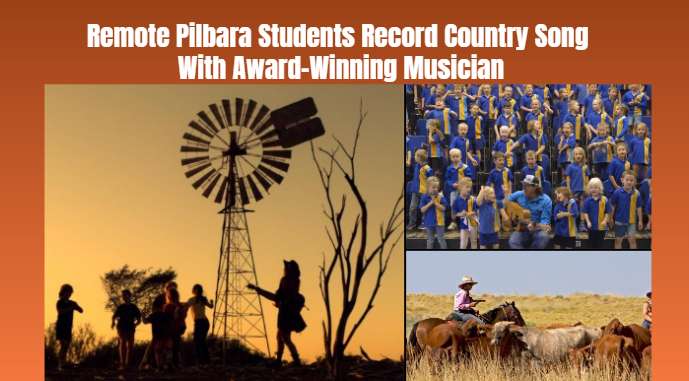
The students collaborated with country musician Josh Arnold to produce a song titled Kids from the Pilbara. The project brought together students from Port Hedland's School of the Air, giving children who usually attend lessons remotely an opportunity to meet their classmates and participate in a shared creative activity.
Students come together at a cattle station The recording took place at Yarrie Station, a cattle property covering approximately 250,000 hectares, around 1,500 kilometres north of Perth. Students travelled to the station to record the song and film a music video with Arnold.
For many of the children, meeting their classmates in person is relatively uncommon. The School of the Air serves students spread across vast distances, where attending a regular classroom each day is often impractical.
Nine-year-old Tanami Fox-Coppin, one of the students involved, said she was excited to have her school friends visit her family's property. The children spent two days camping together while filming scenes that reflected their rural lifestyle.
The video features children singing, riding horses, using dirt bikes and spending time around the station. These activities provide a glimpse into the environment in which many remote students grow up. Musician supports rural education Josh Arnold, a musician from Toowoomba in Queensland, has worked on similar projects with rural and remote students for more than 15 years. He has recorded more than 400 songs with students across Australia, helping young people share stories about their communities through music.
Arnold previously shared a Golden Guitar award with Lee Kernaghan for their 2001 cover of Thank God I'm a Country Boy. His work with remote schools aims to give children opportunities to express themselves creatively and develop pride in their backgrounds.
The Pilbara project also gives families an opportunity to show others what life is like for children growing up far from major population centres. The song and accompanying video may help audiences better understand the experiences of students who complete much of their schooling online. How remote education works Port Hedland's School of the Air provides distance education for children living across the Pilbara. Students participate in online lessons and complete schoolwork at home, often with guidance from a parent or governess.
The model offers flexibility for families living on cattle stations and other isolated properties. However, distance education can also create challenges, particularly when students have fewer opportunities to socialise with classmates.
Tanami's mother, Annabelle Coppin, explained that activities such as the music project can make a positive difference to students' connection with school. Bringing children together allows them to build friendships and create shared memories that may be difficult to develop through online lessons alone.
Although modern technology has replaced many of the older radio-based methods used in remote education, distance learning still requires considerable effort from families and educators. Importance for rural communities The project demonstrates how music and creative activities can complement formal education. For students living in isolated locations, opportunities to meet friends and participate in group projects can support their sense of belonging.
It also draws attention to the unique circumstances of families who choose or need to live and work in remote regions. These communities contribute to Australia's agricultural industries, but geographical isolation can make access to education and social activities more complicated.
By turning their experiences into a country song, the Pilbara students have created a project that celebrates their community while sharing their lives with a wider audience.
StudentsChildrenEducationRemotePilbara
Children living on remote cattle stations in Western Australia's Pilbara region have joined an award-winning country musician to record a song showcasing their education, friendships and everyday lives in the Australian outback.
The students collaborated with country musician Josh Arnold to produce a song titled Kids from the Pilbara. The project brought together students from Port Hedland's School of the Air, giving children who usually attend lessons remotely an opportunity to meet their classmates and participate in a shared creative activity.
Students come together at a cattle station The recording took place at Yarrie Station, a cattle property covering approximately 250,000 hectares, around 1,500 kilometres north of Perth. Students travelled to the station to record the song and film a music video with Arnold.
For many of the children, meeting their classmates in person is relatively uncommon. The School of the Air serves students spread across vast distances, where attending a regular classroom each day is often impractical.
Nine-year-old Tanami Fox-Coppin, one of the students involved, said she was excited to have her school friends visit her family's property. The children spent two days camping together while filming scenes that reflected their rural lifestyle.
The video features children singing, riding horses, using dirt bikes and spending time around the station. These activities provide a glimpse into the environment in which many remote students grow up. Musician supports rural education Josh Arnold, a musician from Toowoomba in Queensland, has worked on similar projects with rural and remote students for more than 15 years. He has recorded more than 400 songs with students across Australia, helping young people share stories about their communities through music.
Arnold previously shared a Golden Guitar award with Lee Kernaghan for their 2001 cover of Thank God I'm a Country Boy. His work with remote schools aims to give children opportunities to express themselves creatively and develop pride in their backgrounds.
The Pilbara project also gives families an opportunity to show others what life is like for children growing up far from major population centres. The song and accompanying video may help audiences better understand the experiences of students who complete much of their schooling online. How remote education works Port Hedland's School of the Air provides distance education for children living across the Pilbara. Students participate in online lessons and complete schoolwork at home, often with guidance from a parent or governess.
The model offers flexibility for families living on cattle stations and other isolated properties. However, distance education can also create challenges, particularly when students have fewer opportunities to socialise with classmates.
Tanami's mother, Annabelle Coppin, explained that activities such as the music project can make a positive difference to students' connection with school. Bringing children together allows them to build friendships and create shared memories that may be difficult to develop through online lessons alone.
Although modern technology has replaced many of the older radio-based methods used in remote education, distance learning still requires considerable effort from families and educators. Importance for rural communities The project demonstrates how music and creative activities can complement formal education. For students living in isolated locations, opportunities to meet friends and participate in group projects can support their sense of belonging.
It also draws attention to the unique circumstances of families who choose or need to live and work in remote regions. These communities contribute to Australia's agricultural industries, but geographical isolation can make access to education and social activities more complicated.
By turning their experiences into a country song, the Pilbara students have created a project that celebrates their community while sharing their lives with a wider audience.
A new agreement between the Victorian and federal governments sets a pathway towards fully funding public schools by 2034, with education leaders cautio...
The Victorian government says the proposed restriction aims to protect student privacy, reduce classroom distractions and help students focus on learning.
Queensland Corrective Services is reviewing an incident after an Indigenous woman in custody was allegedly restrained in hospital following a caesarean...
A community-based storytelling initiative in Mount Druitt is using culture, stories and reading activities to help children strengthen their literacy sk...
Western Australian detectives are investigating whether an organised crime group recruited a 13-year-old Victorian boy who allegedly used a self-loading...
A woman in her 50s died in hospital after experiencing a medical emergency shortly after a roadside breath test in Mount Tarcoola. Western Australia Pol...
Police arrested a 56-year-old man after an alleged disturbance at state MP Hannah Beazley’s electorate office in Victoria Park, Perth. Officers said the...
Western Australian police are investigating a suspicious fire at a high-value Perth property after a threatening message was reportedly found at the scene.
A new agreement between the Victorian and federal governments sets a pathway towards fully funding public schools by 2034, with education leaders cautio...
The Victorian government says the proposed restriction aims to protect student privacy, reduce classroom distractions and help students focus on learning.
Wet weather is expected to add uncertainty to the Supercars championship street race, with leading drivers preparing for difficult track conditions on Q...