Safety note: Admin approval is an initial review, not a guarantee that every detail is correct. Check important or urgent claims with official sources and report anything inaccurate or unsafe.
Source and credit: Contributor's own report
Gold Coast School Greenhouse Helps Students Grow Food and Improve Learning - Gold Coast, QLD
Smart summary
A high-tech greenhouse at Pacific Pines State High School is giving students hands-on experience in growing fresh produce, learning science and developing practical skills, while the program aims to improve school eng...
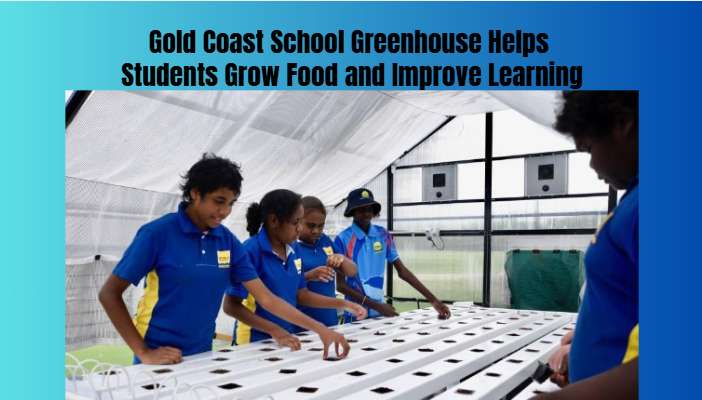
Students at Pacific Pines State High School on the Gold Coast are learning to grow their own food through a high-tech greenhouse program that combines agriculture, science, technology and practical education.
The school is one of nine schools in south-east Queensland participating in a greenhouse initiative run by Food Ladder, a not-for-profit organisation that operates 68 school greenhouses across Australia. The program aims to help students understand food production, develop practical life skills and improve their connection with learning.
Inside the greenhouse, students grow lettuce, herbs and other vegetables while learning how plants respond to environmental conditions. They plant seeds, monitor growing conditions, manage water temperatures and maintain the greenhouse systems before harvesting the produce. The food can then be taken home or used in school cooking classes.
The initiative provides students with opportunities to apply classroom knowledge to real-world activities. Science lessons can involve examining plant growth and water conditions, while technology and engineering concepts are explored through the greenhouse's automated systems, fans and environmental controls. Students also learn how food production connects with household budgets, sustainability and nutrition.
Year 8 student Lilly Anne Robins said growing produce had helped her better understand the value of food and the effort involved in producing it. Other students have described enjoying the opportunity to cook with vegetables they have grown themselves, creating a connection between their classroom activities and everyday life.
Food Ladder chief executive Kelly McJannett said the program focuses on empowering students to grow and nurture their own food rather than simply providing free produce. The organisation aims to equip young people with practical skills they can continue using beyond their school years.
Teachers at Pacific Pines State High School have also found that the greenhouse provides learning opportunities across multiple subjects. In addition to science and technology, geography, business and home economics classes can use the facility to explore topics such as food systems, enterprise and cooking. Students have even expressed interest in growing produce for small school-based business activities.
Research discussed by education expert Donna Pendergast from Griffith Institute for Educational Research suggests that hands-on programs can help students develop a sense of responsibility, collaboration and belonging. Food Ladder has reported that attendance at one participating school increased from 30 per cent to 90 per cent on greenhouse program days, although that result relates to a particular school rather than all participating students.
The initiative also aims to address food insecurity by teaching students how to grow fresh produce and understand its value. Students gain experience in managing resources, caring for plants and working together toward a shared outcome.
Applications are now open for five additional schools in south-east Queensland to join the program, potentially extending its reach to more students and communities.
The Pacific Pines greenhouse demonstrates how practical food-growing activities can complement conventional classroom learning while helping students build skills that may benefit them throughout their lives.
StudentsFoodGreenhouseSchoolLearning
Students at Pacific Pines State High School on the Gold Coast are learning to grow their own food through a high-tech greenhouse program that combines agriculture, science, technology and practical education.
The school is one of nine schools in south-east Queensland participating in a greenhouse initiative run by Food Ladder, a not-for-profit organisation that operates 68 school greenhouses across Australia. The program aims to help students understand food production, develop practical life skills and improve their connection with learning.
Inside the greenhouse, students grow lettuce, herbs and other vegetables while learning how plants respond to environmental conditions. They plant seeds, monitor growing conditions, manage water temperatures and maintain the greenhouse systems before harvesting the produce. The food can then be taken home or used in school cooking classes.
The initiative provides students with opportunities to apply classroom knowledge to real-world activities. Science lessons can involve examining plant growth and water conditions, while technology and engineering concepts are explored through the greenhouse's automated systems, fans and environmental controls. Students also learn how food production connects with household budgets, sustainability and nutrition.
Year 8 student Lilly Anne Robins said growing produce had helped her better understand the value of food and the effort involved in producing it. Other students have described enjoying the opportunity to cook with vegetables they have grown themselves, creating a connection between their classroom activities and everyday life.
Food Ladder chief executive Kelly McJannett said the program focuses on empowering students to grow and nurture their own food rather than simply providing free produce. The organisation aims to equip young people with practical skills they can continue using beyond their school years.
Teachers at Pacific Pines State High School have also found that the greenhouse provides learning opportunities across multiple subjects. In addition to science and technology, geography, business and home economics classes can use the facility to explore topics such as food systems, enterprise and cooking. Students have even expressed interest in growing produce for small school-based business activities.
Research discussed by education expert Donna Pendergast from Griffith Institute for Educational Research suggests that hands-on programs can help students develop a sense of responsibility, collaboration and belonging. Food Ladder has reported that attendance at one participating school increased from 30 per cent to 90 per cent on greenhouse program days, although that result relates to a particular school rather than all participating students.
The initiative also aims to address food insecurity by teaching students how to grow fresh produce and understand its value. Students gain experience in managing resources, caring for plants and working together toward a shared outcome.
Applications are now open for five additional schools in south-east Queensland to join the program, potentially extending its reach to more students and communities.
The Pacific Pines greenhouse demonstrates how practical food-growing activities can complement conventional classroom learning while helping students build skills that may benefit them throughout their lives.
Bluebottles measuring up to three times the usual size have been washing onto Gold Coast beaches earlier than expected, prompting questions from scienti...
Brisbane is transforming plain walls and graffiti-prone public spaces into colourful murals by local artists, with a Newstead tunnel artwork and a Toowo...
Tasmanian homeowners and businesses are facing higher borrowing costs after the Reserve Bank lifted the cash rate to 4.6 per cent, with lower average wa...
The ACT will begin the first phase of the Thriving Kids program on October 1, providing developmental support pathways for children while concerns remai...
Bluebottles measuring up to three times the usual size have been washing onto Gold Coast beaches earlier than expected, prompting questions from scienti...
A Queensland government department has lost approximately $800,000 in a cyberattack, prompting a review that found no government data or sensitive infor...
Brisbane is transforming plain walls and graffiti-prone public spaces into colourful murals by local artists, with a Newstead tunnel artwork and a Toowo...
Two pedestrians remain in critical condition after a car struck them near Tallebudgera Surf Club, prompting a major emergency response and a police inve...
The upcoming Coffs Harbour bypass is expected to remove around 35,000 vehicles a day from the city's main highway route, prompting local businesses, inc...
Bluebottles measuring up to three times the usual size have been washing onto Gold Coast beaches earlier than expected, prompting questions from scienti...
Regional councils are calling on the Australian Government to establish a $200 million funding program to help maintain regional airports, after a surve...
A man convicted of supplying the firearm used in a fatal 2021 brawl in North Booval, Ipswich, has received a longer prison sentence than the gunman, fol...