Safety note: Admin approval is an initial review, not a guarantee that every detail is correct. Check important or urgent claims with official sources and report anything inaccurate or unsafe.
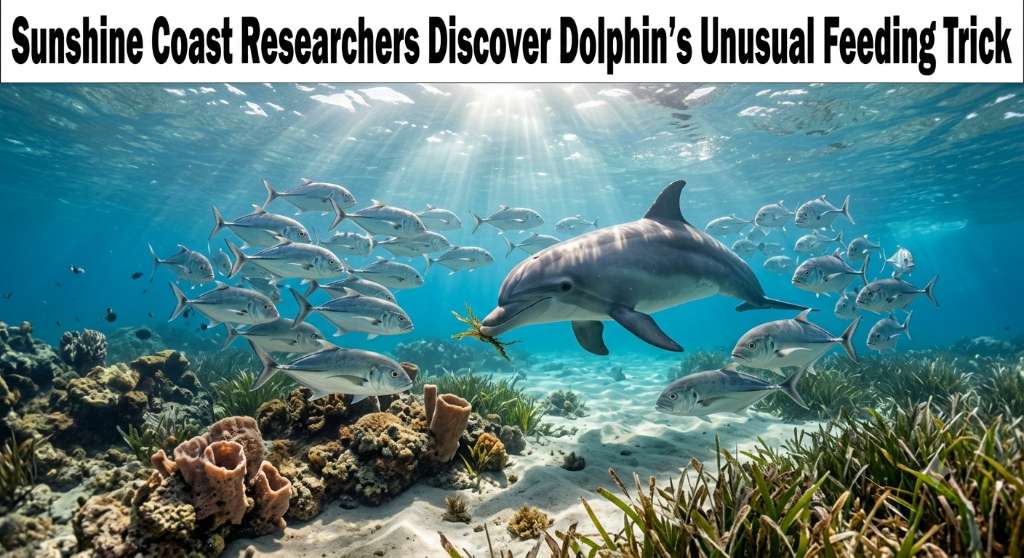
University of the Sunshine Coast researchers have documented a bottlenose dolphin using an unusual technique to obtain food from fish.
Researchers at the University of the Sunshine Coast have documented an unusual feeding behaviour by a dolphin that involves forcing fish to regurgitate their food before eating it.
The behaviour was observed and documented by researchers from the University of the Sunshine Coast as part of ongoing work examining marine wildlife and animal behaviour.
The dolphin, known as Bubbles, was observed interacting with Bigeye trevally, a species of fish found in Australian coastal waters. Instead of simply catching and eating the fish, Bubbles was seen harassing the fish until it released food from its stomach. The dolphin then moved in to consume the regurgitated material.
Researchers described the behaviour as a novel feeding strategy because it involves the dolphin effectively obtaining food indirectly from another animal.
The observation provides researchers with another example of the complex ways dolphins can adapt their feeding behaviour to obtain available food.
Dolphins are already known for using sophisticated hunting techniques. Different populations can develop specialised methods for locating, capturing and consuming prey, with some behaviours being learned and passed between individuals.
The behaviour documented by the Sunshine Coast researchers adds another example to the growing body of scientific knowledge about dolphin intelligence and feeding strategies.
The researchers were particularly interested in the interaction between the dolphin and the Bigeye trevally because the behaviour appears to exploit the fish's own feeding process. Rather than targeting the fish solely as prey, the dolphin takes advantage of the food already inside the fish.
The observation was described by the university as a shortcut to obtaining food. It demonstrates how marine animals can develop flexible strategies when interacting with other species.
The research is also relevant to understanding the behaviour of dolphins living in Australian waters. Detailed observations of individual animals can help scientists identify behaviours that might otherwise go unnoticed.
Bubbles' behaviour was documented by researchers from the University of the Sunshine Coast, with the university publishing details of the observation on September 16, 2026.
The discovery provides an unusual insight into the feeding behaviour of dolphins and highlights the type of animal behaviour that can be observed in Sunshine Coast waters.
For the Sunshine Coast research community, the observation adds to the region's contribution to marine science. The university conducts research across a range of environmental and wildlife subjects, including marine ecosystems and animal behaviour.
The finding also demonstrates that familiar marine animals can still display behaviours that surprise researchers. Observations such as this can help scientists understand how animals respond to their surroundings and develop different ways of obtaining food.
The researchers' documentation of Bubbles and the Bigeye trevally provides a specific example of this flexibility, showing how a dolphin can use another animal's feeding behaviour to its own advantage.
BehaviourResearchersDolphinFeedingCoast
Researchers at the University of the Sunshine Coast have documented an unusual feeding behaviour by a dolphin that involves forcing fish to regurgitate their food before eating it.
The behaviour was observed and documented by researchers from the University of the Sunshine Coast as part of ongoing work examining marine wildlife and animal behaviour.
The dolphin, known as Bubbles, was observed interacting with Bigeye trevally, a species of fish found in Australian coastal waters. Instead of simply catching and eating the fish, Bubbles was seen harassing the fish until it released food from its stomach. The dolphin then moved in to consume the regurgitated material.
Researchers described the behaviour as a novel feeding strategy because it involves the dolphin effectively obtaining food indirectly from another animal.
The observation provides researchers with another example of the complex ways dolphins can adapt their feeding behaviour to obtain available food.
Dolphins are already known for using sophisticated hunting techniques. Different populations can develop specialised methods for locating, capturing and consuming prey, with some behaviours being learned and passed between individuals.
The behaviour documented by the Sunshine Coast researchers adds another example to the growing body of scientific knowledge about dolphin intelligence and feeding strategies.
The researchers were particularly interested in the interaction between the dolphin and the Bigeye trevally because the behaviour appears to exploit the fish's own feeding process. Rather than targeting the fish solely as prey, the dolphin takes advantage of the food already inside the fish.
The observation was described by the university as a shortcut to obtaining food. It demonstrates how marine animals can develop flexible strategies when interacting with other species.
The research is also relevant to understanding the behaviour of dolphins living in Australian waters. Detailed observations of individual animals can help scientists identify behaviours that might otherwise go unnoticed.
Bubbles' behaviour was documented by researchers from the University of the Sunshine Coast, with the university publishing details of the observation on September 16, 2026.
The discovery provides an unusual insight into the feeding behaviour of dolphins and highlights the type of animal behaviour that can be observed in Sunshine Coast waters.
For the Sunshine Coast research community, the observation adds to the region's contribution to marine science. The university conducts research across a range of environmental and wildlife subjects, including marine ecosystems and animal behaviour.
The finding also demonstrates that familiar marine animals can still display behaviours that surprise researchers. Observations such as this can help scientists understand how animals respond to their surroundings and develop different ways of obtaining food.
The researchers' documentation of Bubbles and the Bigeye trevally provides a specific example of this flexibility, showing how a dolphin can use another animal's feeding behaviour to its own advantage.
Newcastle Museum will host the fifth annual Hunter Science Festival on 23 August, featuring 40 interactive exhibits, combat robots, science shows and ha...
The Australian Reptile Park’s funnel-web spider program has reached a significant milestone as efforts continue to secure the future of Australia’s crit...
Australia's nationwide insect survey has passed one million recorded observations, with scientists saying public participation is transforming knowledge...
Queensland's emerging football prospects are coming together for a three-day Brisbane Lions State Academy showcase, giving young players an opportunity...
A Wavell Heights enrolled nurse has been charged with four counts of alleged sexual assault and one count of wilful exposure, with his professional regi...
A 24-year-old Carina Heights man has been charged with 36 offences following an investigation into alleged break-ins, vehicle offences and other propert...
Cairns Regional Council has unanimously voted to seek $400,000 in Queensland Government funding for a program designed to connect local businesses with the region’s growing film...
An automated external defibrillator and memorial plaque have been installed at Ellery Creek Big Hole following the death of disability advocate Ellen Fr...
Queensland firefighters spent several hours monitoring a significant grass fire at Mary Kinross Park in Bargara, near Bundaberg, after the blaze broke out on Wednesday evening....