Safety note: Admin approval is an initial review, not a guarantee that every detail is correct. Check important or urgent claims with official sources and report anything inaccurate or unsafe.
Source and credit: Contributor's own report
Sydney’s Opal Tower declared defect-free eight years after mass evacuation - Sydney, NSW
Smart summary
The Sydney Olympic Park apartment complex has been officially declared defect-free following years of repairs, legal disputes and compensation efforts after residents were evacuated in 2018.
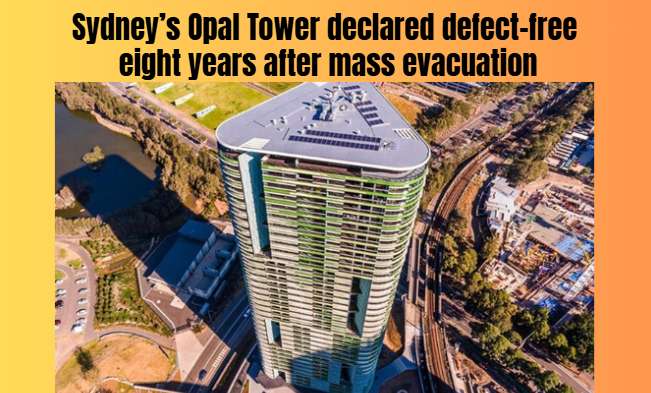
Sydney’s Opal Tower apartment complex has reached a major milestone, with a ceremony marking the building’s official declaration as defect-free nearly eight years after structural cracking forced residents to evacuate.
The 36-storey residential tower at Sydney Olympic Park became the focus of national attention on Christmas Eve in 2018, when cracks appeared in parts of the building. Fears about the building’s safety prompted the evacuation of thousands of residents and the closure of nearby roads and the railway station during the emergency response.
Further cracking was identified in the days that followed, raising questions about the building’s design, construction and structural integrity. Residents faced disruption, uncertainty and the prospect of lengthy repairs while investigations were undertaken.
An engineering report commissioned by the New South Wales government in 2019 concluded that the cracking resulted from a combination of design and construction issues, including changes made after the original design. The findings prompted extensive rectification work and added scrutiny of apartment-building standards across the state.
The repair process involved the building’s owners corporation, the developer, engineering consultants and the builder. Legal proceedings, including a class action and other court cases, were part of efforts to address the defects and secure compensation for affected owners.
Shady Eskander, chairman of the Opal Tower Owners Corporation, said the formal declaration represented the end of a long and difficult period for residents. He described the experience as deeply disruptive to people whose homes had become the centre of a prolonged building-safety dispute.
For some residents, the consequences extended well beyond construction work. People were forced to leave their apartments, arrange alternative accommodation and wait while the building was assessed and repaired. One resident, Nutan Borkar, said she had spent 11 months away from her unit after the incident and was relieved to see the process reach this point.
The building is now covered by a reported 20-year structural warranty, providing additional protection relating to its structural condition. The owners corporation also said compensation matters and legal proceedings had been resolved.
The Opal Tower case contributed to broader debate about building quality, accountability and consumer protection in New South Wales. It also highlighted the importance of independent engineering oversight and reliable construction practices in high-rise residential developments.
Although the latest declaration marks a significant conclusion to the repair process, the experience remains a reminder of the financial and personal consequences that major building defects can create for residents.
BuildingResidentsTowerConstructionOpal
Sydney’s Opal Tower apartment complex has reached a major milestone, with a ceremony marking the building’s official declaration as defect-free nearly eight years after structural cracking forced residents to evacuate.
The 36-storey residential tower at Sydney Olympic Park became the focus of national attention on Christmas Eve in 2018, when cracks appeared in parts of the building. Fears about the building’s safety prompted the evacuation of thousands of residents and the closure of nearby roads and the railway station during the emergency response.
Further cracking was identified in the days that followed, raising questions about the building’s design, construction and structural integrity. Residents faced disruption, uncertainty and the prospect of lengthy repairs while investigations were undertaken.
An engineering report commissioned by the New South Wales government in 2019 concluded that the cracking resulted from a combination of design and construction issues, including changes made after the original design. The findings prompted extensive rectification work and added scrutiny of apartment-building standards across the state.
The repair process involved the building’s owners corporation, the developer, engineering consultants and the builder. Legal proceedings, including a class action and other court cases, were part of efforts to address the defects and secure compensation for affected owners.
Shady Eskander, chairman of the Opal Tower Owners Corporation, said the formal declaration represented the end of a long and difficult period for residents. He described the experience as deeply disruptive to people whose homes had become the centre of a prolonged building-safety dispute.
For some residents, the consequences extended well beyond construction work. People were forced to leave their apartments, arrange alternative accommodation and wait while the building was assessed and repaired. One resident, Nutan Borkar, said she had spent 11 months away from her unit after the incident and was relieved to see the process reach this point.
The building is now covered by a reported 20-year structural warranty, providing additional protection relating to its structural condition. The owners corporation also said compensation matters and legal proceedings had been resolved.
The Opal Tower case contributed to broader debate about building quality, accountability and consumer protection in New South Wales. It also highlighted the importance of independent engineering oversight and reliable construction practices in high-rise residential developments.
Although the latest declaration marks a significant conclusion to the repair process, the experience remains a reminder of the financial and personal consequences that major building defects can create for residents.
A woman aged 46 and a man in his 60s died after an SUV and a van collided near Ulmarra on the NSW North Coast. Police have established a critical incide...
Australian music industry legend Ian “Molly” Meldrum has died aged 83. The legendary Countdown presenter helped introduce generations of Australians to...
Victorian detectives have arrested a teenager following an investigation into alleged organised crime attacks targeting bars, clubs and restaurants acro...
South Australian police have arrested a man and a woman after allegedly discovering 910 alkaloid poppy plants growing at a residential property in Brahm...
Two Australians are facing legal proceedings in Thailand over an alleged multimillion-dollar investment fraud involving approximately $1.9 million, rais...
A juice manufacturing company has admitted breaching workplace safety laws following the death of a 75-year-old worker at its Griffith factory in 2024....
Charles Sturt University has announced the closure of its National Radio Newsroom in Bathurst, affecting several staff members. The Community Broadcasti...
Cricket Australia has unanimously backed Pat Cummins to remain national captain following renewed controversy surrounding Australia's 2018 ball-tamperin...
A woman aged 46 and a man in his 60s died after an SUV and a van collided near Ulmarra on the NSW North Coast. Police have established a critical incide...
Two Australians are facing legal proceedings in Thailand over an alleged multimillion-dollar investment fraud involving approximately $1.9 million, rais...
An Australian-owned energy company has developed a compact nuclear microreactor that reached a major testing milestone in just 155 days in the United St...
Uncovered an Iran-based influence operation that allegedly used artificial intelligence to create a fake journalist and publish misleading articles and...