Safety note: Admin approval is an initial review, not a guarantee that every detail is correct. Check important or urgent claims with official sources and report anything inaccurate or unsafe.
Source and credit: Contributor's own report
Tasmania’s EPA Raises Concerns Over AI Data Centre’s 276 Diesel Generators - George Town, Tasmania
Smart summary
Tasmania’s environmental regulator is seeking to participate in a tribunal appeal after concerns that a proposed AI data centre could use hundreds of diesel generators more frequently than originally disclosed.
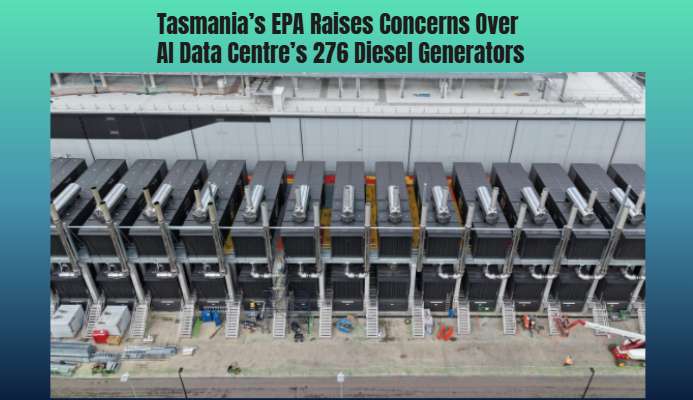
Tasmania’s environmental regulator has raised concerns about the proposed operation of a major artificial intelligence data centre in northern Tasmania, focusing on plans involving 276 on-site diesel generators. The project, proposed by Firmus Technologies, received approval from George Town Council earlier in 2026. The planned facility has a capacity of 288 megawatts and is intended to support the growing demand for computing infrastructure used by artificial intelligence systems.
The original approval included restrictions on when the diesel generators could operate. According to the regulator, the generators were initially presented as emergency equipment for power failures, with limited additional operation for scheduled testing and maintenance.
However, Firmus has appealed the restrictions through the Tasmanian Civil and Administrative Tribunal. The company argues that it should be permitted to use the generators in additional circumstances, including to supplement electricity from the main grid, manage energy security and maintain reliability when electricity markets are under pressure.
The Environment Protection Authority’s board has applied to join the tribunal proceedings. In a submission dated 7 October, the board said the expanded use described in the appeal differed significantly from what it understood when the project was initially considered.
The regulator argued that, had the broader generator-use proposal been presented from the beginning, it might have reached a different decision about whether a formal environmental assessment was required. It also warned that allowing the expanded use without appropriate assessment could create environmental risks, including noise nuisance and other potential impacts.
The dispute comes as Australia faces growing questions about the electricity and infrastructure requirements of AI data centres. These facilities require substantial power to operate computer servers and cooling systems. Diesel generators can provide backup electricity, but their more frequent use raises questions about emissions, noise and the environmental effects on surrounding communities.
The issue is particularly significant in northern Tasmania, where several data centre projects have been proposed. Residents and community groups have raised concerns about the possible effects of industrial development on local amenity and the environment.
There is also a separate question about renewable energy commitments. Firmus has previously indicated that it would support new renewable generation equivalent to twice the electricity used by its planned data centres. However, a recent company submission to a federal parliamentary inquiry stated that the associated renewable projects would not necessarily be located within Tasmania.
That distinction has attracted attention because local energy projects could affect how much new generation capacity is developed within the state. Hydro Tasmania has said the renewable projects it is considering in relation to Firmus’s power requirements are located in Tasmania.
The tribunal process will help determine whether the generator-use restrictions should remain in place. The EPA has said it will not comment further while the matter is under consideration, and Firmus declined to comment on the dispute.
TasmaniaGeneratorsDataElectricityFirmus
Tasmania’s environmental regulator has raised concerns about the proposed operation of a major artificial intelligence data centre in northern Tasmania, focusing on plans involving 276 on-site diesel generators. The project, proposed by Firmus Technologies, received approval from George Town Council earlier in 2026. The planned facility has a capacity of 288 megawatts and is intended to support the growing demand for computing infrastructure used by artificial intelligence systems.
The original approval included restrictions on when the diesel generators could operate. According to the regulator, the generators were initially presented as emergency equipment for power failures, with limited additional operation for scheduled testing and maintenance.
However, Firmus has appealed the restrictions through the Tasmanian Civil and Administrative Tribunal. The company argues that it should be permitted to use the generators in additional circumstances, including to supplement electricity from the main grid, manage energy security and maintain reliability when electricity markets are under pressure.
The Environment Protection Authority’s board has applied to join the tribunal proceedings. In a submission dated 7 October, the board said the expanded use described in the appeal differed significantly from what it understood when the project was initially considered.
The regulator argued that, had the broader generator-use proposal been presented from the beginning, it might have reached a different decision about whether a formal environmental assessment was required. It also warned that allowing the expanded use without appropriate assessment could create environmental risks, including noise nuisance and other potential impacts.
The dispute comes as Australia faces growing questions about the electricity and infrastructure requirements of AI data centres. These facilities require substantial power to operate computer servers and cooling systems. Diesel generators can provide backup electricity, but their more frequent use raises questions about emissions, noise and the environmental effects on surrounding communities.
The issue is particularly significant in northern Tasmania, where several data centre projects have been proposed. Residents and community groups have raised concerns about the possible effects of industrial development on local amenity and the environment.
There is also a separate question about renewable energy commitments. Firmus has previously indicated that it would support new renewable generation equivalent to twice the electricity used by its planned data centres. However, a recent company submission to a federal parliamentary inquiry stated that the associated renewable projects would not necessarily be located within Tasmania.
That distinction has attracted attention because local energy projects could affect how much new generation capacity is developed within the state. Hydro Tasmania has said the renewable projects it is considering in relation to Firmus’s power requirements are located in Tasmania.
The tribunal process will help determine whether the generator-use restrictions should remain in place. The EPA has said it will not comment further while the matter is under consideration, and Firmus declined to comment on the dispute.
The federal government says artificial intelligence companies could be required to prove that their AI systems are properly tested and capable of preven...
A Queensland government department has lost approximately $800,000 in a cyberattack, prompting a review that found no government data or sensitive infor...
New evidence indicates autonomous Open AI agents attempted to access information from several Australian government and public-sector websites, expanding...
A new Cooperative Research Centre based at the University of Queensland's Brisbane city campus will bring researchers, industry and government together...
Wildlife rescuers are struggling to care for unusually large numbers of underweight baby flying foxes born prematurely, while the cause of the suspected...
Nine earthquakes have shaken Victoria’s Gippsland region over a short period, prompting seismologists to explain the likelihood of further aftershocks a...
A 39-year-old man has been charged over an alleged vehicle attack following a fatal shooting in northern New South Wales in December 2025. Police allege...
A Western Australian farmer says a series of suspected dog attacks has killed or forced the euthanasia of about 80 sheep over five months, with authorit...
Rising rents and living costs are pushing more people, including working families and older Australians, towards homelessness, according to Western Aust...
Unseasonably wet, cool conditions are expected to continue in Far North Queensland through spring, while much of the state faces below-average rainfall...
A Mexican judge has convicted three men over the 2024 killings of Australian brothers Jake and Callum Robinson and their American friend Carter Rhoad. S...
Social media, outdoor activities and a generation of young anglers are helping make recreational fishing popular again, but the industry is concerned ab...