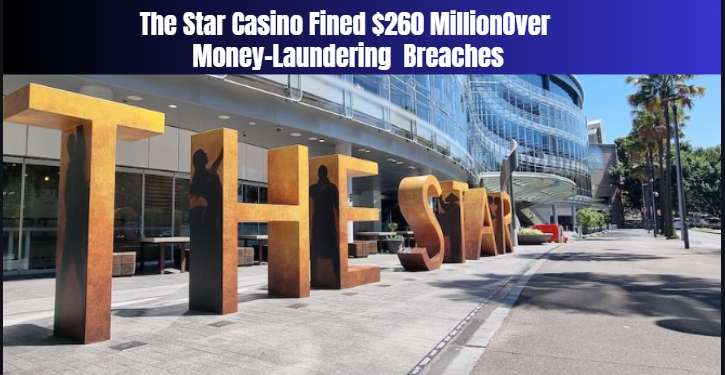
The Star Casino Fined $260 Million Over Money-Laundering Breaches
By Chloe · Published 28 Oct 2026 · Updated 28 Oct 2026
Sydney, NSW · New South Wales News
Safety note: Admin approval is an initial review, not a guarantee that every detail is correct. Check important or urgent claims with official sources and report anything inaccurate or unsafe.
Source and credit: Contributor's own report
The Star Casino Fined $260 Million Over Money-Laundering Breaches - Sydney, NSW
Smart summary
Australia’s Federal Court has imposed a $260 million penalty on Star Entertainment over historical failures to comply with anti-money-laundering laws.
Star Entertainment Group, one of Australia’s major casino operators, has been fined $260 million by the Federal Court over repeated historical breaches of anti-money-laundering laws. The penalty follows legal action brought by Australia’s financial intelligence agency, AUSTRAC, in 2022.
The case examined whether Star had adequately identified and managed the risks associated with money laundering through its casinos. AUSTRAC alleged that the company failed to properly address risks connected with Asian gambling junket operator Suncity and its funder, despite concerns about potential criminal links. The court proceedings focused on the company’s compliance failures and its obligations to prevent its facilities from being used for financial crime. ABC News
Justice Cameron Moore handed down the penalty on 28 October 2026. AUSTRAC had sought a $400 million fine, while Star argued that a penalty exceeding $100 million could force it into liquidation. In determining the final amount, the judge considered both the seriousness of the breaches and the company’s financial position.
The judge said the contraventions were serious and that a significant penalty was warranted. He also emphasised the need to deter the company from putting profit ahead of compliance with anti-money-laundering requirements. The judgment recognised that Star had undertaken substantial remediation efforts, which influenced the final penalty.
Star operates casinos in Sydney and the Gold Coast and also runs a casino in Brisbane. The company’s operations have faced increased regulatory scrutiny in recent years, including consequences for its casino licences in New South Wales and Queensland. The latest penalty adds to the financial and operational challenges facing the business.
Money laundering involves disguising the origins of funds obtained through criminal activity so they appear legitimate. Casinos can face particular risks because large sums may move through gambling transactions, cash exchanges and relationships with high-value customers. Australian laws require relevant businesses to identify suspicious activity, assess customer risks and report certain transactions to authorities.
The Star case highlights the responsibility of casino operators to maintain effective monitoring systems and ensure staff follow legal reporting requirements. Regulators argue that businesses must act on warning signs rather than allow commercial relationships to override compliance obligations.
The penalty is also significant for Australia’s broader financial-crime enforcement framework. Large civil penalties are intended not only to punish past failures but also to encourage other businesses to invest in stronger safeguards. Effective anti-money-laundering controls help authorities trace suspicious funds and reduce the ability of criminal organisations to use legitimate businesses to move money.
Star’s financial position remains an important issue as it faces the cost of the penalty alongside the expense of improving compliance systems and maintaining its casino operations. The court’s decision makes clear that regulatory obligations remain in force even when penalties could place pressure on a company’s future.
The ruling represents a major development in the long-running scrutiny of Star Entertainment and reinforces the importance of accountability in Australia’s gambling sector.
StarPenaltyCasinoCompanyFinancial
Star Entertainment Group, one of Australia’s major casino operators, has been fined $260 million by the Federal Court over repeated historical breaches of anti-money-laundering laws. The penalty follows legal action brought by Australia’s financial intelligence agency, AUSTRAC, in 2022.
The case examined whether Star had adequately identified and managed the risks associated with money laundering through its casinos. AUSTRAC alleged that the company failed to properly address risks connected with Asian gambling junket operator Suncity and its funder, despite concerns about potential criminal links. The court proceedings focused on the company’s compliance failures and its obligations to prevent its facilities from being used for financial crime. ABC News
Justice Cameron Moore handed down the penalty on 28 October 2026. AUSTRAC had sought a $400 million fine, while Star argued that a penalty exceeding $100 million could force it into liquidation. In determining the final amount, the judge considered both the seriousness of the breaches and the company’s financial position.
The judge said the contraventions were serious and that a significant penalty was warranted. He also emphasised the need to deter the company from putting profit ahead of compliance with anti-money-laundering requirements. The judgment recognised that Star had undertaken substantial remediation efforts, which influenced the final penalty.
Star operates casinos in Sydney and the Gold Coast and also runs a casino in Brisbane. The company’s operations have faced increased regulatory scrutiny in recent years, including consequences for its casino licences in New South Wales and Queensland. The latest penalty adds to the financial and operational challenges facing the business.
Money laundering involves disguising the origins of funds obtained through criminal activity so they appear legitimate. Casinos can face particular risks because large sums may move through gambling transactions, cash exchanges and relationships with high-value customers. Australian laws require relevant businesses to identify suspicious activity, assess customer risks and report certain transactions to authorities.
The Star case highlights the responsibility of casino operators to maintain effective monitoring systems and ensure staff follow legal reporting requirements. Regulators argue that businesses must act on warning signs rather than allow commercial relationships to override compliance obligations.
The penalty is also significant for Australia’s broader financial-crime enforcement framework. Large civil penalties are intended not only to punish past failures but also to encourage other businesses to invest in stronger safeguards. Effective anti-money-laundering controls help authorities trace suspicious funds and reduce the ability of criminal organisations to use legitimate businesses to move money.
Star’s financial position remains an important issue as it faces the cost of the penalty alongside the expense of improving compliance systems and maintaining its casino operations. The court’s decision makes clear that regulatory obligations remain in force even when penalties could place pressure on a company’s future.
The ruling represents a major development in the long-running scrutiny of Star Entertainment and reinforces the importance of accountability in Australia’s gambling sector.
Australian property values have fallen for seven consecutive months, with the national median home value dropping approximately $63,400 since March as h...
Around 8,000 customers in Western Australia's coastal city of Albany will need to replace gas appliances with electric alternatives or switch to bottled...
Buyers from Sydney and Melbourne are purchasing homes in Alice Springs at a rapid pace, attracted by strong rental returns and limited housing availabil...
Growing awareness of Auslan is highlighting the importance of teaching children sign language and helping them communicate with people who are deaf or h...
New South Wales has begun accepting firearms under the national gun buyback scheme, but limited appointment availability has created an early challenge...
Australian property values have fallen for seven consecutive months, with the national median home value dropping approximately $63,400 since March as h...
Education experts support New South Wales' proposal to replace computer-based NAPLAN writing tests with traditional pen-and-paper examinations for stude...
A psychiatric report presented to South Australia's Supreme Court has raised questions about Tamika Chesser's mental competence in the case involving th...
A freedom of information request has revealed that Gold Coast Council does not hold a copy of the invoice for Mayor Tom Tate's three-day stay at Donald...