Backpackers Warn Australia's Regional Farms Could Lose Seasonal Workers Under Visa Changes
By Chloe · Published 24 Oct 2026 · Updated 24 Oct 2026
Griffith, NSW · New South Wales News
Safety note: Admin approval is an initial review, not a guarantee that every detail is correct. Check important or urgent claims with official sources and report anything inaccurate or unsafe.
Source and credit: Contributor's own report
Backpackers Warn Australia's Regional Farms Could Lose Seasonal Workers Under Visa Changes - Griffith, NSW
Smart summary
International backpackers say Australia's new working holiday visa ballot system could discourage them from taking difficult regional jobs. Farmers and wine producers warn that reduced access to seasonal workers may t...
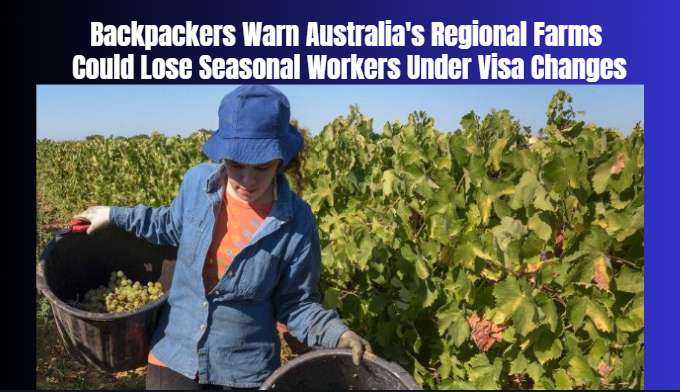
Australia's regional agricultural industry is facing uncertainty as changes to the working holiday visa program raise concerns about the availability of seasonal workers. Backpackers who traditionally travel to rural areas to complete specified work say the new system makes it less worthwhile to take demanding jobs when an extension of their stay is no longer guaranteed.
Under the previous arrangements, eligible working holiday visa holders could qualify for a second year in Australia by completing 88 days of specified regional or rural work during their first year. A further period of qualifying work could make some workers eligible for a third year. These arrangements encouraged many young travellers to work on farms, in vineyards, in packing facilities and in other regional industries.
The changes will introduce a ballot system for people seeking to extend their stay, reducing the certainty that completing the required work will lead to another year in Australia. The number of second-year visas is expected to fall from 57,000 to 45,000, while third-year visas are expected to decrease from 31,000 to 5,000.
Meghan Morris, an Irish backpacker working at De Bortoli Wines in Griffith, said she had accepted difficult jobs because the opportunity to extend her Australian stay made the effort worthwhile. She recalled working in challenging conditions at some previous workplaces, including situations where workers lacked suitable shaded lunch areas or adequate facilities.
Morris said the new system could discourage future travellers from undertaking regional work. Without a reliable pathway to an extended stay, some may prefer to spend their time in major cities or tourist destinations instead of travelling to rural communities for seasonal employment.
Other backpackers have expressed similar concerns. Catalina Quiroga, a Chilean traveller, said the uncertainty made her question whether regional work was worth the effort and expense. Argentinian backpacker Javier Rodriguez, who has worked picking onions, packing produce and gardening, said the possibility of staying longer had been a major incentive to accept demanding jobs in remote locations.
Growers are concerned that these changes could affect Australia's summer harvest. In Young, cherry grower Tom Eastlake said seasonal crops must be picked within a limited period. If businesses cannot find enough workers, some produce may not be harvested in time, potentially creating financial losses and disrupting supply.
The wine industry also depends heavily on temporary workers during its busiest periods. Darren De Bortoli, a Griffith wine producer, said backpackers account for approximately 85 per cent of his workforce during the three-month vintage season, which begins in January. He warned that losing access to this labour could make it difficult for his business to operate normally.
Regional employers argue that international workers contribute more than labour alone. They also bring cultural diversity and help sustain local economies by spending money on accommodation, food, transport and other services.
The Department of Home Affairs said the reforms were intended to manage demand, support a fairer allocation of visas and protect the long-term integrity of the working holiday program. It also said the government would work with agriculture, tourism and hospitality sectors on implementation.
The coming months will be important for growers preparing for summer harvesting. If fewer backpackers choose regional work, employers may need to recruit locally, increase wages or change their harvesting arrangements. The impact will depend on how the visa changes are implemented and whether sufficient workers remain available for Australia's seasonal agricultural needs.
WorkRegionalWorkersCouldBackpackers
Australia's regional agricultural industry is facing uncertainty as changes to the working holiday visa program raise concerns about the availability of seasonal workers. Backpackers who traditionally travel to rural areas to complete specified work say the new system makes it less worthwhile to take demanding jobs when an extension of their stay is no longer guaranteed.
Under the previous arrangements, eligible working holiday visa holders could qualify for a second year in Australia by completing 88 days of specified regional or rural work during their first year. A further period of qualifying work could make some workers eligible for a third year. These arrangements encouraged many young travellers to work on farms, in vineyards, in packing facilities and in other regional industries.
The changes will introduce a ballot system for people seeking to extend their stay, reducing the certainty that completing the required work will lead to another year in Australia. The number of second-year visas is expected to fall from 57,000 to 45,000, while third-year visas are expected to decrease from 31,000 to 5,000.
Meghan Morris, an Irish backpacker working at De Bortoli Wines in Griffith, said she had accepted difficult jobs because the opportunity to extend her Australian stay made the effort worthwhile. She recalled working in challenging conditions at some previous workplaces, including situations where workers lacked suitable shaded lunch areas or adequate facilities.
Morris said the new system could discourage future travellers from undertaking regional work. Without a reliable pathway to an extended stay, some may prefer to spend their time in major cities or tourist destinations instead of travelling to rural communities for seasonal employment.
Other backpackers have expressed similar concerns. Catalina Quiroga, a Chilean traveller, said the uncertainty made her question whether regional work was worth the effort and expense. Argentinian backpacker Javier Rodriguez, who has worked picking onions, packing produce and gardening, said the possibility of staying longer had been a major incentive to accept demanding jobs in remote locations.
Growers are concerned that these changes could affect Australia's summer harvest. In Young, cherry grower Tom Eastlake said seasonal crops must be picked within a limited period. If businesses cannot find enough workers, some produce may not be harvested in time, potentially creating financial losses and disrupting supply.
The wine industry also depends heavily on temporary workers during its busiest periods. Darren De Bortoli, a Griffith wine producer, said backpackers account for approximately 85 per cent of his workforce during the three-month vintage season, which begins in January. He warned that losing access to this labour could make it difficult for his business to operate normally.
Regional employers argue that international workers contribute more than labour alone. They also bring cultural diversity and help sustain local economies by spending money on accommodation, food, transport and other services.
The Department of Home Affairs said the reforms were intended to manage demand, support a fairer allocation of visas and protect the long-term integrity of the working holiday program. It also said the government would work with agriculture, tourism and hospitality sectors on implementation.
The coming months will be important for growers preparing for summer harvesting. If fewer backpackers choose regional work, employers may need to recruit locally, increase wages or change their harvesting arrangements. The impact will depend on how the visa changes are implemented and whether sufficient workers remain available for Australia's seasonal agricultural needs.
Families are raising concerns about limits on education support for students with type 1 diabetes, saying children may need more assistance at school to...
An independent investigation has found that Robe Mayor Lisa Ruffell made allegedly undermining comments about council employees. She strongly disputes t...
Australian workers and industry representatives are calling for stronger action by the Australian Taxation Office after new reporting highlighted that a...
A last-minute Supreme Court injunction has halted plans to remove a large fig tree at Rex Smeal Park in Port Douglas after a local resident gathered mor...
A specialist stonemason is carefully recreating an eroded sandstone lion on a historic Darlinghurst building in Sydney, using archival photographs and t...
A new flight from Sydney to the Gold Coast is drawing attention to a journey that began eight decades ago, connecting Australia’s aviation history with...
Kenyan marathon star Peres Jepchirchir has received a provisional suspension after an out-of-competition sample tested positive for the banned substance...
Australian homicide detectives brought a 26-year-old man back from Poland to face a murder charge over the death of a 22-year-old man whose body was dis...
The Victorian independent MP is now in a serious but stable condition after suffering life-changing injuries in an alleged vehicle attack in Wangaratta.
A driver who admitted causing a fatal crash on the Far South Coast has been sentenced to prison, leaving the victim’s family to describe the devastating...
A man was seriously injured in an alleged assault in Adelaide’s central business district after attending a film screening celebrating queer pride. Fest...