Tasmanian Government Warned of High Risk Before $20 Million Smelter Loan
By Chloe · Published 21 Oct 2026 · Updated 21 Oct 2026
Bell Bay, TAS
Safety note: Admin approval is an initial review, not a guarantee that every detail is correct. Check important or urgent claims with official sources and report anything inaccurate or unsafe.
Source and credit: Contributor's own report
Tasmanian Government Warned of High Risk Before $20 Million Smelter Loan - Bell Bay, TAS
Smart summary
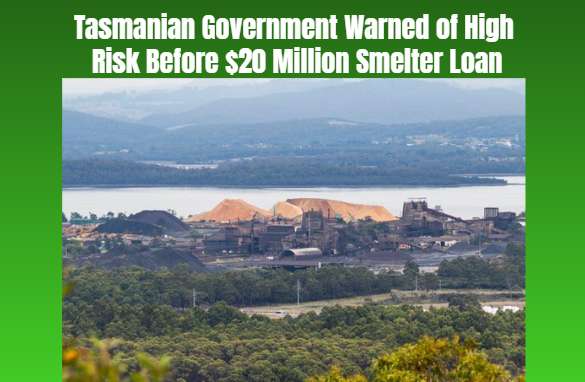
Newly released government documents show Tasmania was warned it might not recover the full value of a $20 million taxpayer-funded loan to the now-closed Liberty Bell Bay manganese smelter.
The Tasmanian government proceeded with a $20 million loan to the Liberty Bell Bay manganese smelter despite receiving advice that the financial risks were high, according to an internal government document obtained by ABC News.
The loan was approved in August 2025 to help the struggling industrial facility purchase manganese ore and restart production. However, the smelter ultimately failed to resume operations and closed in July 2026, resulting in the loss of more than 200 jobs.
The document, prepared by Tasmania’s coordinator-general in July 2025, warned that the business could run out of available capital by the end of that month. It recommended an urgent loan of up to $20 million, stating that without an immediate injection of funds, the smelter faced a very high risk of being unable to restart.
Officials assessed every category of risk associated with the loan as high. The document specifically raised concerns about whether the security provided would be sufficient to recover the outstanding amount if the business failed.
Manganese is an important industrial mineral used in steel production. The smelter’s financial difficulties were linked to ore-supply problems, international market volatility and broader pressures affecting its former owner, GFG Alliance, led by British businessman Sanjeev Gupta.
Despite the risks, officials concluded that allowing the smelter to close without intervention could have more serious consequences for Tasmania’s economy. The government’s assessment estimated that a permanent closure could affect the state economy by as much as $500 million annually if the facility failed to reopen.
The government therefore chose to provide the loan rather than take no action. A substantial portion of the money was used to purchase a shipment of approximately 23,000 tonnes of manganese ore. The ore arrived at the site, but production did not restart.
By January 2026, the former owner had defaulted on the loan agreement. The Tasmanian government subsequently appointed receivers to protect the ore stockpile and its position as a secured lender. The material remains an important part of efforts to recover public money.
Business, Industry and Resources Minister Felix Ellis defended the decision, saying the government believed the consequences of doing nothing would have been greater. He also said the loan was secured and the money was paid directly to the ore supplier.
The amount the government can ultimately recover depends on the sale value of the ore and the outcome of the recovery process. The full financial loss, if any, has not yet been established.
The closure has broader implications for Australia's manufacturing sector. Liberty Bell Bay was the country's only manganese alloy smelter, making the facility important to domestic steelmaking supply chains. Its shutdown also leaves former employees and the surrounding community facing uncertainty about future employment opportunities.
The case raises questions about how governments should balance the risks of supporting struggling industrial businesses against the economic and social consequences of allowing them to close. While public assistance can provide a lifeline to workers and strategically important industries, it cannot guarantee that a business will survive.
For Tasmania, the immediate challenge is to recover as much of the loan as possible while addressing the consequences of the smelter's closure. The episode is also likely to prompt further scrutiny of how major financial-support decisions are assessed and communicated.
LoanGovernmentSmelterManganeseBusiness
The Tasmanian government proceeded with a $20 million loan to the Liberty Bell Bay manganese smelter despite receiving advice that the financial risks were high, according to an internal government document obtained by ABC News.
The loan was approved in August 2025 to help the struggling industrial facility purchase manganese ore and restart production. However, the smelter ultimately failed to resume operations and closed in July 2026, resulting in the loss of more than 200 jobs.
The document, prepared by Tasmania’s coordinator-general in July 2025, warned that the business could run out of available capital by the end of that month. It recommended an urgent loan of up to $20 million, stating that without an immediate injection of funds, the smelter faced a very high risk of being unable to restart.
Officials assessed every category of risk associated with the loan as high. The document specifically raised concerns about whether the security provided would be sufficient to recover the outstanding amount if the business failed.
Manganese is an important industrial mineral used in steel production. The smelter’s financial difficulties were linked to ore-supply problems, international market volatility and broader pressures affecting its former owner, GFG Alliance, led by British businessman Sanjeev Gupta.
Despite the risks, officials concluded that allowing the smelter to close without intervention could have more serious consequences for Tasmania’s economy. The government’s assessment estimated that a permanent closure could affect the state economy by as much as $500 million annually if the facility failed to reopen.
The government therefore chose to provide the loan rather than take no action. A substantial portion of the money was used to purchase a shipment of approximately 23,000 tonnes of manganese ore. The ore arrived at the site, but production did not restart.
By January 2026, the former owner had defaulted on the loan agreement. The Tasmanian government subsequently appointed receivers to protect the ore stockpile and its position as a secured lender. The material remains an important part of efforts to recover public money.
Business, Industry and Resources Minister Felix Ellis defended the decision, saying the government believed the consequences of doing nothing would have been greater. He also said the loan was secured and the money was paid directly to the ore supplier.
The amount the government can ultimately recover depends on the sale value of the ore and the outcome of the recovery process. The full financial loss, if any, has not yet been established.
The closure has broader implications for Australia's manufacturing sector. Liberty Bell Bay was the country's only manganese alloy smelter, making the facility important to domestic steelmaking supply chains. Its shutdown also leaves former employees and the surrounding community facing uncertainty about future employment opportunities.
The case raises questions about how governments should balance the risks of supporting struggling industrial businesses against the economic and social consequences of allowing them to close. While public assistance can provide a lifeline to workers and strategically important industries, it cannot guarantee that a business will survive.
For Tasmania, the immediate challenge is to recover as much of the loan as possible while addressing the consequences of the smelter's closure. The episode is also likely to prompt further scrutiny of how major financial-support decisions are assessed and communicated.
Australia will open military recruitment to eligible students and recent graduates from Papua New Guinea next month, in a pilot program designed to stre...
Victoria's teaching regulator has carried out unannounced inspections at two Fitzroy Community School campuses as investigations into child-safety conce...
Ukraine has urged an international Antarctic conservation commission to press for the immediate release of scientist Leonid Pshenichnov, whose health is...
NSW Police are seeking public assistance to locate Kynan Benson, who was last seen in Vineyard on 15 October. Authorities say his welfare is a concern b...
A last-minute Supreme Court injunction has halted plans to remove a large fig tree at Rex Smeal Park in Port Douglas after a local resident gathered mor...
Sudden hail has damaged crops in parts of Australia just as farmers prepare for an important harvest season, raising concerns about crop quality and pot...
A 79-year-old woman from Busselton is recovering in a Bali hospital after falling down a restaurant stairwell, with her family facing substantial medica...
Australia will open military recruitment to eligible students and recent graduates from Papua New Guinea next month, in a pilot program designed to stre...
Victorian police have charged seven people in connection with an alleged group attack that resulted in a death in Melbourne’s western suburbs. The case...
Northern Territory Police have charged an 18-year-old man following a five-month investigation into a fatal hit-and-run that killed a 57-year-old man in...
New South Wales Police are continuing to search for a shotgun allegedly used during an incident in Sydney’s inner west, after a 32-year-old man was char...