UN Warns Chevron After Satellite Detects Large Methane Plumes Above Western Australia Gas Plant
By Chloe · Published 23 Oct 2026 · Updated 23 Oct 2026
Barrow Island, WA
Safety note: Admin approval is an initial review, not a guarantee that every detail is correct. Check important or urgent claims with official sources and report anything inaccurate or unsafe.
Source and credit: Contributor's own report
UN Warns Chevron After Satellite Detects Large Methane Plumes Above Western Australia Gas Plant - Barrow Island, WA
Smart summary
Repeated satellite observations of methane emissions above the Gorgon liquefied natural gas facility have prompted a United Nations warning and an investigation by Western Australian authorities.
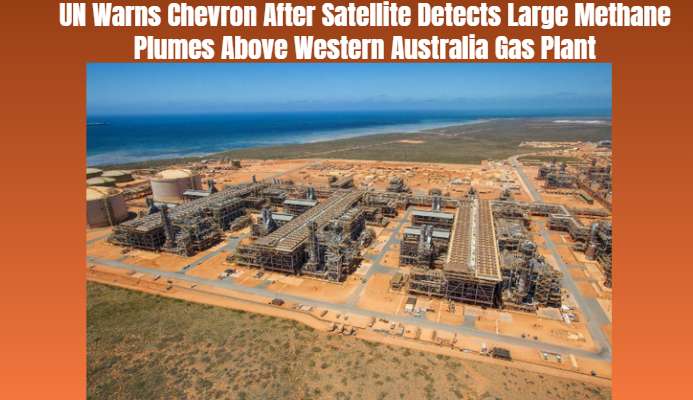
Large plumes of methane have been detected above Chevron’s Gorgon liquefied natural gas (LNG) facility off Western Australia’s Pilbara coast, prompting a warning from the United Nations and an investigation by state authorities. The findings were reported by ABC News on 23 October 2026 after satellite monitoring identified repeated emissions above the major gas-processing complex.
The observations were made by the Tanager-1 satellite, operated by the non-profit organisation Carbon Mapper as part of the United Nations Environment Programme’s International Methane Emissions Observatory. According to the report, five consecutive satellite passes detected methane plumes above the facility beginning in November 2025. The latest reported observation, recorded in late August 2026, indicated an average emission rate of approximately 7.8 tonnes of methane per hour.
Methane is a powerful greenhouse gas that contributes significantly to global warming. Although it remains in the atmosphere for less time than carbon dioxide, it traps substantially more heat over shorter periods. Reducing methane emissions is therefore considered an important part of efforts to limit climate change. Satellite monitoring identifies repeated emissions The repeated detections raised concerns because the emissions appeared across several satellite observations rather than being recorded as a single isolated event. Carbon Mapper’s monitoring data identified the Gorgon facility as the highest methane emitter in Western Australia among the sites shown in its reported observations.
The satellite measurements are designed to identify concentrated greenhouse gas plumes and estimate their intensity. However, satellite observations have limitations, and additional investigation is required to establish the precise source, cause and duration of an emission.
Chevron confirmed that it had received an alert concerning the observations and was engaging with the United Nations Environment Programme to obtain further information. The company said satellite monitoring involved a wide range of uncertainty and that it was seeking clarification about the data. It did not confirm the cause of the emissions or whether the releases had stopped.
Western Australian authorities investigate The Western Australian Department of Water and Environmental Regulation confirmed that it was aware of the reported emissions and was investigating what regulatory or compliance measures might be necessary.
The case has also raised questions about responsibility for monitoring emissions from large industrial facilities. Methane emissions are reported through Australia's National Greenhouse and Energy Reporting Scheme, but the ABC report said federal authorities referred enquiries about the Gorgon issue to state regulators because methane falls outside the facility’s existing federal approval arrangements.
Environmental advocates have called for governments and regulators to coordinate their responses and establish clear responsibility for investigating the findings. Environmental concerns surrounding Gorgon The Gorgon project is one of Australia's largest LNG developments. It operates on Barrow Island, a nature reserve off the Pilbara coast, and includes technology intended to capture and store carbon dioxide produced during gas processing.
The reported methane detections add to existing environmental scrutiny of the project. Its carbon capture and storage system has underperformed against its original objectives since operations began in 2016. Chevron also reported that an unknown quantity of gas had seeped into the island's surface in the previous year.
Researchers cited in the ABC report suggested the emissions could be associated with equipment used to remove impurities from natural gas. However, the cause has not been confirmed, and further measurements would be needed to determine the scale and source of the releases. Significance for Australia's climate commitments The findings highlight the role of satellite technology in identifying industrial emissions that may be difficult to detect through conventional monitoring alone. Independent observations can help regulators identify potential problems and determine whether companies are meeting environmental requirements.
The investigation is still developing. Its outcome will depend on further technical assessment, cooperation between Chevron and regulators, and clarification of the satellite data. The case also demonstrates the importance of transparent emissions reporting as Australia works to reduce greenhouse gas pollution while maintaining its energy industry.
EmissionsMethaneSatelliteReportedMonitoring
Large plumes of methane have been detected above Chevron’s Gorgon liquefied natural gas (LNG) facility off Western Australia’s Pilbara coast, prompting a warning from the United Nations and an investigation by state authorities. The findings were reported by ABC News on 23 October 2026 after satellite monitoring identified repeated emissions above the major gas-processing complex.
The observations were made by the Tanager-1 satellite, operated by the non-profit organisation Carbon Mapper as part of the United Nations Environment Programme’s International Methane Emissions Observatory. According to the report, five consecutive satellite passes detected methane plumes above the facility beginning in November 2025. The latest reported observation, recorded in late August 2026, indicated an average emission rate of approximately 7.8 tonnes of methane per hour.
Methane is a powerful greenhouse gas that contributes significantly to global warming. Although it remains in the atmosphere for less time than carbon dioxide, it traps substantially more heat over shorter periods. Reducing methane emissions is therefore considered an important part of efforts to limit climate change. Satellite monitoring identifies repeated emissions The repeated detections raised concerns because the emissions appeared across several satellite observations rather than being recorded as a single isolated event. Carbon Mapper’s monitoring data identified the Gorgon facility as the highest methane emitter in Western Australia among the sites shown in its reported observations.
The satellite measurements are designed to identify concentrated greenhouse gas plumes and estimate their intensity. However, satellite observations have limitations, and additional investigation is required to establish the precise source, cause and duration of an emission.
Chevron confirmed that it had received an alert concerning the observations and was engaging with the United Nations Environment Programme to obtain further information. The company said satellite monitoring involved a wide range of uncertainty and that it was seeking clarification about the data. It did not confirm the cause of the emissions or whether the releases had stopped.
Western Australian authorities investigate The Western Australian Department of Water and Environmental Regulation confirmed that it was aware of the reported emissions and was investigating what regulatory or compliance measures might be necessary.
The case has also raised questions about responsibility for monitoring emissions from large industrial facilities. Methane emissions are reported through Australia's National Greenhouse and Energy Reporting Scheme, but the ABC report said federal authorities referred enquiries about the Gorgon issue to state regulators because methane falls outside the facility’s existing federal approval arrangements.
Environmental advocates have called for governments and regulators to coordinate their responses and establish clear responsibility for investigating the findings. Environmental concerns surrounding Gorgon The Gorgon project is one of Australia's largest LNG developments. It operates on Barrow Island, a nature reserve off the Pilbara coast, and includes technology intended to capture and store carbon dioxide produced during gas processing.
The reported methane detections add to existing environmental scrutiny of the project. Its carbon capture and storage system has underperformed against its original objectives since operations began in 2016. Chevron also reported that an unknown quantity of gas had seeped into the island's surface in the previous year.
Researchers cited in the ABC report suggested the emissions could be associated with equipment used to remove impurities from natural gas. However, the cause has not been confirmed, and further measurements would be needed to determine the scale and source of the releases. Significance for Australia's climate commitments The findings highlight the role of satellite technology in identifying industrial emissions that may be difficult to detect through conventional monitoring alone. Independent observations can help regulators identify potential problems and determine whether companies are meeting environmental requirements.
The investigation is still developing. Its outcome will depend on further technical assessment, cooperation between Chevron and regulators, and clarification of the satellite data. The case also demonstrates the importance of transparent emissions reporting as Australia works to reduce greenhouse gas pollution while maintaining its energy industry.
Researchers have confirmed that an endangered colony survived devastating cave flooding, but low population numbers and limited genetic diversity are ra...
Australian capital-city house prices fell 4.7 per cent in the September quarter, with Perth recording the sharpest decline as affordability pressures an...
Newly released government documents show Tasmania was warned it might not recover the full value of a $20 million taxpayer-funded loan to the now-closed...
Australia will open military recruitment to eligible students and recent graduates from Papua New Guinea next month, in a pilot program designed to stre...
An 85-year-old man who has worn pink every day in memory of his wife is raising awareness of breast cancer and the need for better support for people li...
Two Colombian police departments say they have no record of operational cooperation with Australia's newly announced anti-drug taskforce, raising questi...
Victorian police are searching for the driver of a white semi-trailer truck after a motorcyclist was found dead on the Maroondah Highway near Yarck. Inv...
Researchers have confirmed that an endangered colony survived devastating cave flooding, but low population numbers and limited genetic diversity are ra...
A major investigation into alleged drug manufacturing has led to arrests, the discovery of illegal gambling venues and the seizure of drugs, weapons, to...
An 85-year-old man who has worn pink every day in memory of his wife is raising awareness of breast cancer and the need for better support for people li...
A new agreement between the Victorian and federal governments sets a pathway towards fully funding public schools by 2034, with education leaders cautio...