BHP Axes 300 Jobs at Iron Ore Mines in Western Australia’s Pilbara
By Neha · Published 14 Oct 2026 · Updated 14 Oct 2026
Pilbara, WA
Safety note: Admin approval is an initial review, not a guarantee that every detail is correct. Check important or urgent claims with official sources and report anything inaccurate or unsafe.
Source and credit: Contributor's own report
BHP Axes 300 Jobs at Iron Ore Mines in Western Australia’s Pilbara - Pilbara, WA
Smart summary
Mining giant BHP confirms workforce reductions across several Pilbara operations, prompting calls from the Western Australian Government and unions to protect skilled workers.
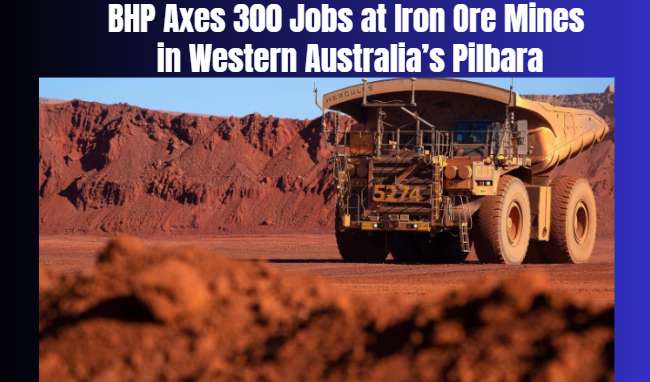
Mining company BHP has confirmed job cuts across its iron ore operations in Western Australia’s Pilbara region, raising concerns about employment, workforce planning and the economic impact on mining communities.
Approximately 300 positions are expected to be affected across four operations: South Flank, Mining Area C, Jimblebar and Newman. These sites form part of the company’s major iron ore production network in the Pilbara, a region that plays an important role in Western Australia’s resources industry.
BHP has said it is making changes intended to support the business’s continued contribution to the region and the state. However, the company has not publicly specified the total number of positions that will be eliminated. It has indicated that it will seek to redeploy affected employees into other roles within the business wherever possible. The announcement has drawn criticism from Western Australian officials. Pilbara Minister Amber-Jade Sanderson described the decision as disappointing and urged the company to retain workers by moving them into other positions where suitable opportunities exist.
The government has also indicated that employment and skills support will be important for workers who need to transition into different roles or industries. Mining employees often possess specialised technical and operational experience, which may be valuable across other resource projects, infrastructure work and industrial sectors.
Unions have also questioned the proposed reductions. The Electrical Trades Union’s Western Australian leadership criticised the decision and raised concerns about whether redundancies are genuinely necessary. Union representatives have called for proper consultation and indicated they will scrutinise the reasons given for each proposed job loss. BHP has rejected the suggestion that unions were caught off guard. The company said consultation with employees began on 5 October and that unions were informed on the same day.
The workforce announcement comes amid an existing dispute between BHP and unions over pay and working conditions at the company’s Port Hedland operations. That disagreement has involved recent strike action, and unions have lodged an application with the Fair Work Commission in an effort to resolve the dispute. BHP electricians working at sites near Newman have also sought supported bargaining arrangements through the commission.
The developments highlight the employment pressures facing workers in a major Australian mining region. Changes at large mining operations can affect not only employees but also contractors, service providers and businesses that depend on local spending.
For workers facing potential redundancy, the immediate questions will include whether alternative positions are available, how consultation proceeds and what support is offered during any transition. The final impact will depend on the number of positions ultimately removed and the extent to which employees can be redeployed.
The announcement also places renewed attention on the relationship between large resource companies, their workforce and the communities that support their operations. While companies regularly review staffing and operating costs, the process can have significant consequences for families and regional economies.
At this stage, the reported figure of around 300 positions should be treated as an estimate rather than a final company-confirmed redundancy total. Further information about individual roles, redeployment opportunities and the final workforce changes will be important in assessing the full impact on Pilbara workers.
WillCompanyMiningPositionsAlso
Mining company BHP has confirmed job cuts across its iron ore operations in Western Australia’s Pilbara region, raising concerns about employment, workforce planning and the economic impact on mining communities.
Approximately 300 positions are expected to be affected across four operations: South Flank, Mining Area C, Jimblebar and Newman. These sites form part of the company’s major iron ore production network in the Pilbara, a region that plays an important role in Western Australia’s resources industry.
BHP has said it is making changes intended to support the business’s continued contribution to the region and the state. However, the company has not publicly specified the total number of positions that will be eliminated. It has indicated that it will seek to redeploy affected employees into other roles within the business wherever possible. The announcement has drawn criticism from Western Australian officials. Pilbara Minister Amber-Jade Sanderson described the decision as disappointing and urged the company to retain workers by moving them into other positions where suitable opportunities exist.
The government has also indicated that employment and skills support will be important for workers who need to transition into different roles or industries. Mining employees often possess specialised technical and operational experience, which may be valuable across other resource projects, infrastructure work and industrial sectors.
Unions have also questioned the proposed reductions. The Electrical Trades Union’s Western Australian leadership criticised the decision and raised concerns about whether redundancies are genuinely necessary. Union representatives have called for proper consultation and indicated they will scrutinise the reasons given for each proposed job loss. BHP has rejected the suggestion that unions were caught off guard. The company said consultation with employees began on 5 October and that unions were informed on the same day.
The workforce announcement comes amid an existing dispute between BHP and unions over pay and working conditions at the company’s Port Hedland operations. That disagreement has involved recent strike action, and unions have lodged an application with the Fair Work Commission in an effort to resolve the dispute. BHP electricians working at sites near Newman have also sought supported bargaining arrangements through the commission.
The developments highlight the employment pressures facing workers in a major Australian mining region. Changes at large mining operations can affect not only employees but also contractors, service providers and businesses that depend on local spending.
For workers facing potential redundancy, the immediate questions will include whether alternative positions are available, how consultation proceeds and what support is offered during any transition. The final impact will depend on the number of positions ultimately removed and the extent to which employees can be redeployed.
The announcement also places renewed attention on the relationship between large resource companies, their workforce and the communities that support their operations. While companies regularly review staffing and operating costs, the process can have significant consequences for families and regional economies.
At this stage, the reported figure of around 300 positions should be treated as an estimate rather than a final company-confirmed redundancy total. Further information about individual roles, redeployment opportunities and the final workforce changes will be important in assessing the full impact on Pilbara workers.
A coffee-price tracker found that 17% of surveyed cafés increased prices after Australia’s credit card surcharge ban began, with average increases of 50...
Australia’s competition regulator has launched Federal Court proceedings against 12 egg producers and suppliers, alleging they coordinated production an...
Tesla has proposed a $3.5 million charging facility in Thurgoona, near the Hume Highway, with space to charge 37 electric vehicles simultaneously. The p...
Tesla has applied to increase the number of fast-charging stalls in Kaniva, western Victoria, from 10 to 18. Local businesses say the charging station i...
Prime Minister Anthony Albanese says Australia will explore options to prevent a planned US military execution livestream from appearing on Australian s...
A coffee-price tracker found that 17% of surveyed cafés increased prices after Australia’s credit card surcharge ban began, with average increases of 50...
Emergency doctors warn that hospitals are struggling to accommodate older patients, with longer waits for inpatient beds, overcrowding and gaps in aged...
A proposed Queensland law would exempt corrective services staff from having to consider prisoners’ human rights when making certain decisions. Supporte...
Emergency financial assistance has been announced for eligible Alice Springs residents who remain without electricity following destructive storms that...
An 18-year-old provisional driver accused of injuring 10 people during a Newcastle Knights supporters’ procession has been served with eight additional...
A landmark Queensland court judgment has awarded Mackay grandfather Robin Smith nearly $1.9 million after he developed asbestosis following workplace ex...