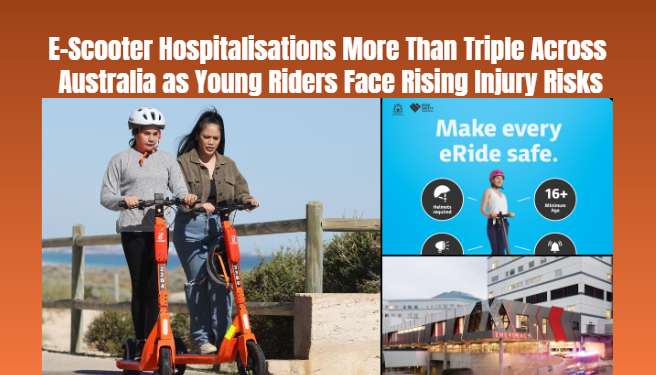
E-Scooter Hospitalisations More Than Triple Across Australia as Young Riders Face Rising Injury Risks
By Chloe · Published 22 Oct 2026 · Updated 22 Oct 2026
National, ACT
Safety note: Admin approval is an initial review, not a guarantee that every detail is correct. Check important or urgent claims with official sources and report anything inaccurate or unsafe.
Source and credit: Contributor's own report
E-Scooter Hospitalisations More Than Triple Across Australia as Young Riders Face Rising Injury Risks - National, ACT
Smart summary
A new report from the Australian Institute of Health and Welfare reveals a sharp rise in hospital admissions involving electric scooters and other powered transport devices, with teenage boys experiencing a particular...
Hospitalisations associated with electric scooter accidents have increased dramatically across Australia, according to a new national report released on Thursday, 22 October 2026. The findings highlight growing safety concerns as electric scooters and electric bikes become more common for everyday travel.
The Australian Institute of Health and Welfare (AIHW) reported that hospitalisations following falls involving e-scooters rose from 1,291 in 2019–20 to 4,089 in 2024–25. The increase comes amid rapid growth in the use of personal electric transport devices across Australian cities and regional communities.
Teenage boys among the most affected The report identified boys aged between 12 and 15 as a group experiencing a particularly significant increase in injuries. Hospitalisations following e-scooter falls among boys in this age group increased approximately 15-fold over the five-year period examined.
In 2024–25, boys aged 12 to 15 were more than four times as likely as girls of the same age to be hospitalised following an e-scooter fall.
Males accounted for approximately two-thirds of hospitalisations involving e-scooter falls during that year. The figures highlight concerns about young riders' experience, protective equipment and the circumstances in which powered devices are being used. Fractures and serious injuries Fractures were among the most common injuries recorded in the report. Almost three in five hospitalisations involved fractures, with their share increasing from 46 per cent in 2015–16 to 58 per cent in 2024–25.
Other injuries included dislocations and internal injuries. The report also recorded an increase in deaths associated with powered scooter incidents over the longer term, from seven in 2014–15 to 20 in 2024–25.
The findings underline the potential consequences of falls and collisions involving powered devices, particularly when riders travel at speed or lose control. Pedestrians also affected The safety concerns extend beyond riders. The report recorded 164 pedestrian hospitalisations following collisions involving e-scooters in 2024–25. A further 147 pedestrian hospitalisations were associated with collisions involving other two- or three-wheeled motor vehicles in the relevant transport categories.
These figures demonstrate that powered mobility devices can create risks for people using footpaths and other shared spaces, not only for those riding them. Differences between states and territories Queensland recorded the highest hospitalisation rate among jurisdictions examined in 2024–25, at 27 admissions per 100,000 people. New South Wales recorded the lowest rate, at 7.8 per 100,000.
The report cautioned that these comparisons need to be interpreted carefully because current hospital data cannot always distinguish e-scooters and e-bikes from other transport devices. Differences in regulations, access to public areas and reporting practices may also affect the figures. Safety measures and improved reporting Researchers have highlighted the importance of helmets, responsible riding, compliant devices and appropriate speed limits. Illegal modifications that increase a device's power or speed can create additional risks for riders and other road users.
New classification codes introduced in July 2026 are expected to improve the collection of national injury data, allowing future reports to distinguish between e-scooters, e-bikes and other transport devices more accurately.
The AIHW report provides an important national overview of the growing injury burden associated with electric mobility. Its findings emphasise the need for better data, effective safety measures and greater awareness as powered devices become an increasingly familiar part of Australian transport.
DevicesHospitalisationsOtherElectricInjuries
Hospitalisations associated with electric scooter accidents have increased dramatically across Australia, according to a new national report released on Thursday, 22 October 2026. The findings highlight growing safety concerns as electric scooters and electric bikes become more common for everyday travel.
The Australian Institute of Health and Welfare (AIHW) reported that hospitalisations following falls involving e-scooters rose from 1,291 in 2019–20 to 4,089 in 2024–25. The increase comes amid rapid growth in the use of personal electric transport devices across Australian cities and regional communities.
Teenage boys among the most affected The report identified boys aged between 12 and 15 as a group experiencing a particularly significant increase in injuries. Hospitalisations following e-scooter falls among boys in this age group increased approximately 15-fold over the five-year period examined.
In 2024–25, boys aged 12 to 15 were more than four times as likely as girls of the same age to be hospitalised following an e-scooter fall.
Males accounted for approximately two-thirds of hospitalisations involving e-scooter falls during that year. The figures highlight concerns about young riders' experience, protective equipment and the circumstances in which powered devices are being used. Fractures and serious injuries Fractures were among the most common injuries recorded in the report. Almost three in five hospitalisations involved fractures, with their share increasing from 46 per cent in 2015–16 to 58 per cent in 2024–25.
Other injuries included dislocations and internal injuries. The report also recorded an increase in deaths associated with powered scooter incidents over the longer term, from seven in 2014–15 to 20 in 2024–25.
The findings underline the potential consequences of falls and collisions involving powered devices, particularly when riders travel at speed or lose control. Pedestrians also affected The safety concerns extend beyond riders. The report recorded 164 pedestrian hospitalisations following collisions involving e-scooters in 2024–25. A further 147 pedestrian hospitalisations were associated with collisions involving other two- or three-wheeled motor vehicles in the relevant transport categories.
These figures demonstrate that powered mobility devices can create risks for people using footpaths and other shared spaces, not only for those riding them. Differences between states and territories Queensland recorded the highest hospitalisation rate among jurisdictions examined in 2024–25, at 27 admissions per 100,000 people. New South Wales recorded the lowest rate, at 7.8 per 100,000.
The report cautioned that these comparisons need to be interpreted carefully because current hospital data cannot always distinguish e-scooters and e-bikes from other transport devices. Differences in regulations, access to public areas and reporting practices may also affect the figures. Safety measures and improved reporting Researchers have highlighted the importance of helmets, responsible riding, compliant devices and appropriate speed limits. Illegal modifications that increase a device's power or speed can create additional risks for riders and other road users.
New classification codes introduced in July 2026 are expected to improve the collection of national injury data, allowing future reports to distinguish between e-scooters, e-bikes and other transport devices more accurately.
The AIHW report provides an important national overview of the growing injury burden associated with electric mobility. Its findings emphasise the need for better data, effective safety measures and greater awareness as powered devices become an increasingly familiar part of Australian transport.
Regional aged-care providers warn that changes to migration pathways could make it harder to recruit and retain workers, putting additional pressure on...
New South Wales health authorities have warned about the risks of unapproved peptide products after monthly emergency department presentations linked to...
A new guide developed with survivors and specialists aims to help doctors and other healthcare professionals recognise signs of modern slavery and conne...
The Northern Territory government plans to introduce legislation requiring future operators of Darwin Private Hospital to provide private maternity serv...
A 74-year-old man has been fined after investigators discovered hundreds of frozen and taxidermied animals, including protected and threatened wildlife,...
A 30-year-old man has been committed to stand trial over an alleged assault that left a 60-year-old woman with multiple serious injuries after a dispute...
A last-minute Supreme Court injunction has halted plans to remove a large fig tree at Rex Smeal Park in Port Douglas after a local resident gathered mor...
Newly released government documents show Tasmania was warned it might not recover the full value of a $20 million taxpayer-funded loan to the now-closed...
Australian workers and industry representatives are calling for stronger action by the Australian Taxation Office after new reporting highlighted that a...
A 29-year-old man was arrested after allegedly attempting to steal a vehicle while carrying an axe following a multi-vehicle collision in Melbourne’s no...
Australia’s cyber.gov.au website is among the government services affected by two critical vulnerabilities in PHP, a programming language used by millio...
A court has heard evidence from a friend of former police officer Beau Lamarre-Condon during his trial over the alleged murders of Jesse Baird and Luke...