Safety note: Admin approval is an initial review, not a guarantee that every detail is correct. Check important or urgent claims with official sources and report anything inaccurate or unsafe.
Source and credit: Contributor's own report
Geelong Pushes for National Levy on AI Data Centres - Geelong, VIC
Smart summary
Greater Geelong Council wants data-centre operators to contribute to local infrastructure as community concerns grow over energy, water use and development impacts.
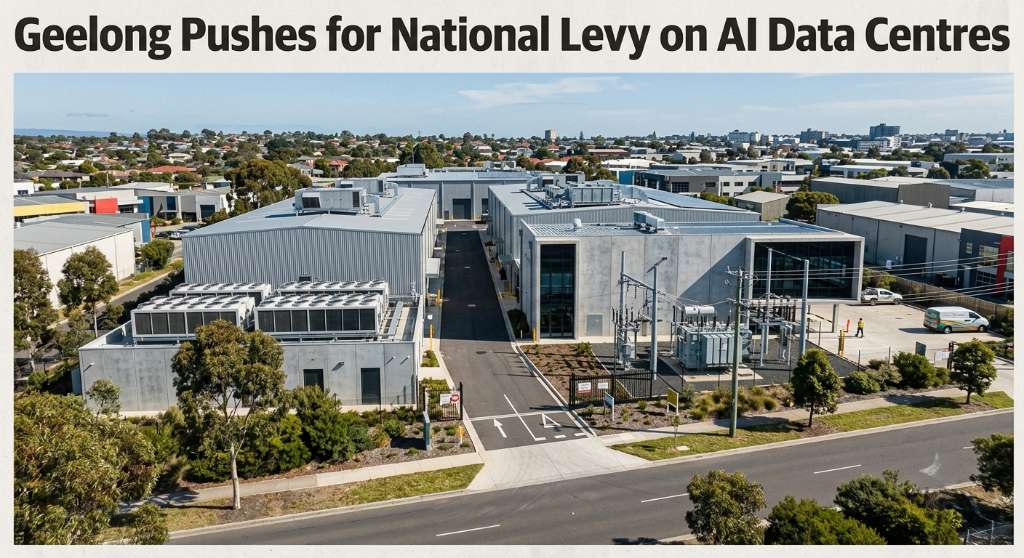
The City of Greater Geelong is calling for a national community-benefits levy on data centres, arguing that rapidly expanding digital infrastructure should provide a greater direct benefit to the communities hosting it.
Council says data centres are increasingly important to Australia's digital economy, including the infrastructure needed to support artificial intelligence and other technology services. However, the growth of these facilities has also raised concerns about their use of electricity and water, their physical scale and their potential impact on surrounding communities.
The proposal would establish a national framework requiring data-centre developments to contribute financially towards local infrastructure. The funds could potentially support projects such as sporting facilities, arts and cultural infrastructure, emergency services and other community priorities.
The council's position comes amid increasing attention on the environmental and social impacts associated with large-scale data infrastructure. Data centres can require substantial amounts of electricity to operate computer equipment and cooling systems, while some facilities can also have significant water requirements.
Greater Geelong leaders have argued that communities should have a stronger voice when major data-centre projects are proposed in or near residential areas. The council is calling for changes to planning and development processes so local communities can better understand proposed facilities and have meaningful opportunities to participate in decisions.
Another concern is the number of jobs created relative to the size of some data-centre developments. While the facilities can represent major investment and provide construction and technology-related employment, councils and communities are questioning whether the long-term local economic benefits are sufficient to offset infrastructure and environmental pressures.
The proposal suggests that a community-benefits system could help create a more balanced relationship between technology companies and host communities. Instead of communities simply accommodating large infrastructure projects, a levy would provide funding that could be invested back into local facilities and services.
The issue is becoming increasingly relevant as demand for computing power grows. Artificial intelligence applications, cloud services and digital platforms require increasingly large amounts of computing infrastructure, creating pressure for additional data-centre capacity across Australia.
Greater Geelong is also arguing that data centres should be located in appropriate industrial areas rather than close to homes and schools where possible. This could reduce concerns about visual impacts, noise and other potential effects on established neighbourhoods.
The council has raised the proposal with federal and state leaders and is seeking broader discussion about how Australia manages the growth of data-centre infrastructure.
The issue is likely to remain significant as governments attempt to balance technological development with energy availability, water resources, planning considerations and community expectations.
For Geelong residents, the debate is ultimately about ensuring that major technology infrastructure delivers tangible local benefits while limiting potential impacts on the community.
The council's proposal does not reject data centres or technological development. Instead, it calls for a framework that gives communities a greater role and ensures some of the economic value generated by major infrastructure is returned to the areas where facilities are built.
InfrastructureCommunitiesDataFacilitiesCentres
The City of Greater Geelong is calling for a national community-benefits levy on data centres, arguing that rapidly expanding digital infrastructure should provide a greater direct benefit to the communities hosting it.
Council says data centres are increasingly important to Australia's digital economy, including the infrastructure needed to support artificial intelligence and other technology services. However, the growth of these facilities has also raised concerns about their use of electricity and water, their physical scale and their potential impact on surrounding communities.
The proposal would establish a national framework requiring data-centre developments to contribute financially towards local infrastructure. The funds could potentially support projects such as sporting facilities, arts and cultural infrastructure, emergency services and other community priorities.
The council's position comes amid increasing attention on the environmental and social impacts associated with large-scale data infrastructure. Data centres can require substantial amounts of electricity to operate computer equipment and cooling systems, while some facilities can also have significant water requirements.
Greater Geelong leaders have argued that communities should have a stronger voice when major data-centre projects are proposed in or near residential areas. The council is calling for changes to planning and development processes so local communities can better understand proposed facilities and have meaningful opportunities to participate in decisions.
Another concern is the number of jobs created relative to the size of some data-centre developments. While the facilities can represent major investment and provide construction and technology-related employment, councils and communities are questioning whether the long-term local economic benefits are sufficient to offset infrastructure and environmental pressures.
The proposal suggests that a community-benefits system could help create a more balanced relationship between technology companies and host communities. Instead of communities simply accommodating large infrastructure projects, a levy would provide funding that could be invested back into local facilities and services.
The issue is becoming increasingly relevant as demand for computing power grows. Artificial intelligence applications, cloud services and digital platforms require increasingly large amounts of computing infrastructure, creating pressure for additional data-centre capacity across Australia.
Greater Geelong is also arguing that data centres should be located in appropriate industrial areas rather than close to homes and schools where possible. This could reduce concerns about visual impacts, noise and other potential effects on established neighbourhoods.
The council has raised the proposal with federal and state leaders and is seeking broader discussion about how Australia manages the growth of data-centre infrastructure.
The issue is likely to remain significant as governments attempt to balance technological development with energy availability, water resources, planning considerations and community expectations.
For Geelong residents, the debate is ultimately about ensuring that major technology infrastructure delivers tangible local benefits while limiting potential impacts on the community.
The council's proposal does not reject data centres or technological development. Instead, it calls for a framework that gives communities a greater role and ensures some of the economic value generated by major infrastructure is returned to the areas where facilities are built.
Tesla is preparing to bring its driverless Cybercab to Australia for a preview, giving Australians an early look at the company’s autonomous vehicle tec...
A 15-year-old Pacific Lutheran College student has developed a privacy-first women’s health app and presented her work at a major national cyber event.
Perth Western Australia · Technology News · 03 Sep 2026
Western Australia Police have announced that hundreds of fines issued through AI-assisted traffic cameras are being dropped following a review of the technology and enforcement...
New workplace data shows staff absenteeism jumped sharply during the historic MCG NFL event, while Melbourne businesses also benefited from a major spen...
Cairns Regional Council has unanimously voted to seek $400,000 in Queensland Government funding for a program designed to connect local businesses with the region’s growing film...
An automated external defibrillator and memorial plaque have been installed at Ellery Creek Big Hole following the death of disability advocate Ellen Fr...
Queensland firefighters spent several hours monitoring a significant grass fire at Mary Kinross Park in Bargara, near Bundaberg, after the blaze broke out on Wednesday evening....