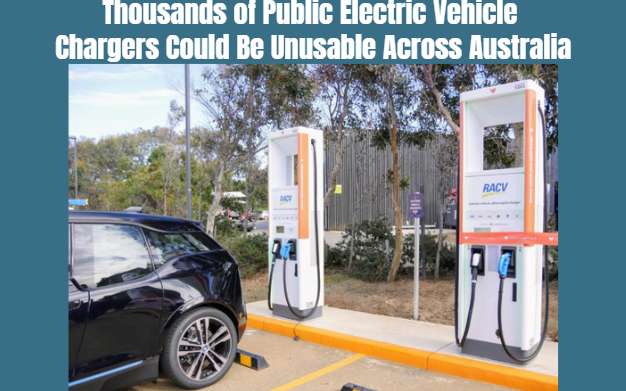
Thousands of Public Electric Vehicle Chargers Could Be Unusable Across Australia
By Chloe · Published 02 Nov 2026 · Updated 02 Nov 2026
National, ACT
Safety note: Admin approval is an initial review, not a guarantee that every detail is correct. Check important or urgent claims with official sources and report anything inaccurate or unsafe.
Source and credit: Contributor's own report
Thousands of Public Electric Vehicle Chargers Could Be Unusable Across Australia - National, ACT
Smart summary
Concerns are growing over the reliability and availability of Australia's public electric vehicle charging network, with thousands of charging points potentially affected by technical and operational problems.
Australia is preparing for a major expansion of its public electric vehicle charging network, but new research has raised concerns that thousands of charging points could remain difficult for motorists to access.
The Federal Government's Accelerating EV Charging Program is expected to support the installation of approximately 14,000 electric vehicle chargers on residential power poles from 2027. The initiative is designed to help people living in apartments and high-density neighbourhoods who do not have private garages or off-street parking.
However, an investigation published by ABC Science on 2 November 2026 has highlighted a significant problem: many of the new chargers may not have dedicated parking spaces.
This means petrol and diesel vehicles could legally occupy the parking spaces directly beside charging equipment, preventing electric vehicle owners from using the chargers.
The problem is already being experienced in Sydney's eastern suburbs. Areas including Waverley, Woollahra and Randwick have large apartment populations and a growing number of electric vehicle owners.
Data provided to ABC by local charging program representatives indicates that some chargers without dedicated parking are being used considerably less frequently than those with reserved spaces.
Anthony Weinberg, who manages the electric vehicle charging program across the three council areas, said some undedicated charging locations were achieving only around 5 to 10 per cent of the usage recorded at dedicated locations.
One example involved two chargers in Bondi. A dedicated charging point on Ocean Street recorded 988 charging sessions over 12 months. Meanwhile, an undedicated charger on Curlewis Street recorded just four sessions during the same period.
These figures have raised questions about whether the government's planned infrastructure expansion will deliver its expected benefits.
The program's modelling estimates that the 14,000 new chargers could support approximately 420,000 electric vehicles. It also forecasts emissions reductions worth around $802 million.
However, independent analysis by Ross de Rango, director of Vehicle Charging Solutions Australia, suggests that chargers without dedicated parking may support significantly fewer vehicles.
His research found that some undedicated charging points could support approximately three electric vehicles rather than the 30 estimated in the government modelling.
This difference could have major implications for the effectiveness of the national charging program.
The Australian Energy Market Commission has also identified uncertainty around the effectiveness of chargers without dedicated parking. Its analysis found limited reliable evidence that these installations would significantly increase electric vehicle ownership.
Charging infrastructure companies have expressed concerns about the proposed installation arrangements. They argue that charging locations should be selected according to their practical usefulness and the availability of parking.
There are also questions about who will pay for the infrastructure. The program could add up to approximately $1.44 annually to individual household electricity bills.
The Department of Climate Change, Energy, the Environment and Water has said that a mixture of dedicated and non-dedicated charging locations is expected. It also believes demand for public charging will increase as more Australians purchase electric vehicles.
The first chargers under the program are scheduled to begin installation from March 2027, subject to the regulatory process.
The issue highlights an important challenge for Australia's transition towards cleaner transport. Installing more charging equipment will not necessarily solve accessibility problems unless drivers can actually park beside the charging points.
ChargingChargersElectricVehicleCould
Australia is preparing for a major expansion of its public electric vehicle charging network, but new research has raised concerns that thousands of charging points could remain difficult for motorists to access.
The Federal Government's Accelerating EV Charging Program is expected to support the installation of approximately 14,000 electric vehicle chargers on residential power poles from 2027. The initiative is designed to help people living in apartments and high-density neighbourhoods who do not have private garages or off-street parking.
However, an investigation published by ABC Science on 2 November 2026 has highlighted a significant problem: many of the new chargers may not have dedicated parking spaces.
This means petrol and diesel vehicles could legally occupy the parking spaces directly beside charging equipment, preventing electric vehicle owners from using the chargers.
The problem is already being experienced in Sydney's eastern suburbs. Areas including Waverley, Woollahra and Randwick have large apartment populations and a growing number of electric vehicle owners.
Data provided to ABC by local charging program representatives indicates that some chargers without dedicated parking are being used considerably less frequently than those with reserved spaces.
Anthony Weinberg, who manages the electric vehicle charging program across the three council areas, said some undedicated charging locations were achieving only around 5 to 10 per cent of the usage recorded at dedicated locations.
One example involved two chargers in Bondi. A dedicated charging point on Ocean Street recorded 988 charging sessions over 12 months. Meanwhile, an undedicated charger on Curlewis Street recorded just four sessions during the same period.
These figures have raised questions about whether the government's planned infrastructure expansion will deliver its expected benefits.
The program's modelling estimates that the 14,000 new chargers could support approximately 420,000 electric vehicles. It also forecasts emissions reductions worth around $802 million.
However, independent analysis by Ross de Rango, director of Vehicle Charging Solutions Australia, suggests that chargers without dedicated parking may support significantly fewer vehicles.
His research found that some undedicated charging points could support approximately three electric vehicles rather than the 30 estimated in the government modelling.
This difference could have major implications for the effectiveness of the national charging program.
The Australian Energy Market Commission has also identified uncertainty around the effectiveness of chargers without dedicated parking. Its analysis found limited reliable evidence that these installations would significantly increase electric vehicle ownership.
Charging infrastructure companies have expressed concerns about the proposed installation arrangements. They argue that charging locations should be selected according to their practical usefulness and the availability of parking.
There are also questions about who will pay for the infrastructure. The program could add up to approximately $1.44 annually to individual household electricity bills.
The Department of Climate Change, Energy, the Environment and Water has said that a mixture of dedicated and non-dedicated charging locations is expected. It also believes demand for public charging will increase as more Australians purchase electric vehicles.
The first chargers under the program are scheduled to begin installation from March 2027, subject to the regulatory process.
The issue highlights an important challenge for Australia's transition towards cleaner transport. Installing more charging equipment will not necessarily solve accessibility problems unless drivers can actually park beside the charging points.
A major Microsoft service disruption affected millions of users worldwide, interrupting email, workplace communication, healthcare administration and bu...
A new national online threat centre has opened to help identify dangerous extremist content, tackle online radicalisation and strengthen Australia's res...
New battery-powered trailer technology is attracting attention in Australia's transport industry, with the potential to reduce fuel consumption, operati...
Western Berry is investing in artificial intelligence, autonomous machinery and mechanical harvesting to reduce farming costs and address seasonal worke...
A private conversation between the two leaders was accidentally recorded during a break at the international climate summit in Türkiye, prompting widesp...
Australia delivers a dominant performance against Asian Cup champions Qatar in Doha, with Riley McGree, Tete Yengi and Nestory Irankunda scoring three f...
Far North Queensland continues to experience extreme temperatures, with Weipa recording its hottest November day and communities facing water shortages...
Western Berry is investing in artificial intelligence, autonomous machinery and mechanical harvesting to reduce farming costs and address seasonal worke...
A private conversation between the two leaders was accidentally recorded during a break at the international climate summit in Türkiye, prompting widesp...
Australia delivers a dominant performance against Asian Cup champions Qatar in Doha, with Riley McGree, Tete Yengi and Nestory Irankunda scoring three f...
A major Microsoft service disruption affected millions of users worldwide, interrupting email, workplace communication, healthcare administration and bu...
A new national online threat centre has opened to help identify dangerous extremist content, tackle online radicalisation and strengthen Australia's res...