Safety note: Admin approval is an initial review, not a guarantee that every detail is correct. Check important or urgent claims with official sources and report anything inaccurate or unsafe.
Source and credit: Contributor's own report
Hobart-Built Electric Ship Completes Major Journey to South America - Hobart, TAS
Smart summary
The world’s largest battery-electric ship, built in Hobart, has arrived in South America after travelling thousands of kilometres across the ocean.
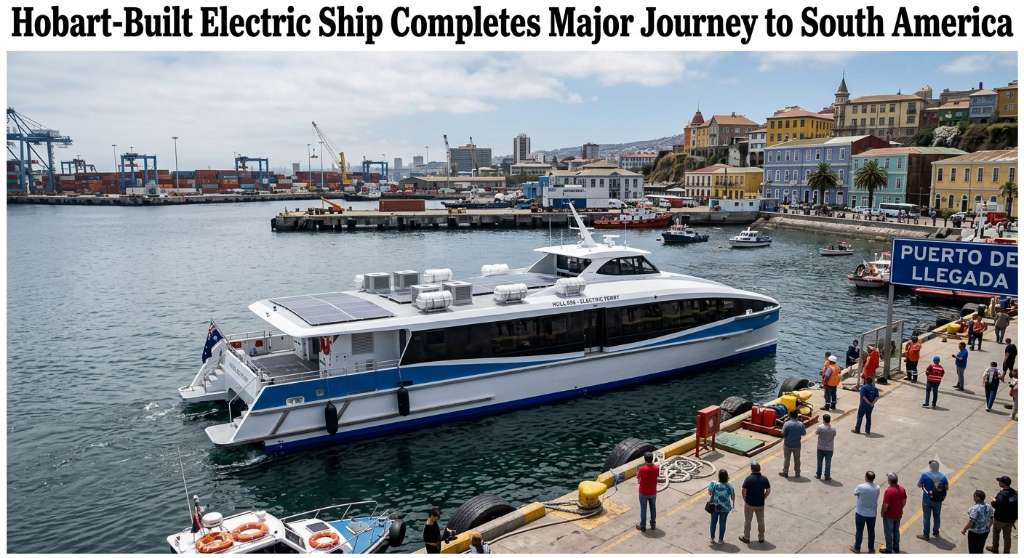
A major Hobart-built vessel has reached South America after completing a long ocean journey, marking an important milestone for Tasmania’s advanced marine manufacturing industry.
The vessel, known as Hull 096, is described as the world’s largest battery-electric ship. It was designed and built by Hobart-based shipbuilder Incat and has now arrived in Uruguay after travelling thousands of kilometres from Tasmania.
The ship’s arrival highlights the international reach of Tasmania’s shipbuilding sector and the growing role of electric technology in commercial marine transport. Unlike conventional vessels that rely heavily on diesel propulsion, the new ferry has been developed around battery-electric technology, representing a significant shift toward lower-emission passenger transport.
Hull 096’s journey from Hobart to South America has attracted attention because of the scale of the vessel and the technology involved. Its successful voyage demonstrates the increasing ability of Australian manufacturers to develop large, sophisticated electric vessels for international markets.
The ship was constructed at Incat’s Hobart facilities, providing a major example of high-value manufacturing taking place in Tasmania. The project has involved engineering, shipbuilding, electrical technology and specialised manufacturing skills, supporting a broad network of workers and suppliers.
The vessel is destined for commercial service in South America, where it will operate as a passenger ferry. Its arrival marks the next stage in the ship’s development before entering regular service.
The project is also significant because the global maritime industry is increasingly examining alternatives to conventional fossil-fuel-powered vessels. Battery-electric ferries can potentially reduce emissions and noise, particularly on routes where vessels repeatedly travel relatively predictable distances and can recharge between services.
For Hobart, the ship represents an international showcase for local engineering and manufacturing expertise. A vessel constructed in Tasmania travelling thousands of kilometres to begin commercial operations overseas demonstrates the global market available to specialist Australian manufacturers.
The milestone comes alongside recognition for the company in Tasmania, with Incat also celebrating being named the state’s Exporter of the Year.
The arrival of Hull 096 in South America therefore represents more than the completion of a delivery voyage. It provides a high-profile example of Hobart-produced technology entering an international transport market while highlighting the potential of cleaner propulsion systems for future passenger vessels.
For Tasmania’s marine industry, the project reinforces Hobart’s reputation as a centre for advanced shipbuilding and innovative vessel design. The successful completion of the journey also provides an important real-world demonstration of large-scale battery-electric marine technology.
As countries and transport operators look for ways to reduce emissions from passenger transport, projects such as Hull 096 could become increasingly important. The Hobart-built vessel now begins its next chapter in South America, carrying with it a significant piece of Tasmanian engineering and manufacturing expertise.
TasmaniaVesselAmericaShipSouth
A major Hobart-built vessel has reached South America after completing a long ocean journey, marking an important milestone for Tasmania’s advanced marine manufacturing industry.
The vessel, known as Hull 096, is described as the world’s largest battery-electric ship. It was designed and built by Hobart-based shipbuilder Incat and has now arrived in Uruguay after travelling thousands of kilometres from Tasmania.
The ship’s arrival highlights the international reach of Tasmania’s shipbuilding sector and the growing role of electric technology in commercial marine transport. Unlike conventional vessels that rely heavily on diesel propulsion, the new ferry has been developed around battery-electric technology, representing a significant shift toward lower-emission passenger transport.
Hull 096’s journey from Hobart to South America has attracted attention because of the scale of the vessel and the technology involved. Its successful voyage demonstrates the increasing ability of Australian manufacturers to develop large, sophisticated electric vessels for international markets.
The ship was constructed at Incat’s Hobart facilities, providing a major example of high-value manufacturing taking place in Tasmania. The project has involved engineering, shipbuilding, electrical technology and specialised manufacturing skills, supporting a broad network of workers and suppliers.
The vessel is destined for commercial service in South America, where it will operate as a passenger ferry. Its arrival marks the next stage in the ship’s development before entering regular service.
The project is also significant because the global maritime industry is increasingly examining alternatives to conventional fossil-fuel-powered vessels. Battery-electric ferries can potentially reduce emissions and noise, particularly on routes where vessels repeatedly travel relatively predictable distances and can recharge between services.
For Hobart, the ship represents an international showcase for local engineering and manufacturing expertise. A vessel constructed in Tasmania travelling thousands of kilometres to begin commercial operations overseas demonstrates the global market available to specialist Australian manufacturers.
The milestone comes alongside recognition for the company in Tasmania, with Incat also celebrating being named the state’s Exporter of the Year.
The arrival of Hull 096 in South America therefore represents more than the completion of a delivery voyage. It provides a high-profile example of Hobart-produced technology entering an international transport market while highlighting the potential of cleaner propulsion systems for future passenger vessels.
For Tasmania’s marine industry, the project reinforces Hobart’s reputation as a centre for advanced shipbuilding and innovative vessel design. The successful completion of the journey also provides an important real-world demonstration of large-scale battery-electric marine technology.
As countries and transport operators look for ways to reduce emissions from passenger transport, projects such as Hull 096 could become increasingly important. The Hobart-built vessel now begins its next chapter in South America, carrying with it a significant piece of Tasmanian engineering and manufacturing expertise.
Tesla is preparing to bring its driverless Cybercab to Australia for a preview, giving Australians an early look at the company’s autonomous vehicle tec...
A 15-year-old Pacific Lutheran College student has developed a privacy-first women’s health app and presented her work at a major national cyber event.
Greater Geelong Council wants data-centre operators to contribute to local infrastructure as community concerns grow over energy, water use and developm...
Perth Western Australia · Technology News · 03 Sep 2026
Western Australia Police have announced that hundreds of fines issued through AI-assisted traffic cameras are being dropped following a review of the technology and enforcement...
New figures have renewed concerns about emergency department delays at Royal Hobart Hospital, with the health system facing questions over patient waiti...
Cairns Regional Council has unanimously voted to seek $400,000 in Queensland Government funding for a program designed to connect local businesses with the region’s growing film...
An automated external defibrillator and memorial plaque have been installed at Ellery Creek Big Hole following the death of disability advocate Ellen Fr...
Queensland firefighters spent several hours monitoring a significant grass fire at Mary Kinross Park in Bargara, near Bundaberg, after the blaze broke out on Wednesday evening....