South Australia’s Upper House Passes Bill to Ban Fracking on the Limestone Coast
By Chloe · Published 29 Oct 2026 · Updated 29 Oct 2026
Limestone Coast, SA
Safety note: Admin approval is an initial review, not a guarantee that every detail is correct. Check important or urgent claims with official sources and report anything inaccurate or unsafe.
Source and credit: Contributor's own report
South Australia’s Upper House Passes Bill to Ban Fracking on the Limestone Coast - Limestone Coast, SA
Smart summary
The proposed permanent ban has won support from the Greens, Liberals and One Nation, but it still faces a challenge in the state’s lower house.
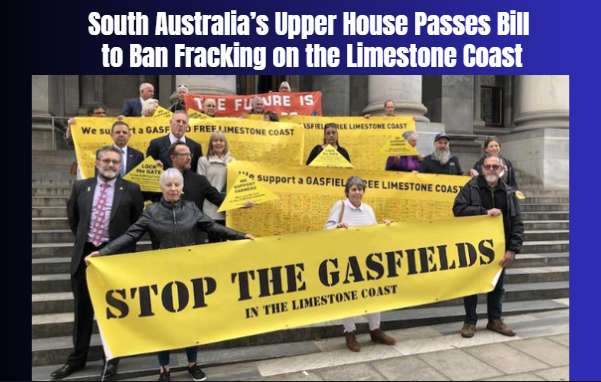
A bill seeking to permanently ban hydraulic fracturing, commonly known as fracking, on South Australia’s Limestone Coast has passed the state parliament’s upper house, marking a significant development in the ongoing debate over regional land use, water resources and energy development.
The bill, introduced by the Greens, received support from the Liberal Party and One Nation in the Legislative Council. However, the proposal has not yet become law. It must pass through the lower house, where the state government opposes the measure. Its future therefore remains uncertain despite the cross-party support secured during the upper-house vote.
Fracking is a method used to extract oil or gas by injecting fluid under high pressure into underground rock formations. The technique has been debated in Australia because of concerns about potential environmental impacts, including effects on groundwater, land management and surrounding ecosystems. Supporters of restrictions argue that sensitive agricultural regions should be protected from risks associated with unconventional gas development, while energy-sector debates also involve questions about future supply, investment and regional economic opportunities.
The Limestone Coast, in the state's south-east, includes agricultural areas and communities whose livelihoods depend on productive land and reliable water resources. For residents and farming interests, decisions about industrial development can have implications extending beyond individual projects, including public confidence in environmental protections and long-term regional planning.
The upper-house vote demonstrates that opposition to fracking restrictions is not divided solely along government-versus-opposition lines. The Greens, Liberals and One Nation supported the bill, although the parties may have different reasons for backing a permanent prohibition. That cooperation has increased pressure for the issue to be considered further in the lower house.
Kirsty Bevan, chief executive of the Conservation Council of South Australia, described the support across parties as an encouraging first step. She also expressed hope that backing from different sectors across the region would help build sufficient support for the bill in the lower house.
The next stage is crucial. The government’s opposition means the proposal faces a political hurdle, and passage through the upper house alone does not establish a permanent ban. Further parliamentary consideration will determine whether the measure advances or stalls.
For communities in the Limestone Coast, the debate highlights a wider challenge facing regional South Australia: balancing economic and energy policy with the protection of farmland, water and local environments. The bill’s progress will be closely watched by environmental groups, regional residents and political representatives as the legislative process continues.
BillHouseRegionalCoastDevelopment
A bill seeking to permanently ban hydraulic fracturing, commonly known as fracking, on South Australia’s Limestone Coast has passed the state parliament’s upper house, marking a significant development in the ongoing debate over regional land use, water resources and energy development.
The bill, introduced by the Greens, received support from the Liberal Party and One Nation in the Legislative Council. However, the proposal has not yet become law. It must pass through the lower house, where the state government opposes the measure. Its future therefore remains uncertain despite the cross-party support secured during the upper-house vote.
Fracking is a method used to extract oil or gas by injecting fluid under high pressure into underground rock formations. The technique has been debated in Australia because of concerns about potential environmental impacts, including effects on groundwater, land management and surrounding ecosystems. Supporters of restrictions argue that sensitive agricultural regions should be protected from risks associated with unconventional gas development, while energy-sector debates also involve questions about future supply, investment and regional economic opportunities.
The Limestone Coast, in the state's south-east, includes agricultural areas and communities whose livelihoods depend on productive land and reliable water resources. For residents and farming interests, decisions about industrial development can have implications extending beyond individual projects, including public confidence in environmental protections and long-term regional planning.
The upper-house vote demonstrates that opposition to fracking restrictions is not divided solely along government-versus-opposition lines. The Greens, Liberals and One Nation supported the bill, although the parties may have different reasons for backing a permanent prohibition. That cooperation has increased pressure for the issue to be considered further in the lower house.
Kirsty Bevan, chief executive of the Conservation Council of South Australia, described the support across parties as an encouraging first step. She also expressed hope that backing from different sectors across the region would help build sufficient support for the bill in the lower house.
The next stage is crucial. The government’s opposition means the proposal faces a political hurdle, and passage through the upper house alone does not establish a permanent ban. Further parliamentary consideration will determine whether the measure advances or stalls.
For communities in the Limestone Coast, the debate highlights a wider challenge facing regional South Australia: balancing economic and energy policy with the protection of farmland, water and local environments. The bill’s progress will be closely watched by environmental groups, regional residents and political representatives as the legislative process continues.
Prime Minister Anthony Albanese is meeting Philippine President Ferdinand Marcos Jr in Manila following a new defence cooperation agreement focused on m...
Public school teachers in the Australian Capital Territory have rejected another government offer, keeping concerns over classroom arrangements and teac...
Independent federal MP Helen Haines has begun rehabilitation after being discharged from a Melbourne hospital, weeks after a vehicle attack outside her...
Independent federal MP Helen Haines has begun rehabilitation after being discharged from a Melbourne hospital, weeks after a vehicle attack outside her...
Australia fell three points short at Murrayfield after a late comeback attempt, with Scotland holding on to secure an important home victory in the inte...
A private conversation between the two leaders was accidentally recorded during a break at the international climate summit in Türkiye, prompting widesp...
Australia delivers a dominant performance against Asian Cup champions Qatar in Doha, with Riley McGree, Tete Yengi and Nestory Irankunda scoring three f...
Far North Queensland continues to experience extreme temperatures, with Weipa recording its hottest November day and communities facing water shortages...
A digital examination platform failure disrupted final assessments in Melbourne, leaving hundreds of students unable to access their exams and forcing u...
Australia fell three points short at Murrayfield after a late comeback attempt, with Scotland holding on to secure an important home victory in the inte...
Prime Minister Anthony Albanese is meeting Philippine President Ferdinand Marcos Jr in Manila following a new defence cooperation agreement focused on m...
New government figures show a decline in the country's illicit tobacco market following record seizures and increased enforcement by Australian Border F...