Safety note: Admin approval is an initial review, not a guarantee that every detail is correct. Check important or urgent claims with official sources and report anything inaccurate or unsafe.
Source and credit: Contributor's own report
Tesla Cybercab Set for Australian Preview - Tamworth, NSW
Smart summary
Tesla is preparing to bring its driverless Cybercab to Australia for a preview, giving Australians an early look at the company’s autonomous vehicle technology.
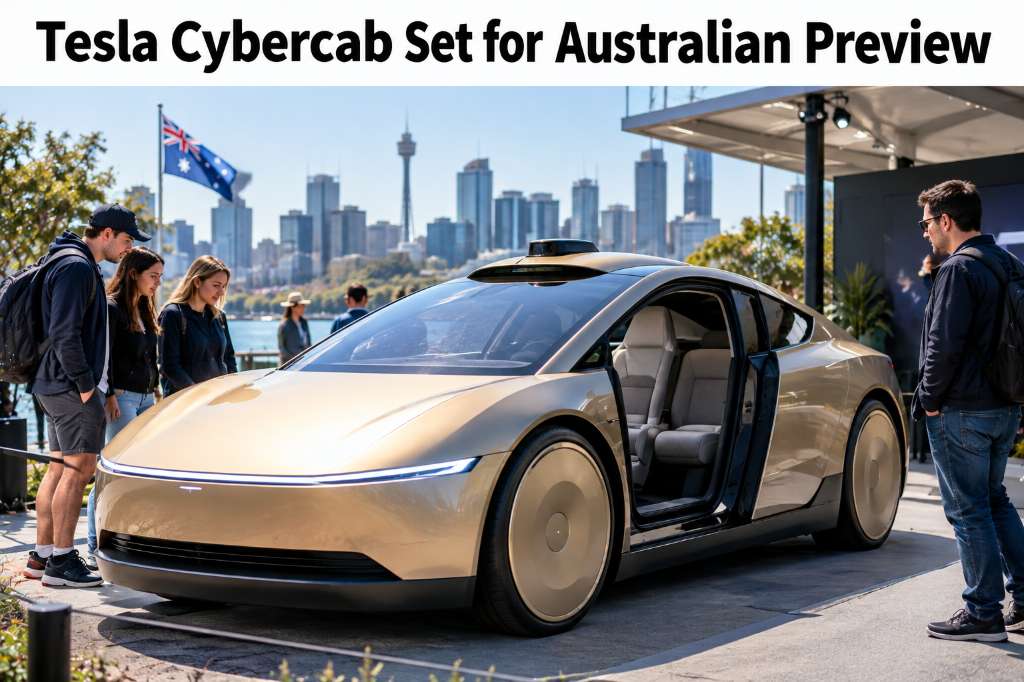
Tesla is preparing to bring its Cybercab to Australia for a public preview, offering Australians an opportunity to see the company’s vision for future driverless transport.
The Cybercab is an autonomous vehicle designed specifically around the idea of self-driving passenger transport. Unlike conventional cars, the concept is intended to operate without a traditional driver being required behind the wheel.
Tesla's decision to bring the Cybercab to Australia provides an opportunity for local audiences to see the technology before any potential wider rollout. The vehicle has attracted international attention because of its focus on autonomous driving and its distinctive design.
The Australian preview comes as interest in electric and autonomous vehicles continues to grow. Australia's electric-vehicle market has expanded in recent years, with consumers having access to an increasing number of battery-electric and plug-in hybrid models.
Autonomous driving remains a more complicated area, however, because vehicles operating without human control require appropriate technology, testing, regulation and safety systems.
The Cybercab is part of Tesla's broader push into autonomous transportation. The company has presented the vehicle as a purpose-built platform for driverless travel rather than simply another electric passenger car.
For Australian motorists, the arrival of the vehicle provides a chance to examine how autonomous transport could eventually change the way people travel. It also raises questions about how self-driving vehicles could operate on Australian roads and how existing road rules and safety requirements would apply.
The technology remains under development, and an Australian preview does not by itself mean that fully autonomous Cybercab services are about to begin operating commercially across the country.
For regional communities such as Tamworth, developments in electric and autonomous transport are also relevant to the longer-term future of mobility. Regional areas have different transport requirements from major capital cities, including longer travel distances and greater reliance on private vehicles.
Electric vehicles are already becoming more common across regional Australia, while autonomous technology could eventually create new possibilities for passenger transport and mobility services.
The Cybercab preview therefore represents another step in the public discussion surrounding autonomous vehicles in Australia.
Tesla has not indicated that the Cybercab will immediately become available as a conventional consumer vehicle following the Australian preview. The timing and conditions for any future commercial introduction will depend on further development, testing and regulatory considerations.
The Australian appearance will nevertheless give members of the public a closer look at one of the most closely watched autonomous vehicle concepts currently being developed.
As electric vehicles and driver-assistance technology continue to evolve, the Cybercab preview provides an indication of the direction in which parts of the automotive industry are moving.
AutonomousCybercabPreviewVehiclesTransport
Tesla is preparing to bring its Cybercab to Australia for a public preview, offering Australians an opportunity to see the company’s vision for future driverless transport.
The Cybercab is an autonomous vehicle designed specifically around the idea of self-driving passenger transport. Unlike conventional cars, the concept is intended to operate without a traditional driver being required behind the wheel.
Tesla's decision to bring the Cybercab to Australia provides an opportunity for local audiences to see the technology before any potential wider rollout. The vehicle has attracted international attention because of its focus on autonomous driving and its distinctive design.
The Australian preview comes as interest in electric and autonomous vehicles continues to grow. Australia's electric-vehicle market has expanded in recent years, with consumers having access to an increasing number of battery-electric and plug-in hybrid models.
Autonomous driving remains a more complicated area, however, because vehicles operating without human control require appropriate technology, testing, regulation and safety systems.
The Cybercab is part of Tesla's broader push into autonomous transportation. The company has presented the vehicle as a purpose-built platform for driverless travel rather than simply another electric passenger car.
For Australian motorists, the arrival of the vehicle provides a chance to examine how autonomous transport could eventually change the way people travel. It also raises questions about how self-driving vehicles could operate on Australian roads and how existing road rules and safety requirements would apply.
The technology remains under development, and an Australian preview does not by itself mean that fully autonomous Cybercab services are about to begin operating commercially across the country.
For regional communities such as Tamworth, developments in electric and autonomous transport are also relevant to the longer-term future of mobility. Regional areas have different transport requirements from major capital cities, including longer travel distances and greater reliance on private vehicles.
Electric vehicles are already becoming more common across regional Australia, while autonomous technology could eventually create new possibilities for passenger transport and mobility services.
The Cybercab preview therefore represents another step in the public discussion surrounding autonomous vehicles in Australia.
Tesla has not indicated that the Cybercab will immediately become available as a conventional consumer vehicle following the Australian preview. The timing and conditions for any future commercial introduction will depend on further development, testing and regulatory considerations.
The Australian appearance will nevertheless give members of the public a closer look at one of the most closely watched autonomous vehicle concepts currently being developed.
As electric vehicles and driver-assistance technology continue to evolve, the Cybercab preview provides an indication of the direction in which parts of the automotive industry are moving.
A 15-year-old Pacific Lutheran College student has developed a privacy-first women’s health app and presented her work at a major national cyber event.
Greater Geelong Council wants data-centre operators to contribute to local infrastructure as community concerns grow over energy, water use and developm...
Perth Western Australia · Technology News · 03 Sep 2026
Western Australia Police have announced that hundreds of fines issued through AI-assisted traffic cameras are being dropped following a review of the technology and enforcement...
A 36-year-old man has been charged after investigators allegedly found fraudulent identification documents, cloned number plates, cash and drug-manufact...
A Sydney court has heard that a man sent 249 messages to a former partner within 24 hours, with the messages treated as a single alleged breach of an ap...
A high-profile athlete has returned to court and told the hearing that an alleged unwanted kiss by former broadcaster Alan Jones remained difficult to f...
Work on the $150 million Sydney Town Hall Square project has been paused after the NSW Planning Minister referred the development for review by the Inde...
Cairns Regional Council has unanimously voted to seek $400,000 in Queensland Government funding for a program designed to connect local businesses with the region’s growing film...
An automated external defibrillator and memorial plaque have been installed at Ellery Creek Big Hole following the death of disability advocate Ellen Fr...
Queensland firefighters spent several hours monitoring a significant grass fire at Mary Kinross Park in Bargara, near Bundaberg, after the blaze broke out on Wednesday evening....