Safety note: Admin approval is an initial review, not a guarantee that every detail is correct. Check important or urgent claims with official sources and report anything inaccurate or unsafe.
Source and credit: Contributor's own report
World’s largest electric ship begins journey from Hobart after major loading operation - Hobart, TAS
Smart summary
Hobart-based shipbuilder Incat has completed the loading of its giant battery-electric vessel Hull 096 onto a heavy-lift ship, marking a major milestone for Tasmania’s maritime industry.
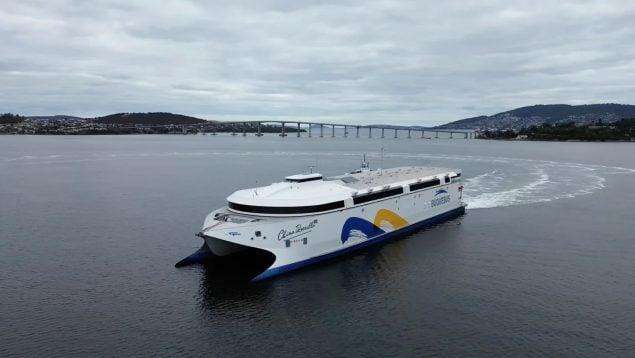
A major maritime milestone has taken place in Hobart as Incat’s Hull 096, described as the world’s largest battery-electric ship, has begun its international journey after being successfully loaded onto the heavy-lift vessel Black Marlin. The operation was completed at the Hobart waterfront with support from maritime partners and represents one of the biggest projects in the history of the Tasmanian shipbuilder.
The 130-metre electric vessel was carefully transferred onto the 217-metre semi-submersible transport ship after a detailed loading process. The operation required careful planning because of the size and weight of the vessel, as well as weather conditions that caused a short delay before completion.
Hull 096 has been developed as a fully battery-powered passenger vessel and is designed to operate between Argentina and Uruguay. The ship represents a significant step forward in sustainable marine transport technology, reducing reliance on traditional fuel-powered vessels.
The project has attracted international attention because of its scale and the technology involved. The vessel contains hundreds of tonnes of battery systems and demonstrates the growing role of electric propulsion in the global maritime industry.
For Hobart and Tasmania, the achievement highlights the importance of the local shipbuilding sector and the skills of workers involved in advanced manufacturing. Incat has been based in Tasmania for decades and has developed a reputation for building innovative high-speed vessels for international markets.
The successful loading operation involved cooperation between Incat, Tas Ports and the vessel’s overseas buyer. Teams worked together to complete the complex process safely before the ship began its voyage towards South America.
The vessel is expected to serve as an example of how cleaner technologies can transform transportation industries. Governments and companies around the world are increasingly exploring electric-powered ships as part of efforts to reduce emissions and improve environmental sustainability.
The project also provides economic benefits for Tasmania by supporting local jobs, engineering expertise and international trade opportunities. The success of Hull 096 strengthens Hobart’s position as a centre for maritime innovation.
Meanwhile, Hobart continues to see major infrastructure developments, including progress on the city’s planned stadium project, which has become another significant focus for Tasmania’s future growth.
The departure of Hull 096 marks an important moment for Hobart’s industrial history and showcases Tasmania’s capability in developing advanced clean-energy technology for global markets.
HobartVesselShipTasmaniaHull
A major maritime milestone has taken place in Hobart as Incat’s Hull 096, described as the world’s largest battery-electric ship, has begun its international journey after being successfully loaded onto the heavy-lift vessel Black Marlin. The operation was completed at the Hobart waterfront with support from maritime partners and represents one of the biggest projects in the history of the Tasmanian shipbuilder.
The 130-metre electric vessel was carefully transferred onto the 217-metre semi-submersible transport ship after a detailed loading process. The operation required careful planning because of the size and weight of the vessel, as well as weather conditions that caused a short delay before completion.
Hull 096 has been developed as a fully battery-powered passenger vessel and is designed to operate between Argentina and Uruguay. The ship represents a significant step forward in sustainable marine transport technology, reducing reliance on traditional fuel-powered vessels.
The project has attracted international attention because of its scale and the technology involved. The vessel contains hundreds of tonnes of battery systems and demonstrates the growing role of electric propulsion in the global maritime industry.
For Hobart and Tasmania, the achievement highlights the importance of the local shipbuilding sector and the skills of workers involved in advanced manufacturing. Incat has been based in Tasmania for decades and has developed a reputation for building innovative high-speed vessels for international markets.
The successful loading operation involved cooperation between Incat, Tas Ports and the vessel’s overseas buyer. Teams worked together to complete the complex process safely before the ship began its voyage towards South America.
The vessel is expected to serve as an example of how cleaner technologies can transform transportation industries. Governments and companies around the world are increasingly exploring electric-powered ships as part of efforts to reduce emissions and improve environmental sustainability.
The project also provides economic benefits for Tasmania by supporting local jobs, engineering expertise and international trade opportunities. The success of Hull 096 strengthens Hobart’s position as a centre for maritime innovation.
Meanwhile, Hobart continues to see major infrastructure developments, including progress on the city’s planned stadium project, which has become another significant focus for Tasmania’s future growth.
The departure of Hull 096 marks an important moment for Hobart’s industrial history and showcases Tasmania’s capability in developing advanced clean-energy technology for global markets.
Tesla is preparing to bring its driverless Cybercab to Australia for a preview, giving Australians an early look at the company’s autonomous vehicle tec...
A 15-year-old Pacific Lutheran College student has developed a privacy-first women’s health app and presented her work at a major national cyber event.
Greater Geelong Council wants data-centre operators to contribute to local infrastructure as community concerns grow over energy, water use and developm...
New figures have renewed concerns about emergency department delays at Royal Hobart Hospital, with the health system facing questions over patient waiti...
Cairns Regional Council has unanimously voted to seek $400,000 in Queensland Government funding for a program designed to connect local businesses with the region’s growing film...
An automated external defibrillator and memorial plaque have been installed at Ellery Creek Big Hole following the death of disability advocate Ellen Fr...
Queensland firefighters spent several hours monitoring a significant grass fire at Mary Kinross Park in Bargara, near Bundaberg, after the blaze broke out on Wednesday evening....