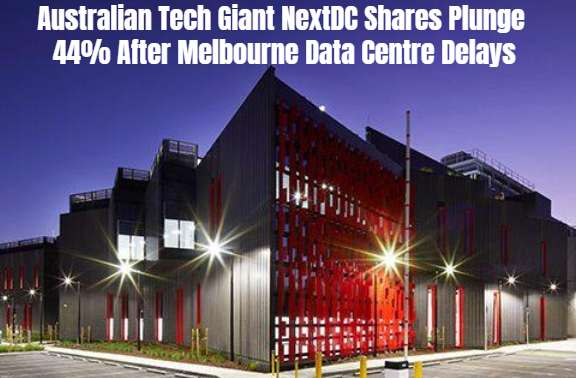
Australian Tech Giant Next DC Shares Plunge 44% After Melbourne Data Centre Delays
By Chloe · Published 21 Oct 2026 · Updated 21 Oct 2026
Melbourne, VIC · Victoria News
Safety note: Admin approval is an initial review, not a guarantee that every detail is correct. Check important or urgent claims with official sources and report anything inaccurate or unsafe.
Source and credit: Contributor's own report
Australian Tech Giant Next DC Shares Plunge 44% After Melbourne Data Centre Delays - Melbourne, VIC
Smart summary
Australian data centre operator Next DC has suffered a major share-price collapse after electricity network upgrade delays forced the company to cut its financial forecasts and suspend new development projects.
Australian data centre operator Next DC experienced a dramatic fall in its share price on Wednesday after announcing a significant downgrade to its financial forecasts for the 2027 financial year. The company’s shares fell approximately 44 per cent, wiping around $3.1 billion from its market value during early trading. The announcement has highlighted the challenges facing companies investing heavily in data centre infrastructure to support artificial intelligence and cloud computing. Reuters
The immediate problem centres on delays to electricity network upgrades at Next DC’s M3 data centre in Melbourne. The upgrades are necessary to provide the power required for the facility to operate as planned. However, the project has encountered delays linked to community opposition and stakeholder concerns.
As a result, electricity supply is not expected to become available on the original schedule. The delay is expected to push approximately $140 million in contracted customer revenue into a later period, creating a substantial gap between the company’s previous expectations and its revised financial outlook. Reuters
Next DC has reduced its forecast revenue for the 2027 financial year to between $475 million and $500 million. Its previous forecast was significantly higher, at $615 million to $640 million. The company has also reduced its expected earnings before interest, taxes, depreciation and amortisation, known as EBITDA, to between $245 million and $265 million, down from its earlier forecast of $385 million to $410 million. Reuters
In response, the company has announced that it will suspend new development projects and land acquisitions for the foreseeable future. It is also considering opportunities to recycle capital, including potentially selling selected development sites to strengthen its financial position.
Data centres require enormous amounts of electricity to operate servers, store information and provide computing capacity. Demand has been increasing as businesses adopt cloud services and develop artificial intelligence systems. However, building these facilities involves substantial investment in land, power infrastructure, cooling systems and specialised equipment.
The Next DC situation demonstrates that growing demand for digital services does not automatically translate into immediate revenue. Even when customers have signed contracts, a data centre cannot deliver its full services until the necessary infrastructure is ready. Delays can therefore affect earnings, investment plans and shareholder confidence.
The development also raises broader questions about Australia's ability to provide sufficient electricity infrastructure for future digital expansion. Data centre operators must coordinate with electricity network providers, regulators, local communities and other stakeholders before large facilities can reach their intended capacity.
For investors, the sharp share-price decline is a reminder that technology infrastructure companies face risks beyond customer demand. Construction schedules, electricity availability, financing costs and regulatory approvals can all influence financial performance.
Next DC's decision to pause new developments reflects the seriousness of the immediate challenges. The company will now need to manage the delayed projects, reassess its investment plans and work towards delivering the power capacity required by its customers.
The longer-term outlook will depend partly on how quickly electricity upgrades progress and whether the company can restore confidence in its revised financial forecasts. The episode also illustrates the practical infrastructure challenges behind Australia's expanding artificial intelligence and cloud computing industries.
MillionDataElectricityFinancialCentre
Australian data centre operator Next DC experienced a dramatic fall in its share price on Wednesday after announcing a significant downgrade to its financial forecasts for the 2027 financial year. The company’s shares fell approximately 44 per cent, wiping around $3.1 billion from its market value during early trading. The announcement has highlighted the challenges facing companies investing heavily in data centre infrastructure to support artificial intelligence and cloud computing. Reuters
The immediate problem centres on delays to electricity network upgrades at Next DC’s M3 data centre in Melbourne. The upgrades are necessary to provide the power required for the facility to operate as planned. However, the project has encountered delays linked to community opposition and stakeholder concerns.
As a result, electricity supply is not expected to become available on the original schedule. The delay is expected to push approximately $140 million in contracted customer revenue into a later period, creating a substantial gap between the company’s previous expectations and its revised financial outlook. Reuters
Next DC has reduced its forecast revenue for the 2027 financial year to between $475 million and $500 million. Its previous forecast was significantly higher, at $615 million to $640 million. The company has also reduced its expected earnings before interest, taxes, depreciation and amortisation, known as EBITDA, to between $245 million and $265 million, down from its earlier forecast of $385 million to $410 million. Reuters
In response, the company has announced that it will suspend new development projects and land acquisitions for the foreseeable future. It is also considering opportunities to recycle capital, including potentially selling selected development sites to strengthen its financial position.
Data centres require enormous amounts of electricity to operate servers, store information and provide computing capacity. Demand has been increasing as businesses adopt cloud services and develop artificial intelligence systems. However, building these facilities involves substantial investment in land, power infrastructure, cooling systems and specialised equipment.
The Next DC situation demonstrates that growing demand for digital services does not automatically translate into immediate revenue. Even when customers have signed contracts, a data centre cannot deliver its full services until the necessary infrastructure is ready. Delays can therefore affect earnings, investment plans and shareholder confidence.
The development also raises broader questions about Australia's ability to provide sufficient electricity infrastructure for future digital expansion. Data centre operators must coordinate with electricity network providers, regulators, local communities and other stakeholders before large facilities can reach their intended capacity.
For investors, the sharp share-price decline is a reminder that technology infrastructure companies face risks beyond customer demand. Construction schedules, electricity availability, financing costs and regulatory approvals can all influence financial performance.
Next DC's decision to pause new developments reflects the seriousness of the immediate challenges. The company will now need to manage the delayed projects, reassess its investment plans and work towards delivering the power capacity required by its customers.
The longer-term outlook will depend partly on how quickly electricity upgrades progress and whether the company can restore confidence in its revised financial forecasts. The episode also illustrates the practical infrastructure challenges behind Australia's expanding artificial intelligence and cloud computing industries.
The final bottles have come off the production line in Launceston, marking the end of local production at one of Tasmania’s best-known breweries. The cl...
Reserve Bank deputy governor Andrew Hauser says inflation is proving difficult to control, increasing concerns that Australians could face another inter...
Australian biofuel producers are urging the federal government to require fuel companies to purchase more locally produced ethanol and biodiesel, after...
National Australia Bank announces plans to reduce its workforce by approximately 2,500 positions by mid-2027, citing rising competition, operating costs...
A fresh protest has erupted in western Victoria over plans to duplicate a major highway, with Djab Wurrung people and supporters opposing the removal of...
Victoria's teaching regulator has carried out unannounced inspections at two Fitzroy Community School campuses as investigations into child-safety conce...
A community-based storytelling initiative in Mount Druitt is using culture, stories and reading activities to help children strengthen their literacy sk...
Western Australian police are investigating a suspicious fire at a high-value Perth property after a threatening message was reportedly found at the scene.
The final bottles have come off the production line in Launceston, marking the end of local production at one of Tasmania’s best-known breweries. The cl...
Sudden hail has damaged crops in parts of Australia just as farmers prepare for an important harvest season, raising concerns about crop quality and pot...