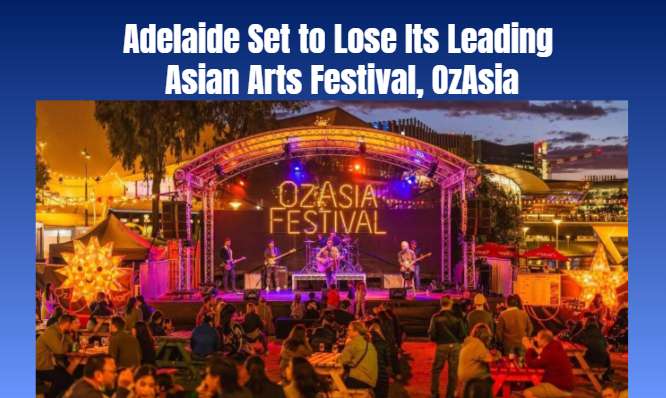
Adelaide Set to Lose Its Leading Asian Arts Festival, Oz Asia
By Chloe · Published 20 Oct 2026 · Updated 20 Oct 2026
Adelaide, SA · South Australia News
Safety note: Admin approval is an initial review, not a guarantee that every detail is correct. Check important or urgent claims with official sources and report anything inaccurate or unsafe.
Source and credit: Contributor's own report
Adelaide Set to Lose Its Leading Asian Arts Festival, Oz Asia - Adelaide, SA
Smart summary
Adelaide is facing the loss of Oz Asia, one of Australia's leading Asian arts festivals, raising questions about the future of major cultural events and opportunities for Asian artists in South Australia.
Adelaide's cultural scene is facing a significant change following news that Oz Asia, a major festival celebrating Asian arts and culture, is set to leave the city after two decades. The announcement was featured in ABC News Australia's coverage on 20 October 2026, highlighting the implications for South Australia's arts sector and its reputation as a destination for international cultural events.
Oz Asia has provided a platform for artists, performers, writers and cultural organisations from across Asia and the Australian Asian diaspora. Its programme has featured theatre, dance, music, visual arts, literature, film and public events, giving audiences opportunities to experience a wide range of artistic traditions and contemporary creative work.
Over the years, the festival has helped connect Adelaide audiences with international performers and emerging artists. It has also created opportunities for cultural exchange, enabling artists to share stories, explore common experiences and introduce audiences to different perspectives on identity, migration, history and modern life.
The festival's departure raises questions about how Adelaide will maintain its position as a centre for major arts events. Large festivals can attract visitors from interstate and overseas, contributing to accommodation bookings, restaurant trade, retail activity and the wider visitor economy. They also create employment and professional opportunities for performers, production crews, technicians, event organisers and other arts workers.
For South Australia's creative sector, the loss of a long-running event can have consequences beyond the festival itself. Local artists may lose opportunities to collaborate with international companies, while venues and suppliers could face changes in demand. Cultural organisations may also need to reconsider their programming and partnerships if established events are no longer available.
Oz Asia's importance extends beyond entertainment. Asian communities have contributed significantly to Australia's cultural and social life, and festivals can provide visible spaces for those experiences to be represented. Events of this kind can help build understanding between communities while supporting artists whose work may not otherwise receive the same level of public attention.
The announcement is likely to prompt discussion among arts organisations, government representatives, audiences and cultural communities about the support available for major festivals. Funding arrangements, organisational priorities, venue requirements and long-term planning are all important factors in the sustainability of large cultural events.
Adelaide has built a reputation for hosting festivals across music, theatre, literature, food and visual arts. Maintaining that reputation requires ongoing investment, strong partnerships and programmes that appeal to local audiences while attracting visitors. The Oz Asia development may encourage organisers and policymakers to examine how future cultural events can be supported and how opportunities for Asian artists can be preserved.
It is important, however, to distinguish the festival's departure from the end of Asian arts and cultural activity in South Australia. Artists and community organisations continue to contribute to the state's cultural landscape through performances, exhibitions, local festivals and educational programmes.
The next stage will be to clarify the practical arrangements surrounding Oz Asia's departure, including its future location, the timing of any transition and the opportunities available to artists and partners who have participated in previous editions.
For Adelaide, the development marks an important moment for the city's cultural sector. The long-term impact will depend on whether other organisations can fill the gap and how the city continues to support international artistic collaboration.
CulturalArtsArtistsAsiaEvents
Adelaide's cultural scene is facing a significant change following news that Oz Asia, a major festival celebrating Asian arts and culture, is set to leave the city after two decades. The announcement was featured in ABC News Australia's coverage on 20 October 2026, highlighting the implications for South Australia's arts sector and its reputation as a destination for international cultural events.
Oz Asia has provided a platform for artists, performers, writers and cultural organisations from across Asia and the Australian Asian diaspora. Its programme has featured theatre, dance, music, visual arts, literature, film and public events, giving audiences opportunities to experience a wide range of artistic traditions and contemporary creative work.
Over the years, the festival has helped connect Adelaide audiences with international performers and emerging artists. It has also created opportunities for cultural exchange, enabling artists to share stories, explore common experiences and introduce audiences to different perspectives on identity, migration, history and modern life.
The festival's departure raises questions about how Adelaide will maintain its position as a centre for major arts events. Large festivals can attract visitors from interstate and overseas, contributing to accommodation bookings, restaurant trade, retail activity and the wider visitor economy. They also create employment and professional opportunities for performers, production crews, technicians, event organisers and other arts workers.
For South Australia's creative sector, the loss of a long-running event can have consequences beyond the festival itself. Local artists may lose opportunities to collaborate with international companies, while venues and suppliers could face changes in demand. Cultural organisations may also need to reconsider their programming and partnerships if established events are no longer available.
Oz Asia's importance extends beyond entertainment. Asian communities have contributed significantly to Australia's cultural and social life, and festivals can provide visible spaces for those experiences to be represented. Events of this kind can help build understanding between communities while supporting artists whose work may not otherwise receive the same level of public attention.
The announcement is likely to prompt discussion among arts organisations, government representatives, audiences and cultural communities about the support available for major festivals. Funding arrangements, organisational priorities, venue requirements and long-term planning are all important factors in the sustainability of large cultural events.
Adelaide has built a reputation for hosting festivals across music, theatre, literature, food and visual arts. Maintaining that reputation requires ongoing investment, strong partnerships and programmes that appeal to local audiences while attracting visitors. The Oz Asia development may encourage organisers and policymakers to examine how future cultural events can be supported and how opportunities for Asian artists can be preserved.
It is important, however, to distinguish the festival's departure from the end of Asian arts and cultural activity in South Australia. Artists and community organisations continue to contribute to the state's cultural landscape through performances, exhibitions, local festivals and educational programmes.
The next stage will be to clarify the practical arrangements surrounding Oz Asia's departure, including its future location, the timing of any transition and the opportunities available to artists and partners who have participated in previous editions.
For Adelaide, the development marks an important moment for the city's cultural sector. The long-term impact will depend on whether other organisations can fill the gap and how the city continues to support international artistic collaboration.
A 231-kilogram tuna caught by a five-person fishing team has helped turn Lakes Entrance into a major fishing destination, attracting anglers from across...
A new Australian Human Rights Commission report calls for stronger workplace protections after workers reported losing jobs, shifts and promotion opport...
Four Melbourne councils and Melbourne Water have joined forces to improve the Yarra River's water quality, with a long-term goal of making parts of the...
Questions are growing over the collapse of the Whyalla steelworks, as the billionaire-backed company involved rejects responsibility for the facility’s...
South Australia Police have released CCTV footage in an effort to identify a man suspected of stealing a gold bracelet from a jewellery store in Salisbu...
A tribunal has upheld an indefinite ban on Adrian Fabio Mangini after findings concerning misleading health claims and inappropriate conduct towards vul...
A 22-year-old man was arrested on Grand Junction Road less than 30 minutes after police were notified that a detained patient had left a health facility...
Australian biofuel producers are urging the federal government to require fuel companies to purchase more locally produced ethanol and biodiesel, after...
Restoration work on bushland damaged during the controversial Roe 8 road project is reportedly progressing better than expected, nearly a decade after v...
Regional aged-care providers warn that changes to migration pathways could make it harder to recruit and retain workers, putting additional pressure on...
A 40-year-old cyclist has died after being struck by an unidentified vehicle on North Lake Road in Bibra Lake early Tuesday morning. The driver failed t...