Five Remote Northern Territory Community Pools Have Closed, With More at Risk
By Chloe · Published 20 Oct 2026 · Updated 20 Oct 2026
Uluru, NT
Safety note: Admin approval is an initial review, not a guarantee that every detail is correct. Check important or urgent claims with official sources and report anything inaccurate or unsafe.
Source and credit: Contributor's own report
Five Remote Northern Territory Community Pools Have Closed, With More at Risk - Uluru, NT
Smart summary
A new report warns that ageing facilities, staff shortages and fragmented funding threaten swimming pools that provide essential recreation and water-safety training in remote communities.
Five swimming pools serving remote communities in Australia's Northern Territory have closed, while other facilities face the possibility of shutting down unless governments provide coordinated, long-term funding.
A report by Royal Life Saving Australia examined 19 remote community pools across the Territory. It found that five had closed and nine had infrastructure more than 30 years old, highlighting the challenges involved in maintaining public swimming facilities in isolated areas.
The findings have prompted Royal Life Saving NT to call on local, Territory and federal governments to recognise community swimming pools as essential infrastructure and invest in their continued operation.
For many remote communities, a swimming pool is much more than a recreational facility. It provides a place where children can learn to swim, residents can practise water-safety skills and local workers can receive lifesaving training. In places far from beaches and other swimming facilities, the local pool may be one of the few accessible locations for supervised swimming.
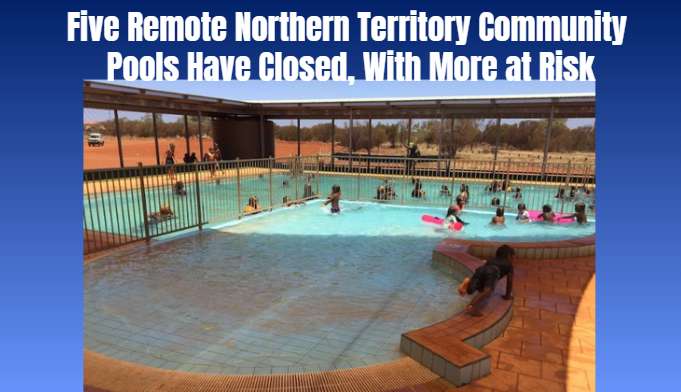
Mutitjulu, a community near Uluru, demonstrates the importance of keeping these facilities open. The community's Tjurpinytjaku Centre swimming pool is used by children and families, particularly during the hotter months, when temperatures can reach the mid-30s.
Anangu elder and traditional owner Rita Jingo told ABC News that local families had worked to establish a pool because alternatives for children were limited. The facility now gives younger residents a safer place to swim and spend time together.
The pool also supports local employment and training. Lifeguards Leigh and Craig Forrester, who returned to Mutitjulu after attending boarding school, use their skills to help keep swimmers safe. Their work illustrates how community facilities can provide employment opportunities while helping residents develop practical safety skills.
However, maintaining these pools requires reliable funding for repairs, water treatment, equipment and staffing. Remote locations can make maintenance more expensive and complicate the recruitment and retention of qualified workers. When essential equipment becomes outdated or operational costs cannot be covered, communities may be left without a functioning pool.
Royal Life Saving NT executive director Floss Roberts warned that the situation had reached a critical point. The organisation said an earlier report in 2010 had already made recommendations for improving remote pools, but many of those recommendations were not implemented.
The issue is particularly concerning because the Northern Territory has Australia's highest drowning rate per capita. Access to swimming lessons and water-safety education can help reduce risks, especially for children who have limited opportunities to learn these skills.
Royal Life Saving NT is calling for a coordinated approach that addresses ageing infrastructure, workforce shortages and ongoing operating costs. The organisation argues that short-term assistance will not be enough without a long-term plan to keep facilities safe and accessible.
The next step will depend on whether governments agree on funding and responsibilities. For affected communities, keeping swimming pools open could mean preserving a vital place for exercise, social connection, employment and lifesaving education.
SwimmingPoolsCommunityFacilitiesPool
Five swimming pools serving remote communities in Australia's Northern Territory have closed, while other facilities face the possibility of shutting down unless governments provide coordinated, long-term funding.
A report by Royal Life Saving Australia examined 19 remote community pools across the Territory. It found that five had closed and nine had infrastructure more than 30 years old, highlighting the challenges involved in maintaining public swimming facilities in isolated areas.
The findings have prompted Royal Life Saving NT to call on local, Territory and federal governments to recognise community swimming pools as essential infrastructure and invest in their continued operation.
For many remote communities, a swimming pool is much more than a recreational facility. It provides a place where children can learn to swim, residents can practise water-safety skills and local workers can receive lifesaving training. In places far from beaches and other swimming facilities, the local pool may be one of the few accessible locations for supervised swimming.
Mutitjulu, a community near Uluru, demonstrates the importance of keeping these facilities open. The community's Tjurpinytjaku Centre swimming pool is used by children and families, particularly during the hotter months, when temperatures can reach the mid-30s.
Anangu elder and traditional owner Rita Jingo told ABC News that local families had worked to establish a pool because alternatives for children were limited. The facility now gives younger residents a safer place to swim and spend time together.
The pool also supports local employment and training. Lifeguards Leigh and Craig Forrester, who returned to Mutitjulu after attending boarding school, use their skills to help keep swimmers safe. Their work illustrates how community facilities can provide employment opportunities while helping residents develop practical safety skills.
However, maintaining these pools requires reliable funding for repairs, water treatment, equipment and staffing. Remote locations can make maintenance more expensive and complicate the recruitment and retention of qualified workers. When essential equipment becomes outdated or operational costs cannot be covered, communities may be left without a functioning pool.
Royal Life Saving NT executive director Floss Roberts warned that the situation had reached a critical point. The organisation said an earlier report in 2010 had already made recommendations for improving remote pools, but many of those recommendations were not implemented.
The issue is particularly concerning because the Northern Territory has Australia's highest drowning rate per capita. Access to swimming lessons and water-safety education can help reduce risks, especially for children who have limited opportunities to learn these skills.
Royal Life Saving NT is calling for a coordinated approach that addresses ageing infrastructure, workforce shortages and ongoing operating costs. The organisation argues that short-term assistance will not be enough without a long-term plan to keep facilities safe and accessible.
The next step will depend on whether governments agree on funding and responsibilities. For affected communities, keeping swimming pools open could mean preserving a vital place for exercise, social connection, employment and lifesaving education.
Unusually wet conditions in Central Australia have helped butterfly numbers increase, prompting thousands of caper white butterflies to migrate south to...
Restoration work on bushland damaged during the controversial Roe 8 road project is reportedly progressing better than expected, nearly a decade after v...
An Australian activist detained in Vietnam has reportedly told his family that he is frightened, renewing concerns about his welfare and circumstances i...
Australian chickpea prices have climbed from around $600 to nearly $1,000 per tonne in some regions, as overseas buyers rush to secure supplies ahead of...
A Victorian coroner has criticised betting company Sportsbet after examining the case of a young man who wagered hundreds of thousands of dollars before...
A driver has died after a car collided with a bus and both vehicles caught fire on Phillip Island, south-east of Melbourne. Police say the car crossed o...
A 231-kilogram tuna caught by a five-person fishing team has helped turn Lakes Entrance into a major fishing destination, attracting anglers from across...
A New South Wales parliamentary inquiry has recommended stopping two proposed waste-to-energy projects near Parkes and Goulburn, citing community opposi...
Six football clubs in Whyalla, South Australia, are facing an uncertain future as expected steelworks job losses threaten player numbers, club finances...
Unusually wet conditions in Central Australia have helped butterfly numbers increase, prompting thousands of caper white butterflies to migrate south to...